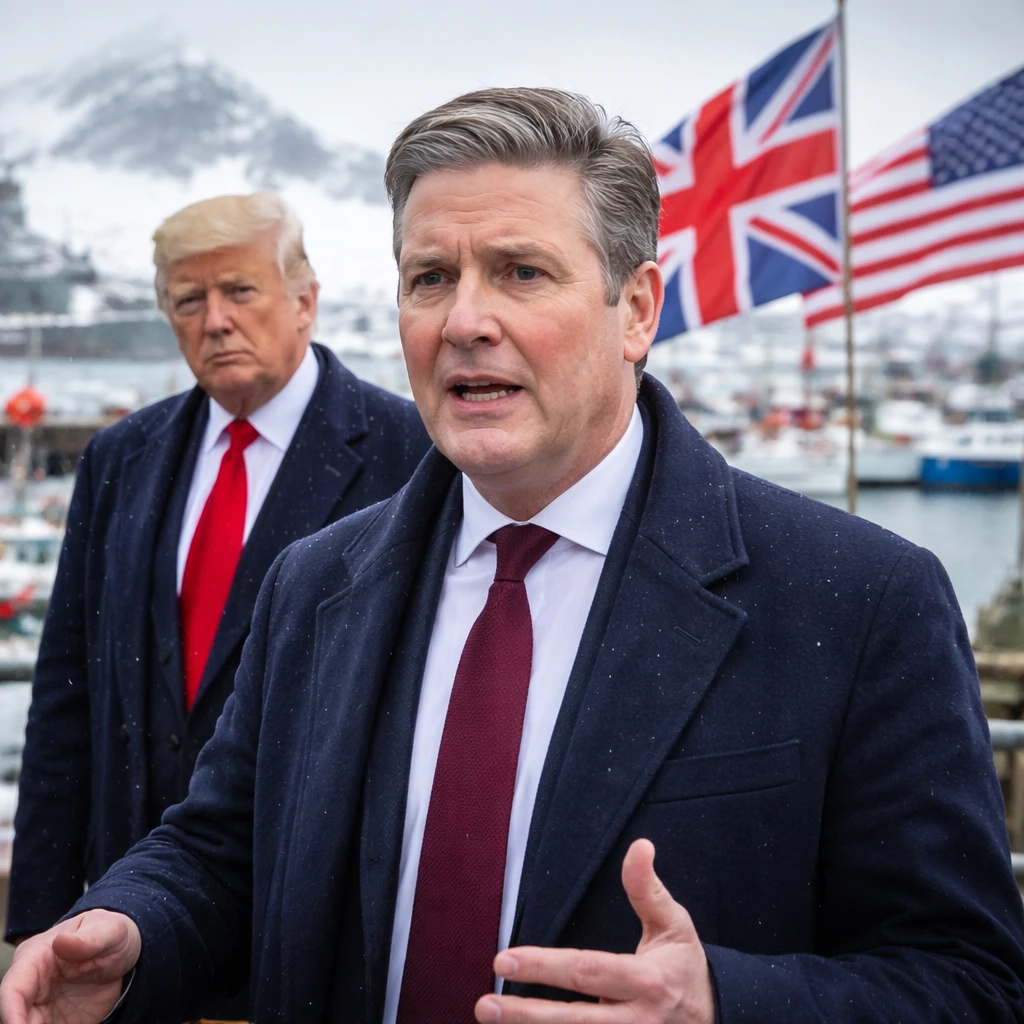

During a press conference in London on Monday, UK Prime Minister Keir Starmer addressed escalating tensions following US President Donald Trump's announcement of a proposed 10% import tariff on goods from eight European nations, including the UK. The tariffs, set to take effect in February, come as a response to opposition from these countries to US ambitions to exercise control over Greenland, a semi-autonomous territory of Denmark and a NATO ally.
Starmer characterized Trump's tariff threat as "entirely misplaced," emphasizing that initiating a trade conflict benefits no party involved. He conveyed that the UK supports the "fundamental right" of Greenland and Denmark to determine the future of the Arctic island. He further stressed that although the UK desires to uphold a robust and constructive partnership with the United States, it must not do so at the expense of acknowledging genuine differences.
President Trump had justified the tariff plans by pointing to the recent symbolic deployment of troops from European countries on Greenland, which he regards as critical to the defense of the US missile shield known as "Golden Dome." He also cautioned that China and Russia might attempt to seize control over Greenland, thereby challenging strategic US interests in the Arctic.
In response to these developments, Starmer highlighted the importance of pragmatism without passivity, and partnership without compromising principles. He indicated the UK government's intention to maintain open communications with European allies, NATO members, and the United States to navigate the dispute diplomatically. At this stage, London has decided not to consider retaliatory tariffs, with Starmer focusing on avoiding escalation to that end.
The proposed tariffs impact eight European countries, with six being members of the 27-nation European Union single market. EU Council President António Costa expressed the union's readiness to defend itself against all forms of coercion, intending to convene an EU leaders' summit later in the week to coordinate responses.
Meanwhile, Denmark's Defence Minister and Greenland's Foreign Minister are scheduled to meet in Brussels with NATO Secretary-General Mark Rutte. This meeting, planned prior to the recent uptick in tensions, is expected to address calls for increased NATO activity in the Arctic region. Danish Defence Minister Troels Lund Poulsen noted that Denmark and Greenland are receiving substantial support in urging NATO to enhance its Arctic presence and will discuss these matters accordingly.
The situation presents a complex challenge balancing security interests in the resource-rich Arctic, transatlantic relations, and trade diplomacy. Starmer's approach underscores a commitment to partnership and principle, steering away from retaliatory measures while maintaining firm stances on sovereignty and regional security issues.