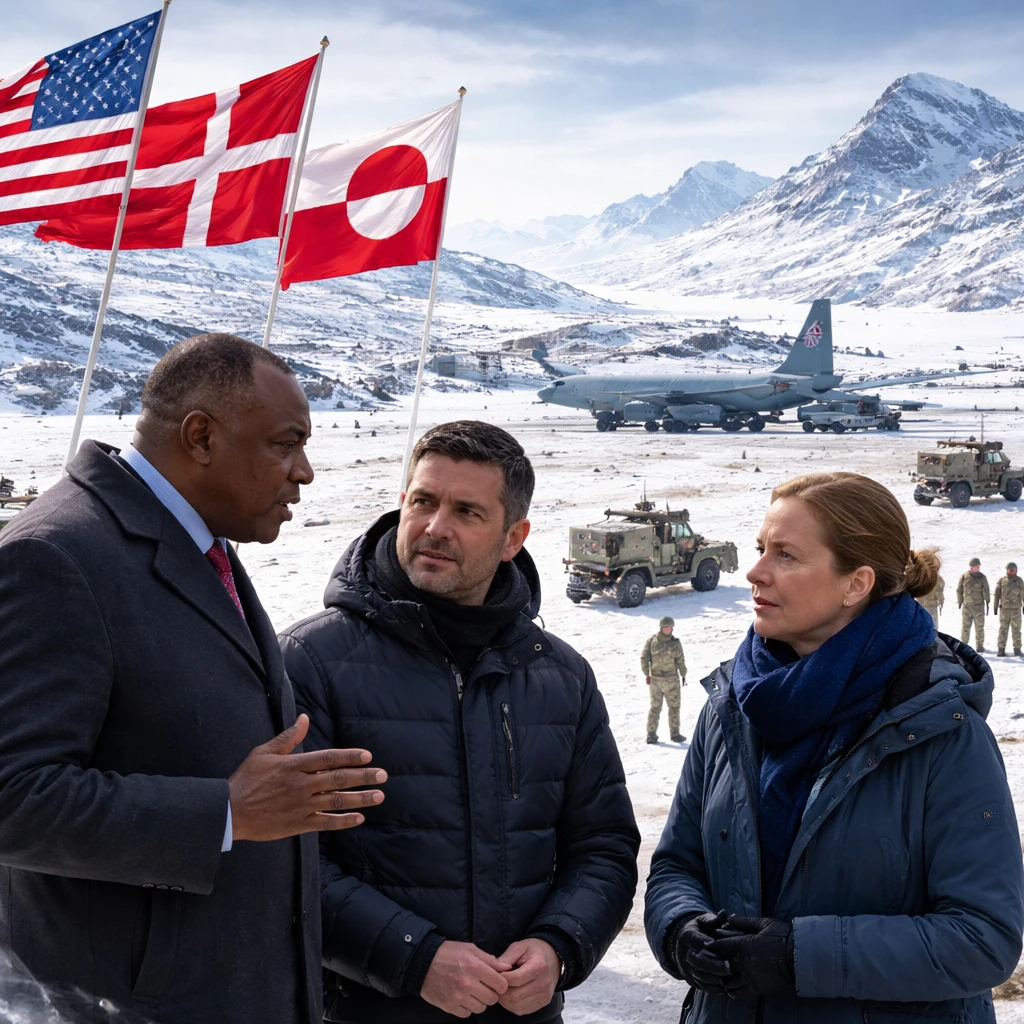

High-level meetings held in Washington D.C. brought together officials from the United States, Denmark, and Greenland to debate the American administration's intentions regarding Greenland, a semiautonomous region under Danish sovereignty. President Donald Trump has publicly sought U.S. acquisition of Greenland, citing national security imperatives and concerns over Chinese and Russian interests in the territory, particularly given Greenland’s substantial untapped critical mineral resources.
Following bilateral discussions involving Denmark’s Foreign Minister Lars Løkke Rasmussen, Greenland’s Foreign Minister Vivian Motzfeldt, U.S. Vice President JD Vance, and Secretary of State Marco Rubio, Rasmussen affirmed that a "fundamental disagreement" persists between the parties. He conceded that no shift in America's stance was anticipated or achieved during the meeting.
Despite this impasse, the talks revealed avenues for potential progress. Denmark, Greenland, and the U.S. agreed to establish a high-level working group intended to explore feasible common ground. While the specific composition and scope of the group were not delineated, Rasmussen indicated it would convene shortly to examine ways to address U.S. security objectives without infringing upon Denmark’s established "red lines." Emphasizing their status as NATO allies, he cautiously expressed hope that this initiative could reduce diplomatic tensions.
The Danish Defense Minister Troels Lund Poulsen described the working group’s formation as a positive although preliminary measure, valuing the opportunity it provides for direct dialogue rather than indirect commentary or speculation between the involved parties.
Simultaneously, as discussions unfolded in Washington, Denmark announced an increase in its military presence in Greenland. This was complemented by symbolic deployments from allied European NATO nations including France, Germany, Norway, and Sweden, intended to demonstrate solidarity with Copenhagen’s position. The United Kingdom contributed a single officer to a reconnaissance unit preparing for an Arctic endurance exercise. Germany’s deployment of 13 troops, conveyed via a joint flight from Denmark, underscored an agenda focused on assessing security challenges posed by Russian and Chinese activities in the Arctic.
Poulsen characterized these military movements as an exploratory measure to determine practical implementation of augmented presence and increased exercise frequency in the Arctic, with the ultimate aim of establishing a sustained Danish military foothold that incorporates rotating participation from allies in training and maneuvers.
While the European forces currently deployed are limited in number, their timing appears deliberately coordinated to serve as both a political and strategic message to the United States. Analyst Maria Martisiute at the European Policy Center in Brussels emphasized that this initiative signals European commitment to Arctic security through allied cooperation, contrasting with U.S. ambitions for unilateral control of Greenland, thereby complicating Washington's position.
Importantly, these European-led efforts in Greenland operate independently of NATO command structures, which remain under significant U.S. influence. Nonetheless, European stakeholders remain invested in maintaining NATO's role in regional security conversations. Germany indicated that its operations seek to gather on-the-ground intelligence to inform future NATO deliberations. Danish and Greenlandic officials intend to discuss Arctic defense with NATO Secretary General Mark Rutte in Brussels imminently, reflecting ongoing evaluation of alliance approaches to Arctic security enhancement.
Martisiute further expressed anticipation for the announcement of NATO-endorsed military activities or deployments in the Arctic, cautioning that absence of such initiatives risks stalling NATO’s operational engagement in the region, potentially undermining collective defense objectives. The present situation, thereby, heightens the importance of coordinated allied responses amid persistent geopolitical sensitivities surrounding Greenland's governance and Arctic security.