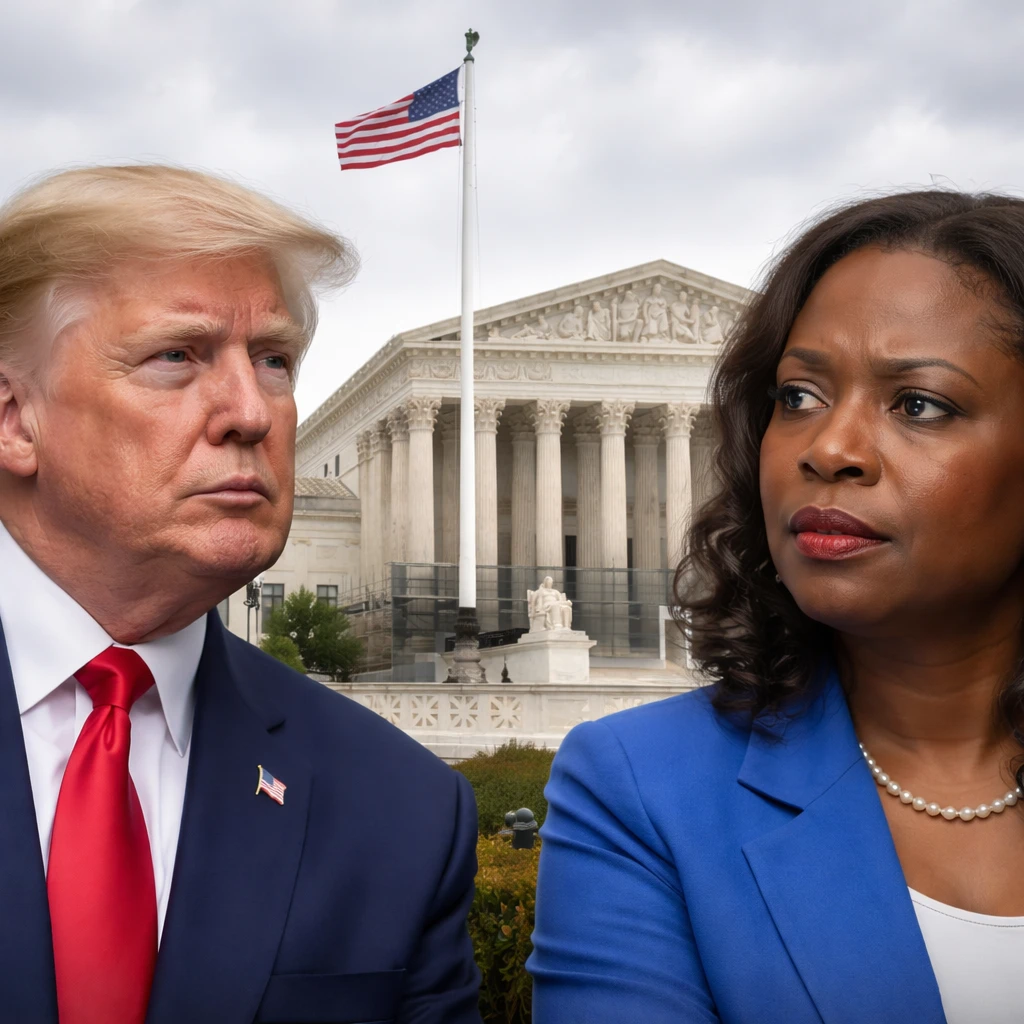

WASHINGTON - In a landmark development, the Supreme Court has convened to examine President Donald Trump's extraordinary attempt to remove Federal Reserve Governor Lisa Cook. This case has thrust the Court into a politically sensitive arena as it evaluates an emergency appeal from the president’s legal team amid a backdrop of contested claims and institutional precedent.
Trump's challenge centers on accusations that Cook engaged in mortgage fraud, charges the governor firmly rejects. The action, if successful, would mark the first time in the Federal Reserve’s 112-year existence that a sitting governor has been dismissed by a president, signaling a potential shift in the longstanding autonomy of the central bank.
Critics of the president interpret the move as a strategic effort to gain influence over U.S. interest rate policy. Trump has publicly pushed for significant interest rate reductions, aiming to facilitate more affordable government borrowing and lower consumer lending costs, especially in sectors like housing and automotive purchases. These financial variables have an outsized impact on voter sentiment regarding economic management amid high cost concerns.
Federal Reserve Chair Jerome Powell, alongside the board, enacted three rate cuts during the final four months of 2025, actions that, however, paused at a pace slower than Trump's preference. The board further indicated a cautious stance on upcoming rate changes to avoid exacerbating inflationary pressures.
During the Supreme Court proceedings, Powell is anticipated to attend as justices review the Trump administration's urgent request to permit Cook's removal while her legal challenges proceed. This move follows lower court decisions allowing Cook to maintain her role as one of the seven members governing the central bank.
Should Trump succeed in appointing a replacement, it would increase his influence on the Federal Reserve Board to four seats out of seven. Cook, notably the first Black woman on the Fed’s governance board, was appointed by President Joe Biden in 2022.
Legal experts, including Columbia University law professor Lev Menand, argue this case extends beyond Cook’s personal circumstances, posing a broader threat to the Federal Reserve’s independent role in managing monetary policy. Menand emphasizes the gravity of permitting presidential encroachment into what has traditionally been a politically neutral institution.
This concern over institutional independence prompted public support for Cook from a coalition of respected former Federal Reserve Chairs - Alan Greenspan, Ben Bernanke, and Janet Yellen - as well as five former Treasury secretaries spanning both major political parties, alongside other economic officials. Their legal submissions caution that an immediate dismissal of Cook could expose the Federal Reserve to overt political influence, potentially undermining public trust and diminishing the credibility and effectiveness of U.S. monetary policy.
Economists warn that if the Federal Reserve’s authority becomes politically compromised, particularly by succumbing to presidential pressure for lower interest rates, market confidence could erode. This scenario might lead investors to demand increased yields on U.S. government debt, consequently elevating borrowing costs despite intended policy objectives.
The escalating controversy surrounding Cook coincides with broader confrontations between Trump and the Fed. The Justice Department has commenced a criminal inquiry into Chair Powell, issuing subpoenas to the central bank, reflecting an intensification of the conflict.
Powell has addressed the president’s allegations directly, characterizing the threat of prosecution as a facade concealing dissatisfaction with interest rate decisions. The Justice Department justifies its investigation with concerns about Powell's congressional testimony regarding substantial renovation expenditures of Fed properties.
Historically, the Supreme Court has intermittently supported Trump’s emergency applications to counter legal setbacks, often deferring to presidential discretion in agency leadership changes absent evidence of misconduct. However, in the context of the Federal Reserve, the Court is adopting a more measured approach, acknowledging the unique quasi-public structure and critical role of the institution.
Trump’s dismissal attempt against Cook does not rest on a broad assertion of unfettered presidential authority to fire Fed governors. Rather, it relies on allegations brought forward by a federal housing official accusing Cook, alongside New York Attorney General Letitia James and California Senator Adam Schiff—all Democrats—of mortgage fraud, which all parties deny.
The specific allegations against Cook involve claims that in mid-2021 she designated two properties in Michigan and Georgia as primary residences, a classification that can entitle borrowers to favorable mortgage rates and lower down payments. Cook refutes any fraudulent intent or misconduct and has not been formally charged with a crime. Her legal representative has stated that no criminal or fraudulent activity exists and that any discrepancies are innocuous.
Documentation reveals that Cook described her Atlanta condominium as a "vacation home" on a loan estimate from May 2021 and classified it as a second home in a security clearance form. Her lawyer argues the case is primarily based on an isolated reference in a mortgage form that is inconsistent with other life disclosures, undermining the fraud allegations.
At the lower court level, Judge Jia Cobb determined that the administration failed to meet the legal threshold requiring "for cause" grounds for removal, which are limited to misconduct in office. The judge also found that firing Cook without due process would violate her rights to contest termination. Subsequently, an appeals court panel by a 2-1 margin declined the government’s request to proceed with the firing.
In proceedings before the Supreme Court, government lawyers contend that Cook’s entitlement to a hearing is unfounded and that courts should defer to presidential discretion in the dismissal. Solicitor General D. John Sauer argues that Trump acted lawfully after concluding that misrepresentations concerning mortgage rates, whether negligent or fraudulent, disqualify Cook from shaping U.S. interest rates.
Opposing them, Cook’s counsel, including prominent conservative lawyer Paul Clement, urges caution against predetermining her status based on unverified accusations. They advocate for her continued service during ongoing legal proceedings, emphasizing the necessity of factual resolution over premature judgment.