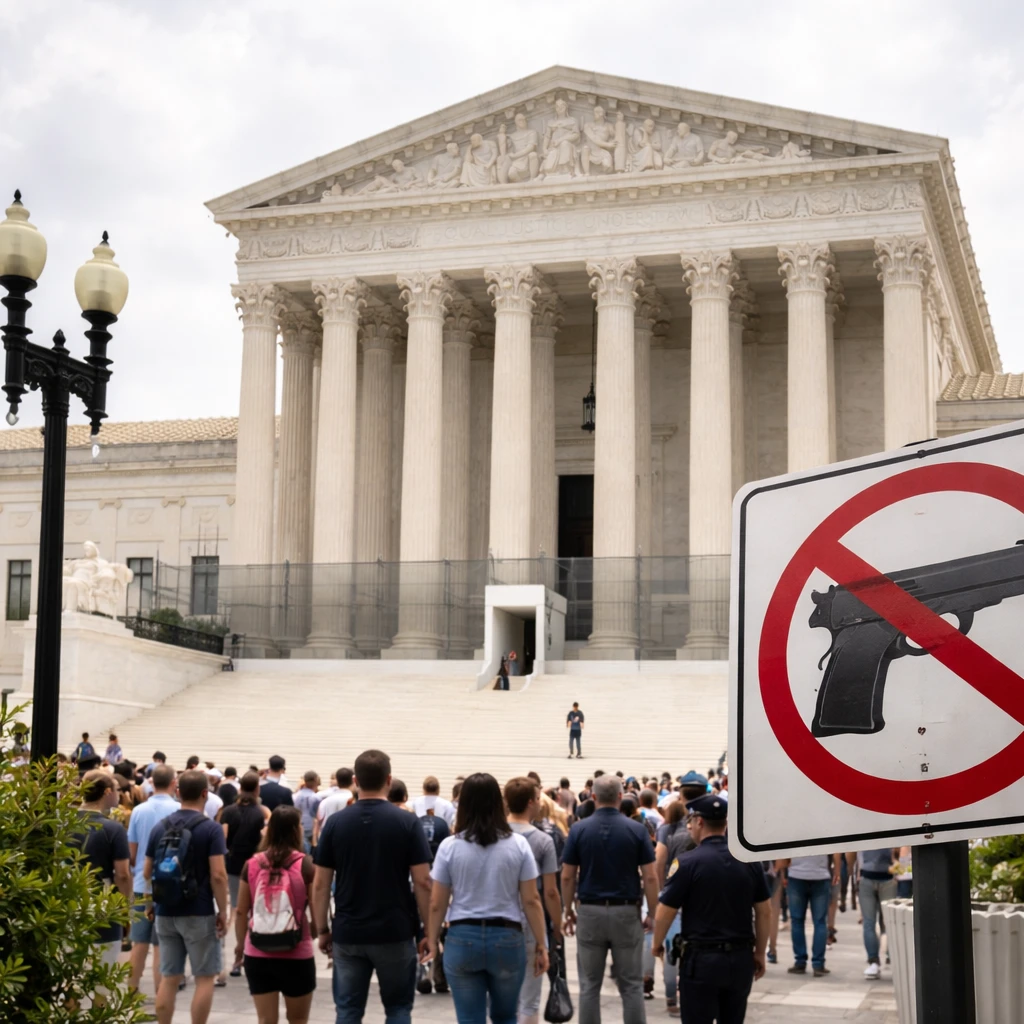

On Tuesday in Washington, the Supreme Court appeared inclined to invalidate Hawaii's prohibitions against carrying firearms into commercial establishments including malls and hotels unless authorized by the property's owner. This measure, often referred to by critics as the 'vampire rule' due to its requirement for explicit permission, limits gun presence at various retail and accommodation venues.
The Trump administration supported the legal challenge contesting this law. Hawaii defended its regulation as a means to empower private property owners to control whether firearms are permitted on their premises.
However, conservative justices on the court voiced significant doubts about the state's position. They questioned whether such restrictions could similarly apply to First Amendment rights, such as free speech, on private property. Justice Samuel Alito remarked, "You’re just relegating the Second Amendment to second-class status," underscoring concerns that the state's approach might undermine constitutional protections for gun owners.
Prior to the Supreme Court's 2022 ruling that affirmed a general right to carry firearms in public under the Second Amendment, concealed-carry permits were rarely granted in Hawaii. Attorney Neal Katyal highlighted that since that decision, the state has issued thousands of such permits, signaling a notable policy shift.
Other states—specifically four—have instituted laws similar to Hawaii's restrictions on firearms in private commercial spaces. Yet, in jurisdictions such as New York, comparable presumptive bans on guns on private property have been blocked in legal challenges.
The court's prospective decision will not affect other existing state limitations on firearms, such as prohibitions in parks, beaches, or establishments that serve alcoholic beverages. If the Supreme Court rules against Hawaii's current law, individual business owners in the state would still retain the ability to ban guns on their premises independently.
This case arrived at the Supreme Court following a challenge initiated by a gun-rights organization and three Maui residents. While the law was initially enjoined by a lower court judge, a higher appeals court permitted its enforcement pending the Supreme Court's review. The justices are expected to issue their verdict by the end of June.
In addition to this matter, the court is considering another gun-related case this term involving whether individuals who regularly consume marijuana and other substances may legally possess firearms.
The judiciary has recently ruled in varied ways on firearm regulations: overturning a federal ban on bump stocks during the Trump administration and upholding restrictions on 'ghost guns' introduced under the Biden administration, as well as a federal firearm statute designed to assist domestic violence victims.