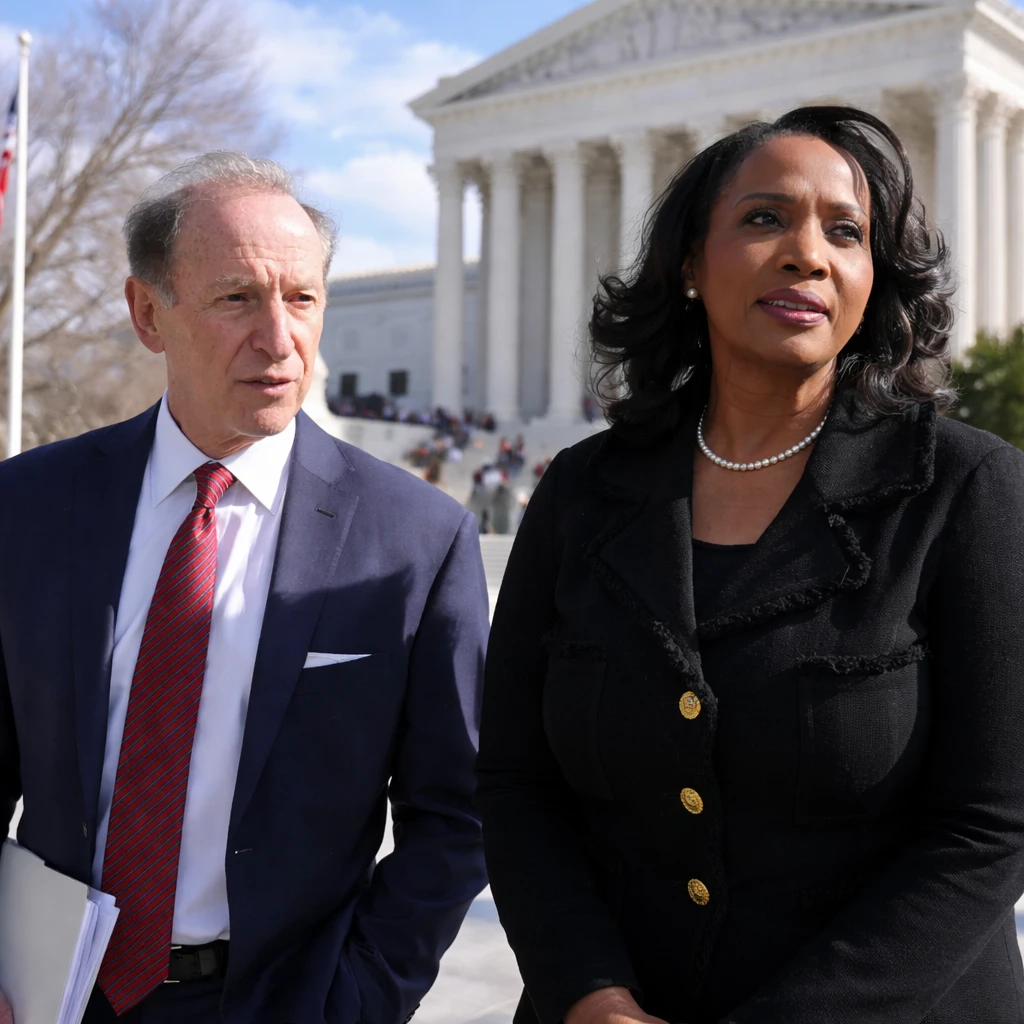

Over the past year, the Supreme Court has repeatedly affirmed the president's broad power to remove leaders of independent federal agencies, but it appears to be delineating a boundary when it comes to the Federal Reserve. The Court has indicated through its recent decisions and arguments that the Fed's governance is distinct from other agencies and deserves special treatment.
The justices have asserted that while the president can dismiss directors of agencies such as the National Labor Relations Board or the Merit Systems Protection Board at will, the removal of Federal Reserve governors must adhere to a "for cause" standard. This standard generally requires justifications like neglect of duty or misconduct, limiting the president’s unfettered authority to remove these officials.
Previously, the Court permitted President Donald Trump to terminate Gwynne Wilcox of the National Labor Relations Board and Cathy Harris of the Merit Systems Protection Board, albeit temporarily. However, the Court simultaneously made an exception for the Fed, emphasizing its unique nature.
In the ruling, the Court noted, "The Federal Reserve is a uniquely structured, quasi-private entity that follows in the distinct historical tradition of the First and Second Banks of the United States." This distinction is now under scrutiny in a Supreme Court case examining Trump’s attempt to remove Fed Governor Lisa Cook. During oral arguments held recently, the Court seemed inclined to prevent Cook’s removal.
Justice Brett Kavanaugh, among the president’s appointees on the Court, expressed concern that allowing the firing could "weaken, if not shatter, the independence of the Federal Reserve." This underscores the justices' recognition of the Fed's critical role and the need to safeguard its autonomy.
Despite these comments, the Court avoided definitively clarifying the legal rationale that differentiates the Fed from other independent agencies. This ambiguity has attracted criticism from legal scholars who argue that the Fed shares many structural similarities with agencies like the Federal Trade Commission or the National Labor Relations Board, where agency members can be removed by the president without stringent cause.
Jane Manners, a Fordham University law professor, said, "There’s no historical grounds for distinguishing the Fed from other independent agencies that Congress has designed. The Court hasn’t fully explained why the Fed is treated differently." Peter Conti-Brown, a financial regulation scholar at the University of Pennsylvania, dismissed the supposed differentiation as "hocus pocus." These critiques highlight the unsettled nature of the Court’s reasoning on the issue.
Simultaneously, in a separate case involving FTC Commissioner Rebecca Slaughter, the Court suggested it might allow President Trump broader removal authority and even reconsider a 90-year-old precedent that historically restricted presidents' powers to remove independent agency officials. The conservative majority on the Court favors the "unitary executive" theory, which advocates for the president’s comprehensive control over executive branch officials.
Justice Kavanaugh remarked during the FTC case that agency directors wield significant authority over individual freedoms and large economic sectors without direct accountability, underscoring the perceived need for enhanced presidential oversight.
However, the Federal Reserve is viewed differently. The Court's conservative members have held that the Fed's core responsibility — managing monetary policy through interest rates and money supply — traditionally operates outside direct executive control. This rationale distinguishes it from agencies exercising clear executive powers.
Law professor Aaron Nielson from the University of Texas, who represented the Fed's position in the Cook case, asserted in court filings that, "Whereas the modern FTC indisputably exercises executive power, the Fed’s core function is monetary policy, which need not and often does not require executive power." He further noted that the historical model for the Fed can be traced back to the First and Second Banks of the United States, which conducted monetary policy but were not executive branch agencies.
Conversely, Columbia law professor Lev Menand, author of a book on the Fed, argued that the Fed does exercise executive authority when it regulates the banking industry, including managing the money supply. Menand emphasized that government authority is classified into only three branches—legislative, executive, and judicial—and the Fed fits exclusively within the executive branch. According to him, "There is no fourth type of government power. There is no other place to locate the Fed." This view counters the Court’s tentative distinction.
During the recent oral argument, the Court mostly refrained from examining in depth why the Fed should be deemed different, a reticence partially explained by the fact that neither party strongly challenged the presumption of the Fed's unique status. Cook’s legal team, benefiting from this distinction, had little incentive to dispute it.
Even the government's chief Supreme Court attorney, D. John Sauer, acknowledged that Trump could remove Cook only for cause maintaining, "There is a long tradition of having this exercise of monetary policy be exercised independent of executive influence," a point he said Congress intentionally preserved.
Cook’s counsel, Paul Clement, highlighted the government's acceptance of the Fed's distinct status: "They could have argued the Fed is not that different from the FTC, but instead they conceded it is different at least for this case, which complicates their position." Clement added that while all federal agencies are important, the Fed has a special place due to its significant market influence and historical treatment in policy matters.
The Supreme Court faces a preliminary decision on whether Cook will remain in her role while lower courts continue to adjudicate the broader dispute over her firing. A broader ruling that comprehensively addresses the Fed’s unique status and legal protections could come later. For now, the Fed’s substantial size and critical role in financial markets may provide it with a degree of judicial safeguarding not extended to other agencies.