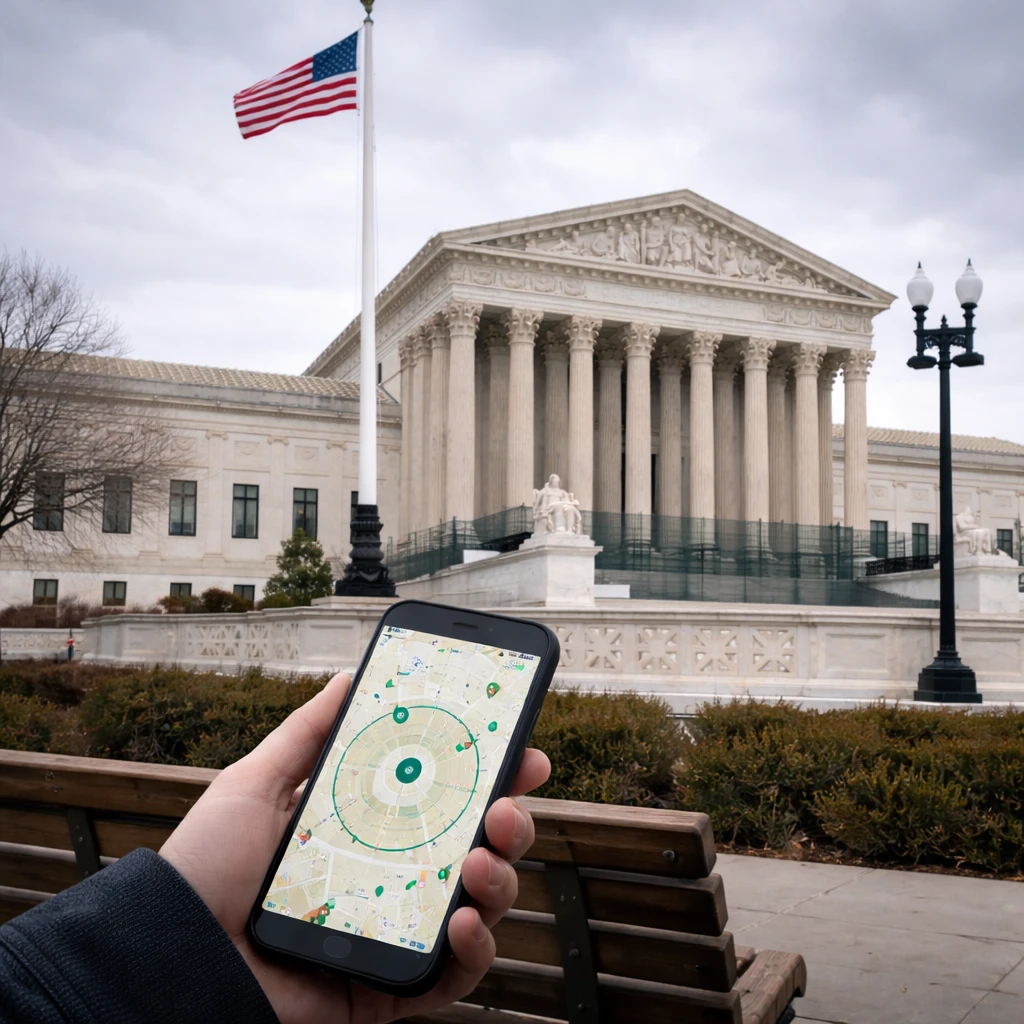

In a significant development concerning digital privacy and law enforcement practices, the U.S. Supreme Court consented on Friday to consider the constitutionality of broad search warrants that seek to collect location data from multiple cellphone users. These warrants, known as geofence warrants, are increasingly employed by police to locate individuals who may have been near the scene of a crime.
The legal challenge focuses on a geofence warrant applied in the context of a 2019 bank robbery at the Call Federal Credit Union in Midlothian, a suburb of Richmond, Virginia. This particular warrant required Google to provide location records of all devices present within a designated geographical area during a specified timeframe, regardless of any direct connection to criminal activity.
Authorities used the location data obtained through the warrant to identify and apprehend Okello Chatrie, who was subsequently convicted on related charges, later pleading guilty and receiving a prison sentence approaching twelve years.
Legal representatives for Chatrie contested the use of the geofence warrant, arguing it infringed on privacy rights by enabling law enforcement to collect location histories indiscriminately from people nearby the bank, without any prior evidence linking these individuals to the robbery. Prosecutors countered that since Chatrie had enabled Google's Location History feature, his expectation of privacy in his location data was diminished.
At the trial court level, a federal judge found that the geofence warrant did violate Chatrie's constitutional rights but ruled the evidence admissible nonetheless. The judge reasoned that the police officer applying for the warrant had a reasonable belief that the search was lawful.
This case led to differing appellate court decisions. The federal appeals court in Richmond upheld Chatrie's conviction, albeit in a fragmented judgment. Conversely, a separate federal appeals court in New Orleans determined that geofence warrants breach the Fourth Amendment's protections against unreasonable searches.
The Supreme Court has scheduled oral arguments for this pivotal case later this year, with proceedings anticipated either in the spring or at the outset of the Court's next term in October. The ruling will address how the Fourth Amendment applies to modern digital search techniques that collect broad swaths of location data, setting a precedent with significant implications for privacy law and law enforcement methodology.