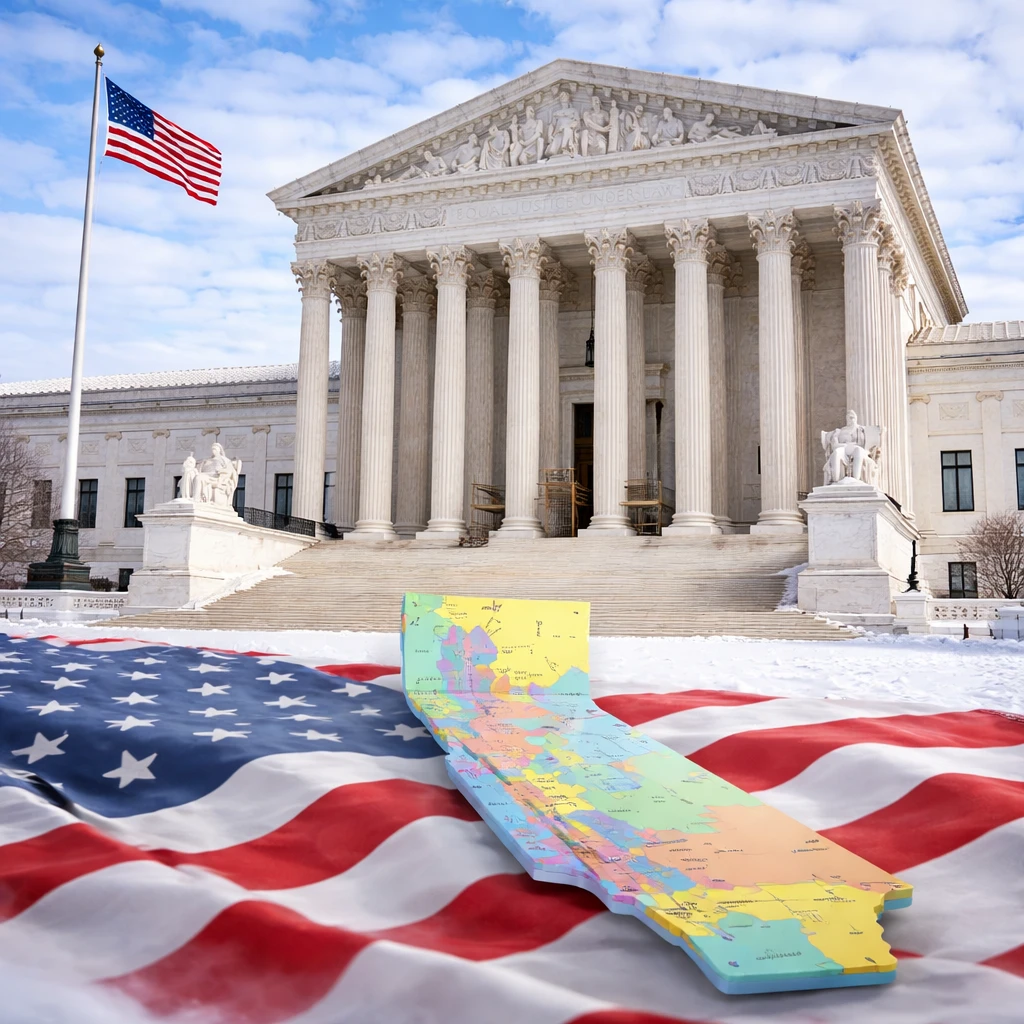

In a ruling issued on Wednesday, the Supreme Court authorized California to proceed with using a freshly devised congressional map validated by voters, a plan that potentially benefits Democratic candidates in this year's midterm elections. This determination dismissed an urgent appeal lodged by California Republicans and the Trump administration, with no justices voicing dissent against the concise order.
Previously, the Court sanctioned the use of Texas' congressional map, designed to favor Republicans, despite a lower court's assessment suggesting possible racial discrimination. Conservative Justice Samuel Alito, in December, observed that both California and Texas seemed to have enacted new electoral maps motivated by political advantage, a factor that the Court has ruled cannot serve as grounds for federal litigation.
The Republican opposition, supported by the Trump administration, argued that California's new map improperly depended on race as a criteria. However, a lower court panel rejected this claim by a two-to-one vote.
By issuing an unsigned order, the Supreme Court has affirmed the continued use of the California congressional districts configured to potentially flip as many as five seats currently held by Republicans. This development is part of an ongoing tit-for-tat national redistricting conflict spurred by the strategies of former President Donald Trump, with significant implications for congressional majority control in the 2024 midterm elections.
At the request of former President Trump, Texas Republicans conducted a redistricting effort last year, aiming to gain five additional congressional seats. California's Democratic Governor, Gavin Newsom, who has aspirations for the presidency in 2028, pledged to respond in kind, although the state's process requires securing voter approval, not merely legislative consent, for such maps.
The filing period for California's congressional primaries is scheduled to start on Monday, marking a critical juncture as political campaigns gear up under these new electoral boundaries.