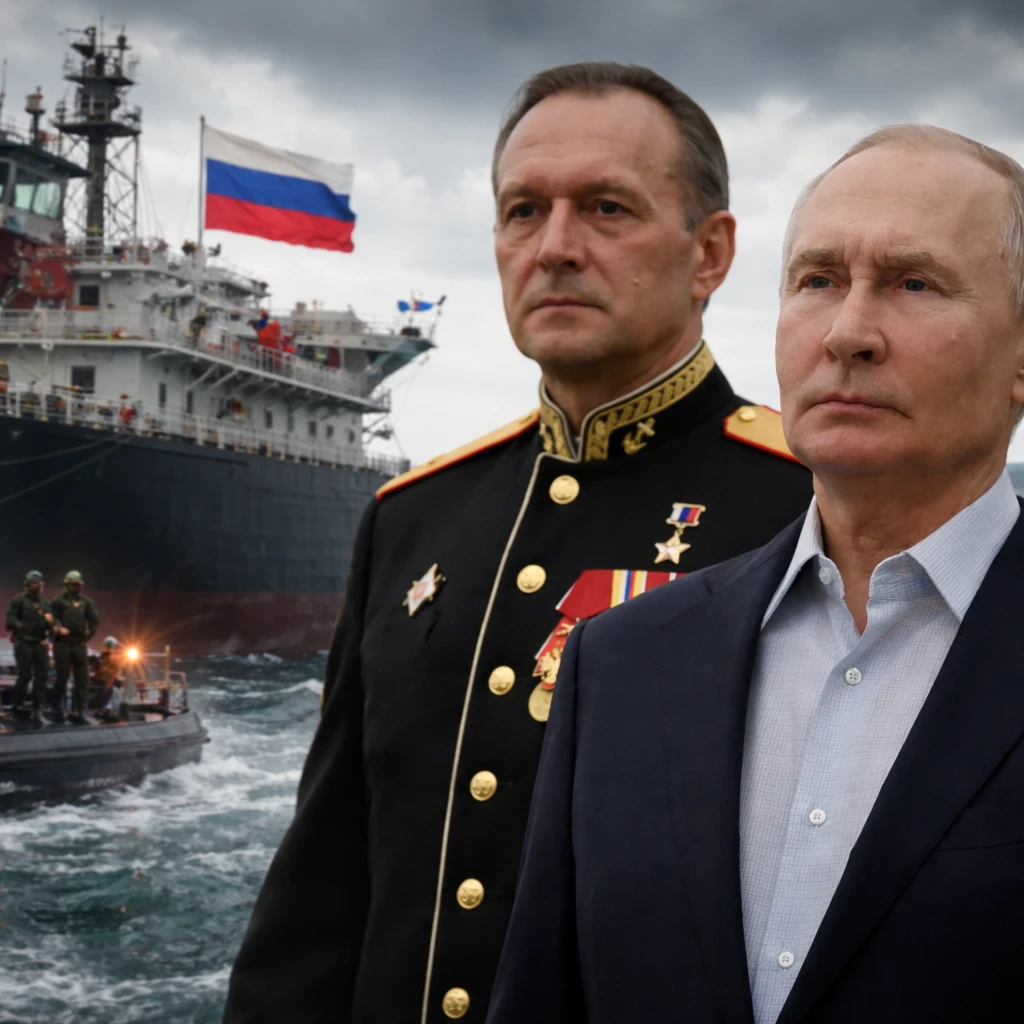

On Thursday, the Russian government issued a stern denunciation of the United States' recent capture of an oil tanker flying the Russian flag, an event that has intensified the strain in U.S.-Russia relations and threatens to affect President Donald Trump's initiatives aimed at encouraging Russia to conclude its ongoing nearly four-year conflict in Ukraine.
The U.S. military detained the vessel, named Bella 1, in the North Atlantic on Wednesday, citing violations of U.S. sanctions as the principal reason for the interception. In response, the Russian Foreign Ministry released a statement condemning the action, warning that such seizures could escalate military and political tensions across the Euro-Atlantic region and lower the threshold for the use of force against civilian shipping.
While Russian President Vladimir Putin had not yet publicly addressed the tanker’s seizure at the time, he previously remained silent regarding the U.S. capture of Venezuelan leader Nicolás Maduro — an operation that Russian officials described as blatant aggression. The U.S. seizure of the oil tanker presents a distinct challenge for the Kremlin amidst these broader geopolitical dynamics.
Within Moscow, hawkish voices have criticized the government for a sluggish reaction and advocated for proactive measures, including the deployment of Russian naval resources to safeguard the so-called "shadow fleet" of tankers that transport Russian oil globally under complex circumstances. There are calls to protect these vessels more assertively from future embargo enforcement actions.
Western allies of Ukraine have long signaled intentions to tighten sanctions on these shadow transportation networks, which have been a key conduit for Russia's oil exports. Observers within Russia fear that the U.S.'s recent move could establish a precedent for other countries to seize vessels carrying sanctioned oil cargo.
Daniel Fried, a former U.S. Assistant Secretary of State for European and Eurasian Affairs and current member of the Atlantic Council, commented that Russia’s official rhetorical protests mask a strategic helplessness. "The Russians tend to scream and yell when they’re embarrassed," Fried noted, emphasizing that Russia lacked means to counter the seizure and that this incident exposes political vulnerabilities within Moscow.
The U.S. European Command clarified that Bella 1 was detained due to violations of sanctions related to Venezuela as it attempted to circumvent a blockade. The tanker had been renamed Marinera and reflagged to Russia in an apparent attempt to avoid restrictions on vessels transporting Venezuelan oil, a key target of the Trump administration’s embargo enforcement.
U.S. Energy Department officials reiterated Washington’s position that only sanctioned and approved channels can be used for Venezuelan oil exports and imports to align with national security and legal considerations.
Russian officials have dismissed the U.S. rationale, with the Foreign Ministry branding the seizure as "utterly cynical," denouncing it as a manifestation of neo-colonial ambitions and a gross violation of international maritime law. The ministry claims the tanker possessed a valid permit to fly the Russian flag issued in December, and strongly rejected threats to prosecute the crew on what it terms "absurd pretexts." Moreover, Russia declared that unilateral sanctions imposed by the United States and Western nations are illegitimate and do not justify the seizure of vessels on international waters.
The Foreign Ministry expressed regret and concern regarding Washington’s apparent readiness to provoke acute international crises, adding that such actions further strain already tense Russian-American relations encumbered by longstanding disagreements.
The maritime incident ignited discord among Russian military bloggers and commentators, some of whom accused the Kremlin of insufficiently responding to what they considered an affront by the U.S. military. There was criticism directed at the Russian military for failing to dispatch warships swiftly to escort the tanker and prevent its capture. Proposals emerged to deploy security teams or military contractors onboard shadow fleet vessels to deter future seizures.
Alexander Kots, a military correspondent for the tabloid Komsomolskaya Pravda, argued that the Kremlin’s muted response could encourage the U.S. and Western powers to intensify seizures of Russian-related shipping. He urged a more confrontational stance, warning against appeasing an adversary perceived as emboldened by lack of firm opposition.
Analysts like Fried countered by highlighting Russia’s limited standing to credibly challenge the legality of the U.S. actions given Moscow’s ongoing invasion of Ukraine. He also pointed to the limited nature of Russia's legal claim over the vessel, which had only recently been granted temporary registration under the Russian flag. Fried characterized the situation as reflective of Russia’s strategic overstretch amid an unprofitable war and a weakening economy.
Fried further speculated that while Russian authorities might consider retaliatory moves against U.S. interests, President Putin may be reluctant to antagonize Trump, given that positive personal engagement has yielded more progress in the past.
Amid escalating tensions following the tanker’s seizure, Senator Lindsey Graham of South Carolina announced that President Trump has endorsed a sanctions package designed to significantly impact Russia's economy. This legislation has been under development for several months and intends to further restrict Moscow's financial and economic capabilities.