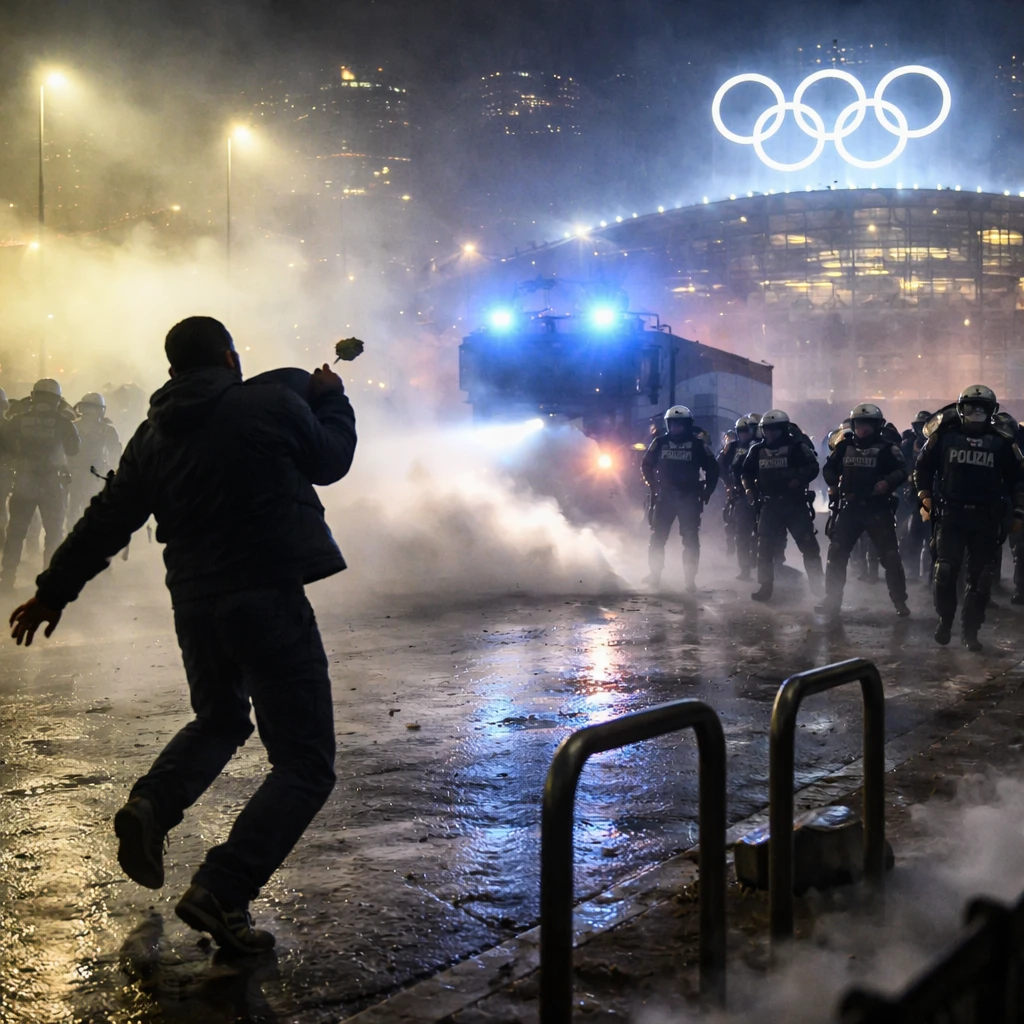

On Saturday near Milan, Italian law enforcement resorted to tear gas and water cannon to disperse a faction of demonstrators who had escalated a protest surrounding the Winter Olympics. The unrest arose following a largely peaceful march involving thousands of protesters who voiced concerns over the environmental damages attributed to the Games, as well as opposition to the presence of U.S. Immigration and Customs Enforcement (ICE) agents in Italy.
The disturbance involved a subset of masked protesters who ignited firecrackers and smoke bombs on a bridge near a construction area about 800 meters from the Olympic Village, which is currently accommodating approximately 1,500 athletes. Despite a police barricade comprised of vans and temporary metal fencing securing access to the athletes' quarters, these protesters diverted their path toward the Santagiulia Olympic ice hockey venue.
Authorities successfully held back this confrontational group following the short clash, by which point the predominant peaceful contingent, which included families with young children and students, had already disbanded. Throughout the protest, a substantial police presence maintained security along the entire demonstration route.
Officials indicated no disruption to the transit of athletes to their events, all situated on the outskirts of Milan, ensuring the Games' schedule remained unaffected.
The demonstration coincided with U.S. Vice President J.D. Vance’s visit to Milan, where he served as the head of the American delegation attending the Winter Olympics’ opening ceremony. While the protests took place near the Olympic venues, Vance and his family toured Leonardo da Vinci’s "The Last Supper" at a location closer to Milan's city center, removed from the protest sites.
Among the central grievances expressed by protestors was the U.S. Homeland Security Investigations unit, an investigative branch of ICE focused on cross-border crimes, which frequently deploys officers to overseas events like the Olympics as part of security arrangements. Protesters voiced opposition specifically to the presence of this unit, distinguishing it from ICE’s Enforcement and Removal Operations, known for immigration crackdowns within the U.S., whose officers have not been reported as deployed to Italy.
The peaceful segment of the demonstration, which police estimated to include 10,000 individuals, featured symbolic actions such as carrying cardboard cutouts representing trees felled during the construction of a new bobsled track in Cortina. Participants were accompanied by dancers performing to drumming rhythms, and music blared from a lead truck including an anti-ICE anthem with explicit language.
Banners and signs underscored the environmental and political message of the movement. One banner read, "Let’s take back the cities and free the mountains," held by a group self-identified as the Unsustainable Olympic Committee. Another collectivity, the Association of Proletariat Excursionists, organized the display of the cutout trees. Protester Guido Maffioli remarked on the organizers’ bypassing of conventional legal procedures required for major infrastructure projects, justified by the urgency of hosting the Games, and warned of potential financial burdens transferred to Italian taxpayers by the private entity managing the Olympics.
Handmade placards conveyed messages such as "Get out of the Games: Genocide States, Fascist Police and Polluting Sponsors," directly criticizing the involvement of fossil fuel companies sponsoring the Winter Olympics. One protester carried an artificial tree adorned with the sign "Infernal Olympics," symbolizing environmental degradation.
This Saturday's protests followed a similar event the previous week, where hundreds gathered to oppose the deployment of ICE agents. Despite official clarifications that only a small number of ICE investigative officers would be present and confined to U.S. diplomatic premises without operational capacity on public streets, demonstrators maintained their opposition to ICE's involvement.