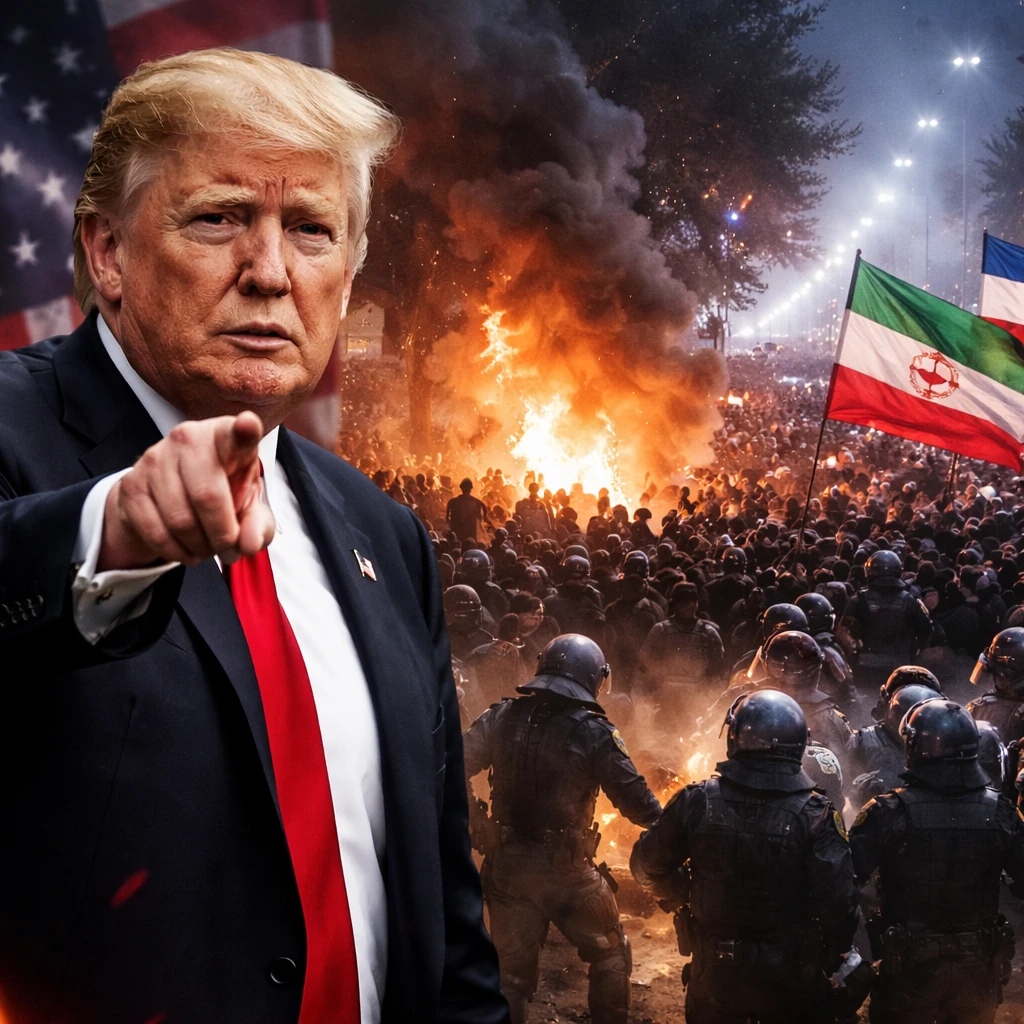
In a striking shift amid escalating tensions, US President Donald Trump announced that Iran is seeking negotiations with Washington. His remarks came after he issued warnings of strong retaliatory measures against the Islamic Republic due to its brutal crackdown on ongoing protests sweeping the country. Activists reported that the death toll in these nationwide demonstrations has climbed to at least 599 individuals.
Tehran has yet to issue a direct statement responding to President Trump's assertions. These comments followed a visit by Oman's Foreign Minister, who has historically acted as an intermediary between the US and Iran, to Tehran over the weekend. It remains ambiguous what concessions Iran may offer, particularly since President Trump has laid out stringent conditions related to Iran's nuclear program and ballistic missile arsenal — capabilities Tehran regards as vital to its national defense.
Addressing foreign diplomats in Tehran, Iranian Foreign Minister Abbas Araghchi declared that the situation in the country is under 'full control.' Araghchi accused Israel and the United States of instigating the violent outbreaks, although no evidence to support this was presented publicly. These statements were broadcast by Al Jazeera, the Qatar-funded satellite news network, which has maintained live coverage from inside Iran despite widespread internet shutdowns.
"The protests turned violent and bloody to provide a pretext for the US president to intervene," Araghchi stated. Despite this stance, he simultaneously affirmed Iran’s willingness to pursue diplomatic engagement. Further, the Iranian Foreign Ministry’s spokesperson Esmail Baghaei indicated that a communication channel remains open with the US, but emphasized that any dialogue must be rooted in respect for mutual interests and concerns, rejecting unilateral negotiations enforced through coercion.
Pro-government demonstrators took to the streets on Monday expressing support for the theocratic regime. This mass rally appeared to be a show of strength following days of unrest that directly challenged the authority of the nation’s supreme leader, 86-year-old Ayatollah Ali Khamenei. Iranian state television aired footage of chants such as 'Death to America!' and 'Death to Israel!' The General Prosecutor of Iran announced intentions to file charges against protesters under this banner, a designation that carries the death penalty.
President Trump and his national security advisors are reportedly weighing a variety of responses against Iran, including cyberattacks and direct military strikes by US or Israeli forces, according to sources familiar with internal White House discussions who spoke on condition of anonymity due to the sensitivity of the matter. "The military is evaluating options, and we are considering some very strong measures," Trump conveyed to journalists aboard Air Force One Sunday night. He warned that if Iran retaliated, the US would respond by striking them harder than ever before.
Trump confirmed ongoing efforts within his administration to arrange talks with Tehran but cautioned that military action might be necessary amid rising death reports and sustained arrests of demonstrators. "I believe they are tired of US pressure," he remarked. "Iran desires to negotiate." Conversely, Iran’s parliamentary speaker issued a stark warning on Sunday, labeling US and Israeli forces as 'legitimate targets' should the US use its military to protect protestors.
More than 10,600 individuals have been detained during nearly two weeks of protests, according to the US-based Human Rights Activists News Agency, which has historically provided accurate reporting during previous civil unrest episodes. The agency's figures, based on verified supporter reports inside Iran, estimate that 510 of those killed were demonstrators, while 89 were security personnel.
The widespread internet blackout and severed telephone lines have severely hindered external verification of the scale and circumstances of the protests and casualties. The Associated Press has been unable to independently confirm mortality figures as Iranian authorities have not publicly disclosed comprehensive casualty data.
Observers and those outside Iran fear that the information clampdown emboldens hardliner factions within Iran's security forces to intensify their harsh suppression efforts. Demonstrators flooded streets in Tehran and the country’s second-largest city overnight from Saturday into early Sunday morning, with footage online purportedly showing further gatherings through late Sunday and into Monday. A Tehran official interviewed by state media acknowledged the ongoing protests.
At 2 p.m. on Monday, Iran's state television broadcast images of large crowds converging on Tehran's Enghelab Square, also known as the Islamic Revolution Square. Government, security, and religious leaders had exhorted citizens to attend the rally throughout the morning, framing it as an 'Iranian uprising against US-Zionist terrorism' without addressing the underlying public frustration related to the country's faltering economy. State broadcasters presented footage from national demonstrations attempting to depict a popular counterweight to the earlier opposition protests.
In Tehran itself, an eyewitness told the press that nightly calls to prayer result in streets emptying rapidly. By the time of Isha, the night prayer, thoroughfares are desolate. This atmosphere is attributed largely to fear of being caught in government crackdowns. Police issued text warnings to the public stating that given the presence of 'terrorist groups and armed individuals' at recent meetings, and in light of a determined policy of zero tolerance towards agitators, families were strongly urged to safeguard their youths and adolescents. A separate warning, attributed to the intelligence wing of the paramilitary Revolutionary Guards, directly discouraged participation in protests. The witness spoke anonymously, citing ongoing repression risks.
These demonstrations began on December 28 as a response to the Iranian rial's sharp devaluation—now trading above 1.4 million per US dollar—and reflect nationwide economic hardships exacerbated by international sanctions targeting Iran’s nuclear activities. Over time, the protests evolved into broader dissent challenging the theocratic governance.
A video circulating online purportedly depicts dozens of corpses at the Kahrizak Forensic Medicine Center outside Tehran. People familiar with the facility and human rights activists' groups confirmed the video's location on Monday. The footage shows staff walking past multiple body bags arranged in a large hall, attempting identification processes. Some bodies appear laid out on blue tarps outdoors. A large truck is partially visible in segments of the video.