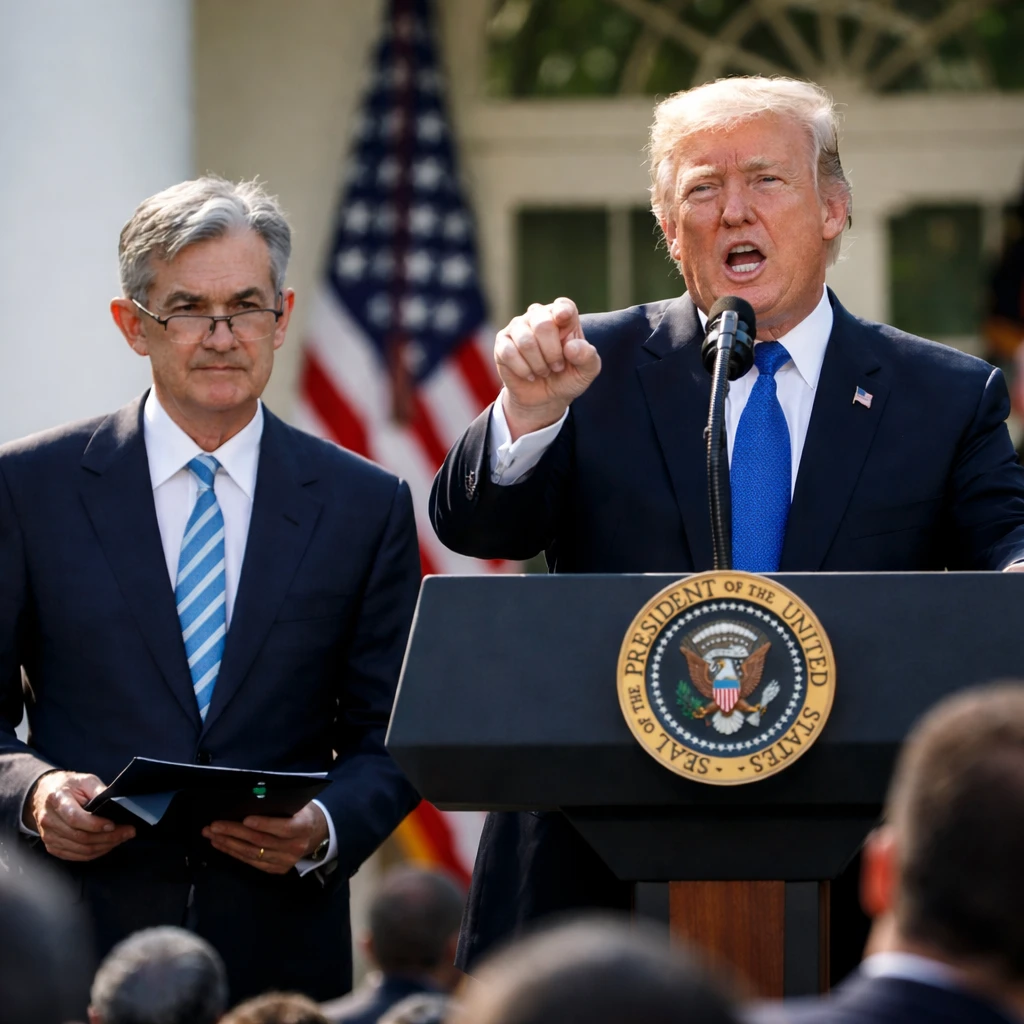

In recent developments that sharply intensify the ongoing conflict between the U.S. Federal Reserve and the Trump administration, Federal Reserve Chair Jerome Powell revealed over the weekend that the Justice Department has threatened the Fed with criminal indictment tied to his testimony about the central bank's building renovations. This move signifies a serious escalation after President Donald Trump’s repeated efforts to assert greater control over the Fed, which is designed to operate independently from political influence.
President Trump has openly criticized Powell for hesitating to lower short-term interest rates sooner and has even threatened his removal from office. Trump's stance reflects his strong desire for the Fed to reduce borrowing costs as a measure to stimulate economic activity and decrease the federal government's interest payments on its debt. Despite the Fed lowering interest rates three times in the latter part of 2025, Trump's dissatisfaction has persisted.
Adding to the tension, Trump has accused Powell of mismanaging the Fed’s $2.5 billion building renovation project, using it as a basis for potential legal actions. Powell characterized these criminal charge threats as mere "pretexts" aimed at undermining the Fed’s autonomy in monetary policy decisions, a departure from his usual responses to the president’s attacks.
While Republican lawmakers have largely refrained from a widespread response, some notable departures from the party line have emerged. Senator Thom Tillis of North Carolina, a Banking Committee member responsible for overseeing Federal Reserve nominations, asserted that any uncertainty about efforts within the Trump administration to challenge the Fed's independence should be dispelled by these events.
The administration's pressure on Federal Reserve officials extends beyond Powell. Trump has moved to dismiss Federal Reserve Governor Lisa Cook, based on allegations of mortgage fraud—claims made without substantiation by Bill Pulte, a Trump appointee to the Federal Housing Administration.
The critical importance of maintaining an independent Federal Reserve lies in its significant impact over the U.S. economy. The Fed has the authority to adjust short-term interest rates, which influences borrowing costs for consumers and businesses. By lowering rates, the Fed encourages spending and economic growth during downturns. Conversely, it raises rates to combat inflation, though this can lead to economic slowdowns and job losses.
Economists value a politically independent Fed because it enables the institution to implement unpopular but economically necessary policies, such as raising interest rates to control inflation, without yielding to political pressures. Historical experiences, particularly inflation crises in the 1970s and 1980s, underscore the benefits of such independence. Notably, former Chair Arthur Burns’ perceived susceptibility to political influence during President Nixon’s administration worsened inflation, while Paul Volcker’s later stringent rate hikes brought inflation under control despite causing economic pain.
Market participants are closely observing the situation. Any attempt to remove Powell could cause instability, including declines in stock markets and rising bond yields, which would translate to higher borrowing costs across various sectors, including housing and consumer credit.
Investors generally prefer a Fed that operates independently because its policies are more predictable and focused on long-term economic health rather than political cycles. The Fed’s transparent communication strategies help markets anticipate changes, which stabilizes borrowing costs. By contrast, a Fed influenced by political motives could inject uncertainty into financial markets, likely pushing inflation expectations and long-term yields higher.
International examples illustrate the risks of compromised central bank independence. In Turkey, political interference led to artificially low rates amidst soaring inflation, resulting in economic instability. Subsequent restoration of some independence led to sharp increases in interest rates and a reduction in inflation but also imposed significant economic burdens.
Despite its independence, the Fed is accountable within the political framework. The Chair and board members are presidential appointees confirmed by the Senate, serving staggered terms that can alter the institution's policy direction over time. President Biden appointed four of the current seven board members, including Powell and Cook, with their terms extending over several years. Trump’s efforts to replace Governors ahead of scheduled term completions could reshape the Fed's policy orientation.
While the President can appoint a new Fed Chair when an existing term ends—Powell’s is due in May—the Federal Open Market Committee’s 12 voting members collectively influence interest rate decisions, thus diluting the Chair's unchecked control. Congressional legislation also shapes the Fed’s mandate, establishing dual objectives of price stability and maximum employment.
Legal precedents suggest that the President cannot dismiss a Fed Chair solely over policy disagreements. Removal would likely require demonstrable misconduct or negligence—potentially why the administration is focusing on the renovation controversy to establish "for cause" grounds. Should such a dismissal occur, it could trigger a legal battle, possibly escalating to the Supreme Court.
Overall, these developments put the Federal Reserve’s independence at significant risk, raising questions about the stability of U.S. monetary policy and financial markets amid mounting political pressures.