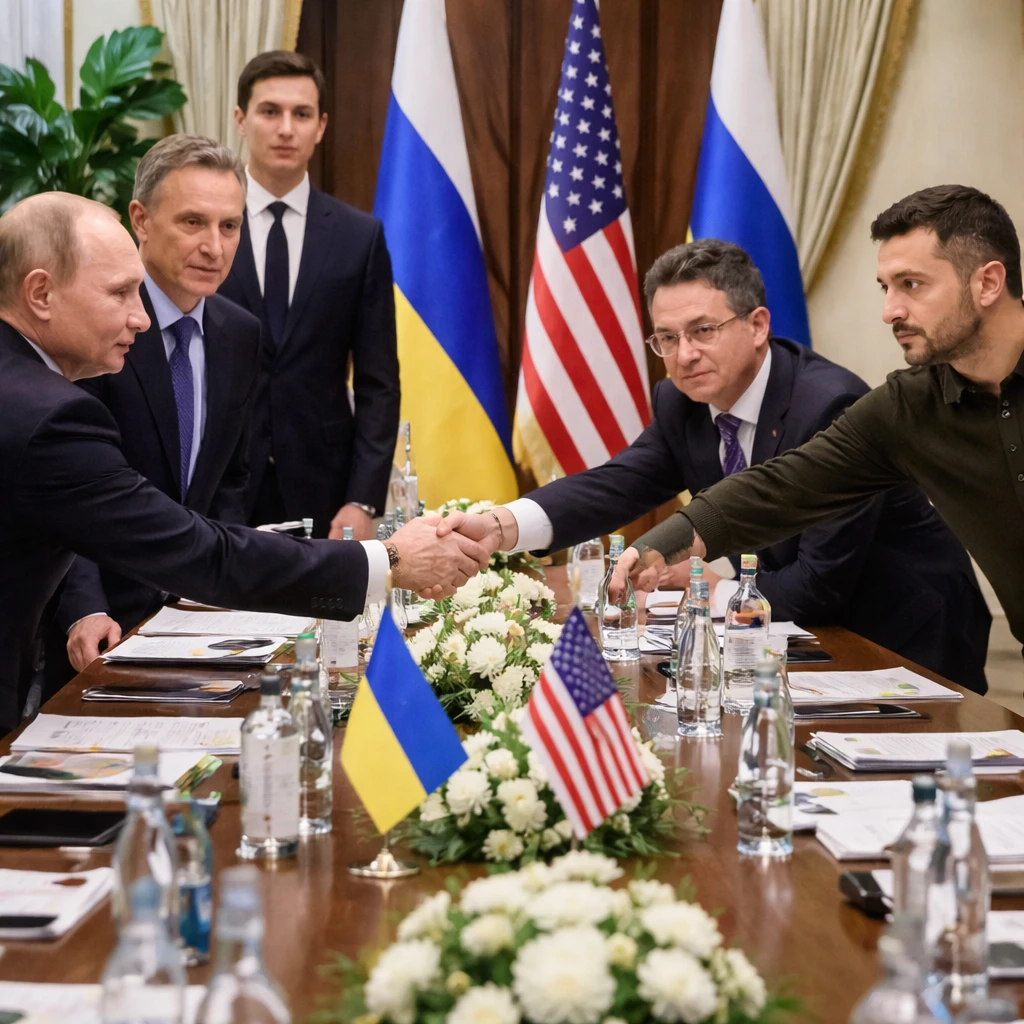
In Abu Dhabi, political representatives from Ukraine, Russia, and the United States convened on Friday to deliberate over potential peace measures aimed at ending the ongoing conflict instigated by Russia's full-scale invasion nearly four years ago. Central to discussions is the future of Ukraine’s eastern Donbas region.
These trilateral talks followed an extensive overnight meeting in Moscow between Russian President Vladimir Putin and envoys from U.S. President Donald Trump, lasting well into the early hours of Friday morning. The Kremlin underscored that any lasting peace agreement would require Kyiv’s withdrawal of military forces from eastern territories that Russia claims to have annexed, despite never having completely controlled them.
On his part, Ukrainian President Volodymyr Zelenskyy reaffirmed his openness to the idea of instituting a free trade zone administered by Ukraine within the eastern region. After a conversation with Trump at the World Economic Forum in Davos, Switzerland, Zelenskyy expressed optimism about the proposal's potential benefits to Ukrainian businesses, noting, "I think it will be positive for our business."
Friday marked the first occasion where officials from the Trump administration simultaneously engaged with Ukrainian and Russian negotiators. Although the talks are in their nascent stages with numerous challenges yet to be overcome, some observers interpret this engagement as a signal of incremental progress toward a peace deal.
Speaking to reporters in a WhatsApp audio message, Zelenskyy outlined that while the ultimate status of the lands in eastern Ukraine currently held by Russian forces remains unsettled, the peace proposals are approaching readiness. However, the Kremlin provided minimal information beyond describing the meeting as a "working group on security issues."
Kremlin spokesman Dmitry Peskov revealed that the Russian delegation, headed by Admiral Kostyukov, consisted predominantly of military officials and mentioned that talks could continue into Saturday if necessary. Additionally, Putin's envoy Kirill Dmitriev held separate discussions with Trump's envoy Steve Witkoff focusing on economic matters.
Yuri Ushakov, a Kremlin foreign affairs adviser who partook in Putin's meeting with U.S. envoys Witkoff and Jared Kushner, emphasized that the parties reaffirmed the necessity of resolving territorial disputes as a prerequisite for a sustainable settlement. The Moscow discussions, which began just prior to midnight, extended nearly four hours past 3 a.m. Friday.
These talks closely followed sharp criticism by Zelenskyy directed at European allies for a perceived sluggish and fragmented reaction, which he argued has left Ukraine vulnerable to Russian aggression despite ongoing U.S. efforts to broker peace. Ushakov indicated that Trump's team updated Putin on his meeting with Zelenskyy and previous engagements with Ukrainian and European officials. He described the dialogue as "frank, constructive," and "fruitful." Insights from Trump’s Board of Peace participants, including Josh Gruenbaum, were also involved, with Russia considering an invitation to join the board. Putin confirmed his intent to allocate $1 billion from Russian assets frozen in the U.S. to aid reconstruction efforts in Gaza through this framework. Trump responded positively to Putin’s proposal to use these frozen assets, stating, "If he’s using his money, that’s great."
During a closed-door meeting lasting about an hour at Davos, Zelenskyy and Trump discussed developments candidly, with Zelenskyy describing it as "productive and meaningful." Trump commented aboard Air Force One en route back to Washington, expressing confidence that both Putin and Zelenskyy desire a resolution and that concessions are underway, though main sticking points, especially regarding boundaries, persist as they have over the past several months.
Since the conflict’s inception in 2014 and the intensified Russian invasion in 2022, Russia's larger military strength has resulted in control over roughly 20% of Ukraine's territory. Despite battlefield gains, Moscow faces significant costs and economic pressure due to ongoing sanctions. Ukraine, while boosting domestic arms production, remains reliant on Western military support and grapples with manpower shortages, including an estimated 200,000 troop desertions and widespread draft evasion.
Addressing the World Economic Forum post-discussion with Trump, Zelenskyy enumerated criticisms against European countries. While the European Union, fearing threats to regional defense, has supplied financial, military, and humanitarian aid, internal EU disagreements and hesitancy have led to perceived inadequate support. He lamented Europe's slow decision-making processes, underinvestment in defense, failure to curb Russia's sanction-defying oil tanker operations, and reluctance to deploy frozen assets to finance Ukraine.
Characterizing Europe's position as "lost," Zelenskyy urged for a more forceful global role from the continent. He drew contrasts with the United States, highlighting its assertive policies in nations such as Venezuela and Iran. Referencing the film "Groundhog Day," Zelenskyy stressed the repetitive nature of his appeals for European defense autonomy, noting the lack of progress over the previous year. He emphasized the continuation of conditions compelling him to voice similar concerns repeatedly.