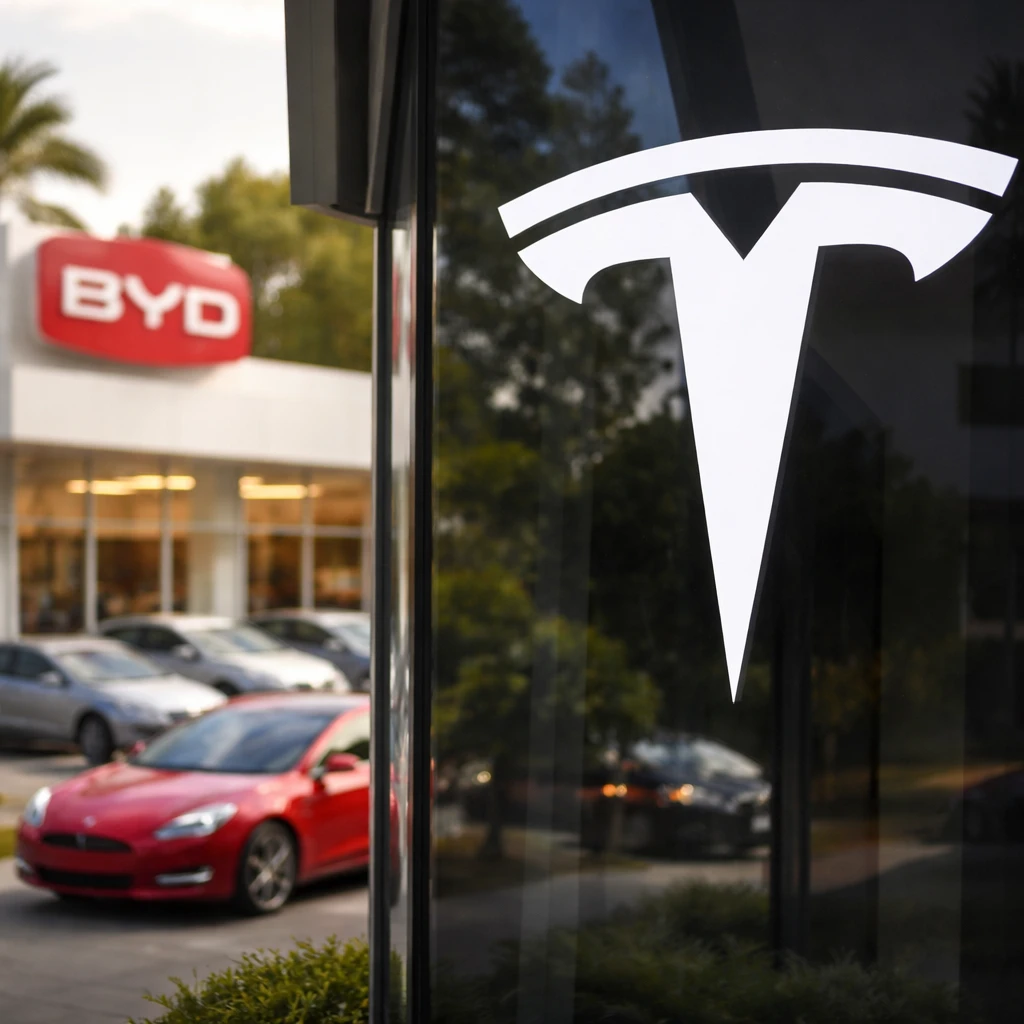

Tesla has relinquished its position as the leading seller of electric vehicles globally after experiencing a sales decline for the second year running. In 2025, the company reported delivering 1.64 million vehicles, marking a 9% reduction compared to 2024 figures. This marks a significant shift in the global EV market dynamics, as BYD, a Chinese manufacturer, sold 2.26 million vehicles last year, ascending to the top spot in the world’s electric vehicle sales rankings.
Elon Musk, Tesla's CEO, had previously downplayed BYD’s threat as Tesla’s growth appeared unstoppable, disrupting traditional automotive manufacturers with greater resources and helping establish Musk as the world’s wealthiest individual. However, for the fourth quarter of 2025, Tesla's sales volume reached 418,227 vehicles, missing the 440,000 units anticipated by analysts surveyed by FactSet. This shortfall coincides with the expiration of a $7,500 U.S. tax credit incentive for electric vehicle buyers, which was phased out by the previous Trump administration at the end of September.
The company's stock experienced a modest increase, rising 0.5% to $451.60 during early trading on the day of the report. Despite the multifaceted challenges facing Tesla—including reduced sales, political controversies surrounding Musk’s right-wing affiliations, and intensifying foreign competition—investors remain optimistic about Tesla's strategic transition. This outlook is reinforced by expectations that Tesla’s leadership in forthcoming sectors such as autonomous robotaxi services and humanoid robots designed for domestic and workplace applications will drive future growth. Supporting this confidence, Tesla’s stock closed out 2025 with an approximate 11% gain.
In an effort to counteract declining sales, Tesla introduced stripped-down versions of the Model Y and Model 3 during the fourth quarter, debuting these in early October. The revised Model Y is priced just below $40,000, while the entry-level Model 3 is offered for under $37,000. These adjustments aim to enhance Tesla’s competitive position particularly against Chinese electric vehicle models in European and Asian markets.
Looking ahead to the upcoming quarterly earnings report in late January, consensus analyst projections compiled by FactSet forecast a 3% decline in sales alongside a near 40% drop in earnings per share. However, these downward trends are expected to eventually stabilize and begin improvement through 2026.
Investors are showing relative indifference to the current sales reductions, focusing instead on Musk's broader pivot from automotive sales to emerging business lines such as driverless robotaxi services, the company's energy storage operations, and the production of robots for both domestic and industrial applications. Reflecting the board’s support of this strategic direction, Tesla awarded Musk an extensive long-term compensation package, approved by shareholders at the annual meeting in November. Adding to Musk’s financial gains, a recent Delaware Supreme Court ruling restored a $55 billion pay package initially awarded to Musk in 2018 but previously contested.
Additionally, Musk is poised to potentially become the world’s first trillionaire later this year through a landmark initial public offering (IPO) anticipated from his space exploration company SpaceX. Industry analysts expect this IPO to perform exceptionally well.
(This report has been updated to correct BYD’s vehicle sales figure for 2025, which stands at 2.26 million vehicles.)