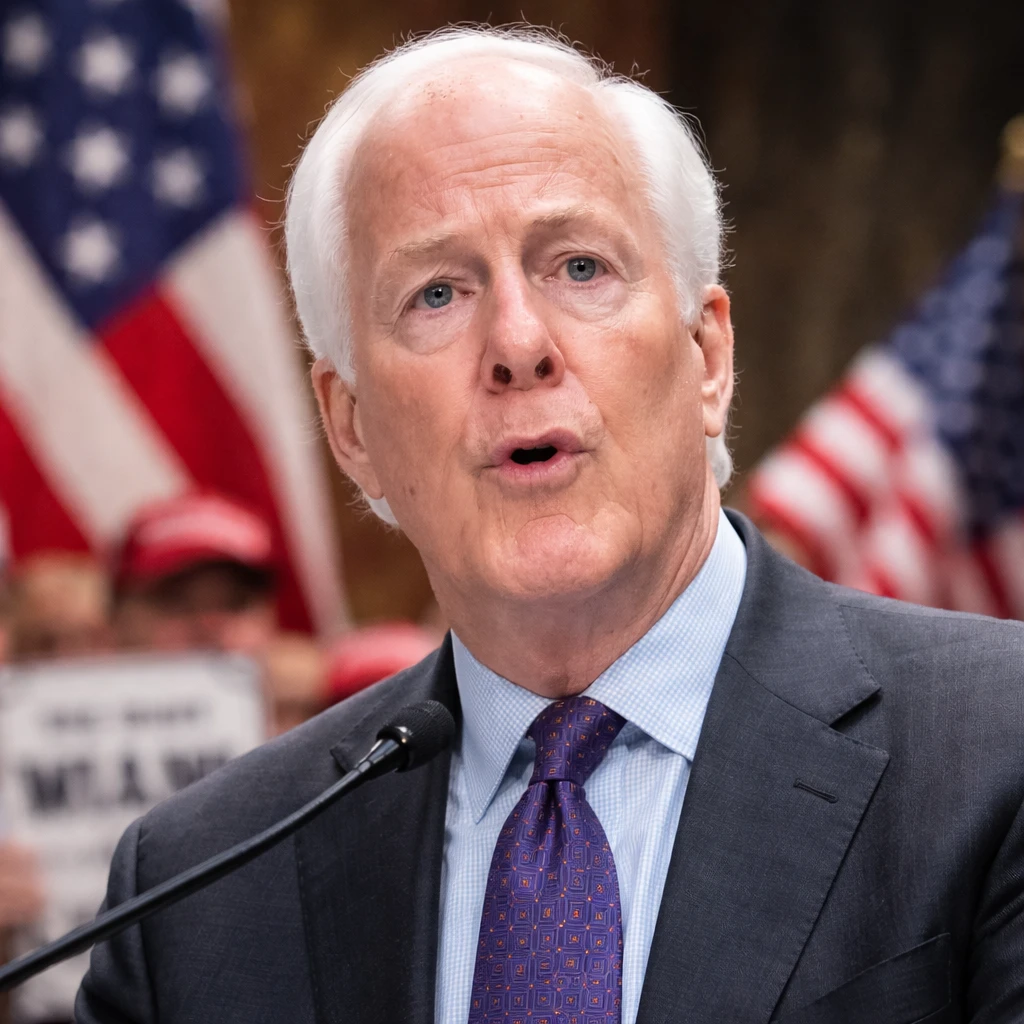
At a campaign event positioned near the U.S.-Mexico border barrier, Texas Senator John Cornyn presented a composed acknowledgement of President Donald Trump’s role in securing billions in federal funding for the border wall, expressing his gratitude in a measured Houston drawl. This restrained tone diverges from the heightened rhetoric that has come to characterize much of the Republican discourse on immigration and one that helped fuel Trump’s ascent to the presidency. However, Cornyn’s steady demeanor belies the significance of the campaign he is undertaking to retain his Senate seat against challengers who tout closer connections to the former president and the MAGA movement, advocating a more fiery partisan approach.
The 73-year-old four-term senator, who previously served as a Texas Supreme Court justice, is confronting perhaps the most formidable primary threat of his career. His challengers, Attorney General Ken Paxton and Representative Wesley Hunt, both self-described Trump Republicans, are capitalizing on perceptions that Cornyn represents an older, more traditional Republican archetype that may be increasingly out of step with the party’s current base. This primary, scheduled for March 3, has the potential to mark Cornyn as the first Texas Republican senator to lose renomination, reflecting a pivotal examination of what Republican voters seek in their representatives in the era of Trump’s influence on the party.
Senate Republicans, along with Cornyn’s supporters, have invested significant financial resources into the race, deploying tens of millions of dollars mainly against Paxton and Hunt to help swing the outcome in Cornyn’s favor. Both opponents emphasize their loyalty to Trump’s agenda and critique Cornyn for being out of touch with Texas conservatives, underscoring a campaign defined less by policy and more by alignment with Trump’s political style and brand.
Addressing the media, Cornyn expressed frustration with what he termed “performance artists” in Washington — politicians who prioritize attention-grabbing behavior and prolific social media activity over substantive legislative work. He positioned himself as a counterpoint to such figures, embodying a quieter, more deliberate approach to governance.
Paxton’s entry into the race followed his clearance from several legal challenges, including an impeachment trial on corruption charges and a securities fraud case settlement. He has cast the investigations against him as politically motivated attacks, drawing parallels to Trump’s narrative of establishment persecution. Paxton asserts that Cornyn has lost connection with Texas voters, presenting himself as the more authentic representative of the party’s base.
Meanwhile, Hunt, in his second term as a U.S. House Representative, has sought to raise his profile by endorsing Trump’s 2024 presidential comeback campaign early and suggesting that Cornyn’s time has passed. The introduction of a third high-profile candidate increases the likelihood that no one will secure an outright majority, pushing the primary into a runoff in May. The GOP nominee will then face the victor of the Democratic primary between Representative Jasmine Crockett and state Representative James Talarico.
Supporters of Cornyn, such as Mike Fleming, an 80-year-old retired sales manager attending a Hunt event, acknowledge the senator’s decades of service and regard him favorably despite concerns about his current positioning. Fleming described Cornyn as a “good man” and credited his broader leadership ambitions, noting Cornyn’s unsuccessful bid for Senate majority leader after the 2024 elections.
The primary contest illustrates a shift in Republican priorities, with some voters favoring more aggressive, outspoken candidates over those who present themselves as seasoned statesmen. Cornyn and aligned political action committees have outspent their rivals by a considerable margin, investing over $30 million on television advertisements largely targeting Paxton and Hunt. Nonetheless, Senate Republican leadership harbors concerns about Paxton’s electability in the general election due to his controversies.
Wayne Hamilton, a former Texas GOP executive director, underscored that being a distinguished statesman no longer suffices in Republican primaries, which now reward louder, more combative stances. Cornyn also contends with perceptions among some party voters that he lacks consistent conservative credentials, a view articulated by Robyn Richardson, who criticizes his voting record.
Throughout his career, Cornyn has faced GOP backlash over key issues. Texas conservatives remain displeased with his role in negotiating a 2022 bipartisan gun control law following the tragic Robb Elementary School shooting, a measure that fell short of Democratic ambitions but nonetheless represented the most significant firearm legislation in decades. Additionally, his early skepticism of Trump, including doubts about the border wall initiative and refusal to endorse unfounded election fraud claims after the 2020 presidential race, has further alienated some activists. Paxton’s supporters leverage these moments to paint Cornyn as out of step with core party principles, especially on border security where Cornyn’s initial criticism of Trump’s wall proposal has been a focal point.
Despite these challenges, Cornyn has worked to highlight areas of agreement with Trump, airing ads demonstrating his presence with Border Patrol agents and his role in securing $11 billion for border infrastructure. He also promotes his near-perfect alignment with Trump’s legislative objectives, including support for Supreme Court nominees. However, these efforts compete with a broader conservative realignment, which Cornyn resists.
Political consultant Vinny Minchillo describes Cornyn as emblematic of a previous generation of Texas Republicans, akin to the leadership style of former President George W. Bush, a persona that is increasingly at odds with the current GOP environment dominated by Trump-aligned rhetoric and supporters. The diminishing influence of traditional Republican dynasties is symbolized by the electoral defeat of George P. Bush, a notable Texas political figure, in his attempt to unseat Paxton for attorney general.
Notably, former President Trump has withheld an endorsement in the Texas Senate primary, diverging from his recent pattern of backing numerous Republican candidates statewide. This leaves Cornyn among a small group of incumbent GOP senators without Trump’s formal backing. In the closing stages of the campaign, Cornyn is banking on voters prioritizing effective governance over theatrical campaigning, describing himself as a “workhorse” rather than a “show horse.”
As the March primary looms, Cornyn’s campaign illustrates the tension within the Republican Party between establishment figures and insurgent candidates aligned with the former president. The outcome may signal how Texas Republicans intend to navigate their party’s evolving identity and the political strategies necessary for success within the contemporary Republican landscape.