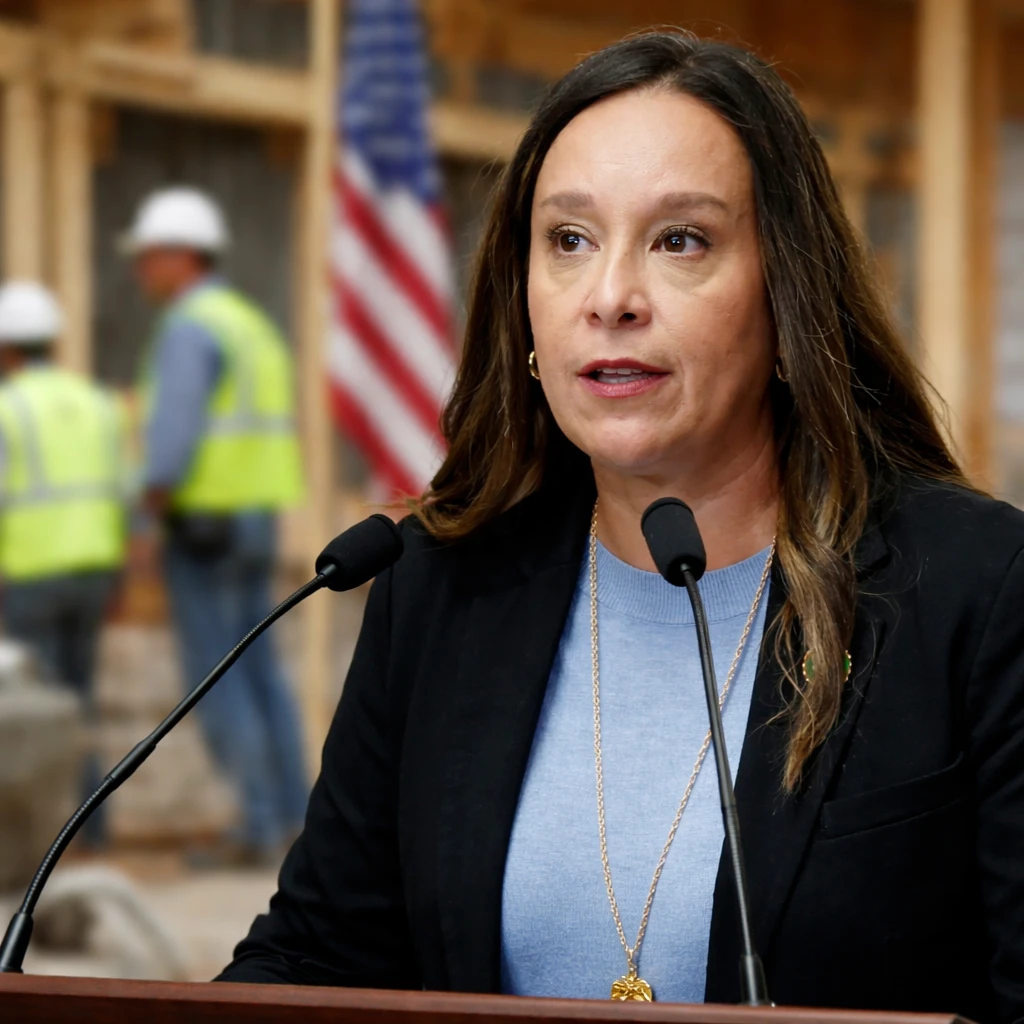

U.S. Representative Monica De La Cruz, a Republican from Edinburg, Texas, has pledged to seek new avenues to facilitate legal employment options for migrant workers in the construction industry. The announcement came on Monday following a meeting with the South Texas Builders Association, where industry leaders shared frustrations about the detrimental effects of immigration arrests at construction sites on their operations.
De La Cruz articulated the possibility of creating a specialized visa category tailored for construction workers, akin to the H-2A visa program currently utilized by the agricultural sector. "We'd like to see where the construction industry would fit," she stated, expressing a commitment to finding suitable legal frameworks for this workforce segment.
Her advocacy arises in the context of intensified immigration enforcement under the Trump administration, which has seen over 9,100 arrests conducted by Immigration and Customs Enforcement (ICE) officers within South Texas over the past year alone. Despite President Trump’s re-election campaign promise to increase deportations, De La Cruz emphasized her dedication to representing the constituents of South Texas, even if that stance challenges prevailing federal immigration policies. "They elected me to represent them in Washington, D.C., and to be their voice, even when it pushes against the Trump administration," she said. "At the end of the day, I want to represent South Texas, and I want to represent our community and make sure that we continue to be prosperous."
The discussion surrounding a new legal workforce category signals a shift among certain Republican circles, traditionally characterized by firm opposition to immigration relaxation. Within Texas and at the federal level, some Republicans now advocate for measured reforms, balancing enhanced enforcement with mechanisms to legally accommodate workers in vital economic sectors. The rationale behind stricter enforcement has included claims that it would create more employment opportunities for U.S.-born workers.
Congressional actions reflect this nuanced approach. In September, Pennsylvania Republican U.S. Representative Lloyd Smucker reintroduced the Essential Workers for Economic Advancement Act. This legislation proposes the establishment of a new visa classification aimed at nonagricultural workers, underscoring bipartisan interest in addressing workforce needs through targeted immigration adjustments.
De La Cruz's support surfaced subsequent to her confidential meeting with the South Texas Builders Association. During this sessions, builders not only discussed operational challenges but also inquired about workers’ legal protections during immigration raids on construction sites. Mario Guerrero, executive director of the association, described the group’s uncertainty regarding the legality of ICE actions and the lack of clarity about warrant requirements during such enforcement activities. De La Cruz expressed willingness to seek definitive answers and guidance from relevant authorities to better inform the industry.
Concerns about ICE raids have created persistent apprehension among workers across various sectors, including construction and the food service industry, particularly in the Rio Grande Valley. These issues were spotlighted in a large November gathering of over 300 industry representatives spanning lumber, real estate, banking, and construction, alongside elected officials. The event highlighted the economic disruptions resulting from immigration detentions, which have caused work stoppages and hindered project completion.
Following the meeting, Guerrero and his association received invitations to engage with congressional members such as De La Cruz and Laredo Democrat U.S. Representative Henry Cuellar, a co-sponsor of Smucker’s legislation. Guerrero emphasized a collaborative intent: "We're trying to do the right thing. If we need to keep having these meetings in order for us to keep moving in the right direction, that's what we're trying to do."
This initiative represents a continuation of De La Cruz's efforts to reform immigration frameworks affecting labor markets. In the previous year, she introduced the Bracero 2.0 bill, aiming to reform the H-2A visa program governing agricultural labor. Proposed enhancements included simplifying the application process, piloting regional programs for intra-state job changes without repeated visa requests, adjusting wage parameters tied to state minimums plus additional compensation, and extending contract durations from 10 to 12 months.
Although the Bracero 2.0 bill has yet to secure a congressional vote, the Department of Homeland Security independently enacted rules in October to streamline H-2A visa applications, signaling executive responsiveness to labor concerns within agriculture.