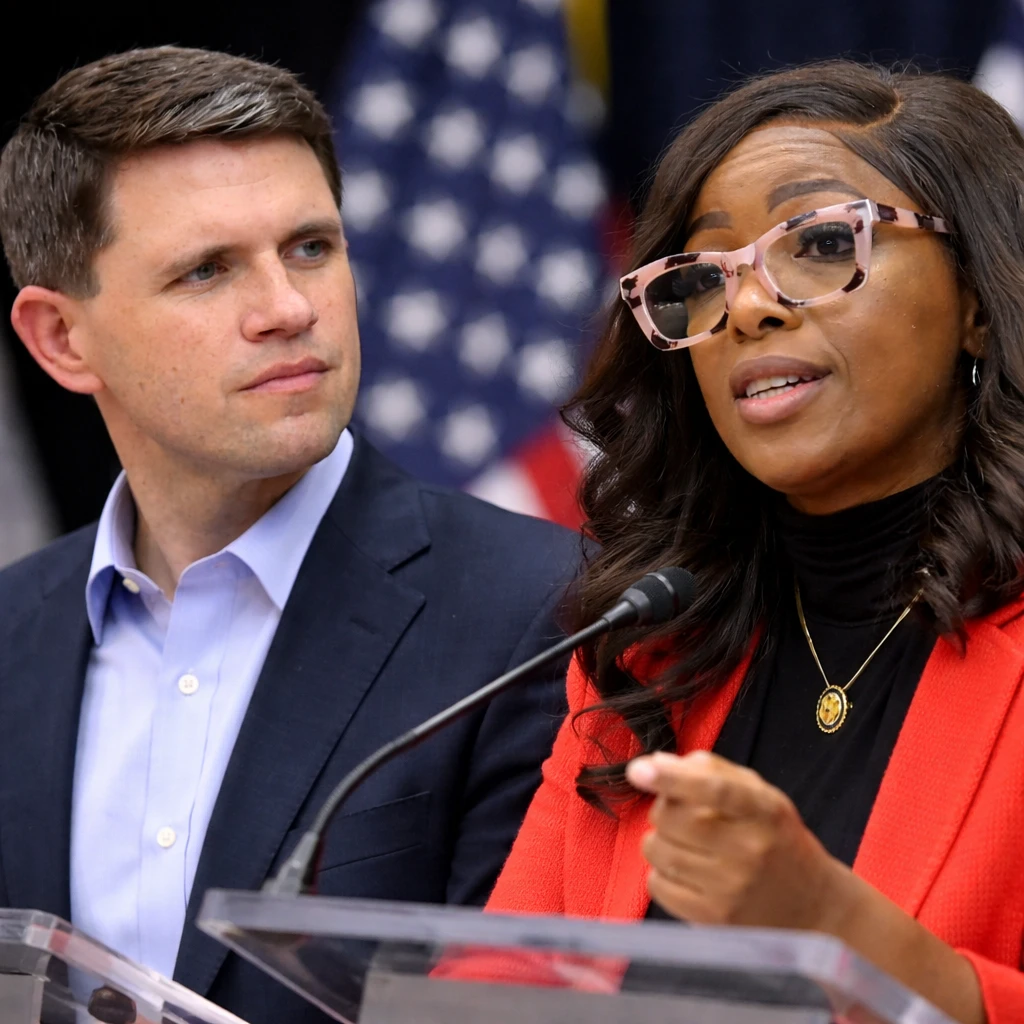

The inaugural debate between Democrats Jasmine Crockett and James Talarico for the U.S. Senate seat from Texas illuminated substantive policy agreement accompanied by contrasting personal styles. The discussion, hosted at the Texas AFL-CIO political convention before a large assembly of labor union members and their families, provided an early glimpse of the Democratic themes poised to shape the November midterm election campaign aimed at challenging the entrenched Republican majority in the Senate.
Crockett, a bold and outspoken second-term member of the U.S. House of Representatives known for her candid approach and national profile, displayed a confrontational cadence, emphasizing her identity as a Black woman poised to mobilize disaffected Black voters. Conversely, Talarico, a more reserved and reflective four-term state representative and Presbyterian seminarian, stressed his ability to engage rural voters disillusioned with Republicans, positioning himself as a battle-tested advocate from within Texas' state legislature.
Both candidates expressed their readiness to assume the role of a “fighter” in Washington, D.C., underscoring a shared commitment to tackling pressing economic challenges, health care reform, and tax policy renewal. They advocated for reversing tariffs, citing harm to sectors like agriculture and ranching, while proposing a vision that includes raising taxes on wealthier Americans to address fiscal concerns.
On the issue of President Donald Trump’s impeachment, the candidates' stances diverged somewhat. Crockett unequivocally endorsed initiating impeachment proceedings, beginning with investigations into tariff use, citing ample grounds for such action and indicating readiness to lead in this capacity should Democrats regain control of the House Judiciary Committee. Talarico refrained from explicitly supporting impeachment at this stage but acknowledged the administration had committed impeachable offenses and emphasized a fair and measured approach to any trial in the Senate, where conviction votes would occur.
The debate also addressed recent tensions surrounding the U.S. Immigration and Customs Enforcement (ICE). Both condemned the shooting of an individual in Minneapolis by federal immigration authorities and criticized ICE’s sizable presence in the city. Talarico advocated explicitly for cutting ICE funding and redirecting those resources into community investment. Crockett agreed that reform was imperative but expressed a broader intent to overhaul the agency without committing to specific funding decisions, emphasizing the necessity to “clean house.” Both called for impeachment proceedings against Department of Homeland Security Secretary Kristi Noem, under whose leadership ICE operates.
The candidates' contrasting communication styles became evident in their portrayals of themselves as political fighters. Crockett highlighted her direct and impassioned style, shaped by her background as a Dallas civil rights attorney and former public defender. She framed her campaign as tapping into a moment of raw political energy among Democratic voters. In contrast, Talarico focused on his legislative experience in opposing Republican policies, such as Texas Governor Greg Abbott’s tax credit initiatives favoring private school choice. He cast himself as a pragmatic educator capable of championing policies supportive of public education and broader constituent values in the Senate.
Health care proposals drew further attention, with Crockett endorsing Medicare for all, depicting it as a bold leadership initiative necessary to ensure universal access. Talarico, while supportive of the concept, expressed openness to alternatives like universal basic income, acknowledging promising pilot programs but stopping short of committing to specific policy advocacy in the Senate context.
The March 3 primary will determine which candidate progresses to challenge the Republican nominee, who will emerge from a field including four-term incumbent Senator John Cornyn, Representative Wesley Hunt, and State Attorney General Ken Paxton.