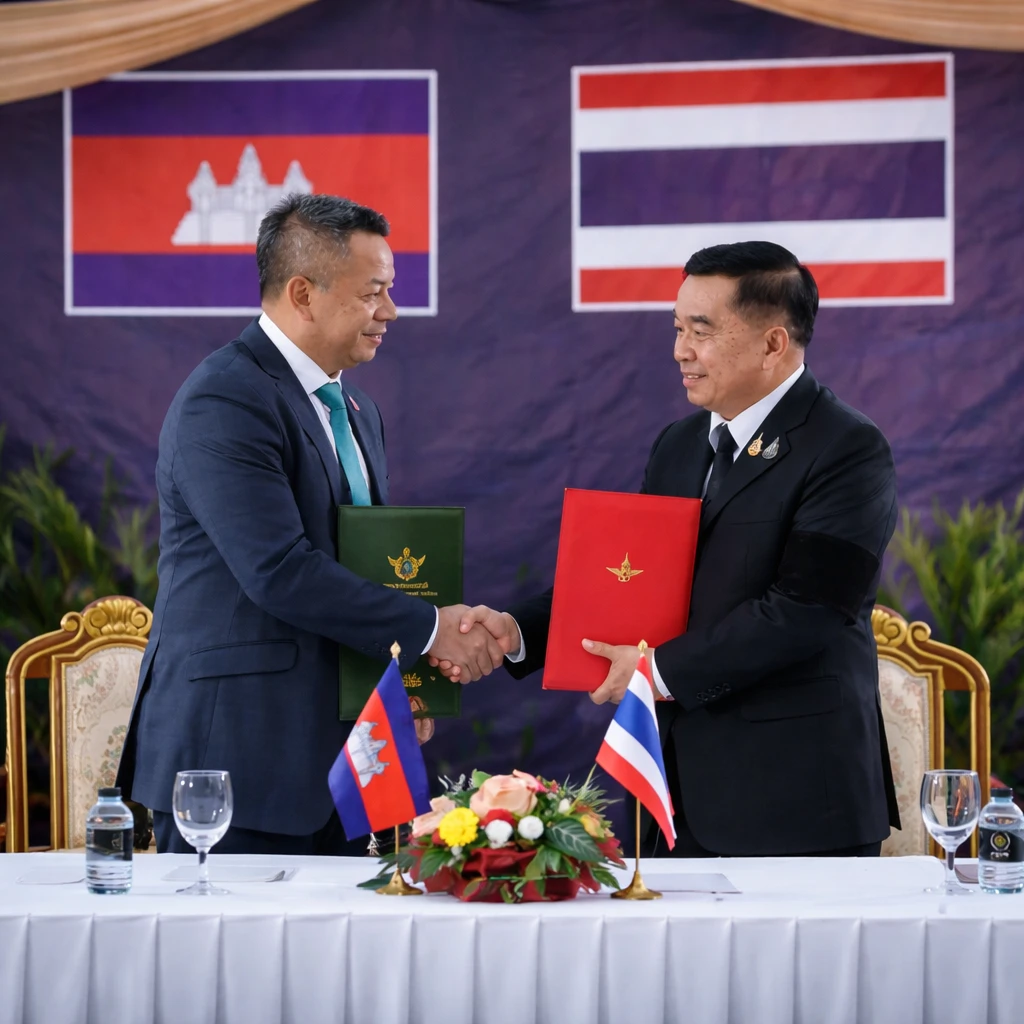

On Saturday, Thailand and Cambodia ratified a ceasefire intended to halt ongoing hostilities along their shared border, which had escalated due to opposing territorial claims. The truce commenced at noon local time (0500 GMT) and mandates an immediate cessation of military maneuvers and prohibits violations of airspace for military-related operations. Notably, airstrikes by Thailand targeting Cambodian positions persisted until the morning of the agreement, according to Cambodia's Defense Ministry.
The accord further stipulates that, contingent on the ceasefire's stability over a 72-hour period, Thailand will return 18 Cambodian soldiers detained since earlier clashes in July— a central request from Cambodia.
Shortly after the agreement's enactment, Thailand’s Foreign Ministry lodged a protest against Cambodia, stating that a Thai soldier suffered permanent disabling injuries after triggering an anti-personnel land mine allegedly placed by Cambodian forces.
The ceasefire was endorsed by Cambodia’s Defense Minister Tea Seiha and Thailand’s counterpart Nattaphon Narkphanit at a border checkpoint, following several days of negotiations at the military level. It reaffirms commitment to preceding ceasefires, including one that concluded a five-day conflict in July and was brokered with significant diplomatic involvement from Malaysia and U.S. pressure.
Despite formal agreements, a harsh propaganda exchange and minor violent incidents have persisted, culminating in intense clashes in early December.
U.S. Secretary of State Marco Rubio welcomed the truce, urging strict adherence to its terms and prior accords. Concurrently, United Nations Secretary-General Antonio Guterres called the truce a constructive step toward easing civilian suffering, ending hostilities, and fostering conditions for lasting peace. He acknowledged international mediation efforts and affirmed U.N. readiness to support regional stability.
The conflict has inflicted heavy casualties, particularly among civilians and soldiers. Thailand reported losses of 26 military personnel and one civilian since December 7, with civilian fatalities reaching 44. Cambodia has not disclosed military casualties but acknowledged 30 civilian deaths and 90 injuries. Large-scale evacuations have affected communities on both sides of the border.
Minister Seiha highlighted the ceasefire’s significance for displaced populations, enabling their safe return home, resumption of agriculture, and reopening of schools.
Each nation has accused the other of initiating the fighting and claims self-defense motivations. The agreement also addresses concerns over land mine deployment, directing both parties to observe international prohibitions. Thailand reported multiple injuries caused by mines it attributes to recent Cambodian placement, while Cambodia contends these are remnants from past conflicts.
The agreement includes provisions for joint humanitarian demining operations to safeguard military personnel and civilians, and commands both countries to refrain from spreading misinformation or false news.
Additional commitments entail renewed efforts at borderline demarcation and cooperation to combat transnational crimes, notably online fraud schemes linked to organized groups operating with bases in Cambodia.
Malaysia’s Prime Minister Anwar Ibrahim, who played a key role in the initial ceasefire, emphasized the mutual understanding that restraint benefits civilian well-being.
However, many clauses in this accord mirror those in earlier agreements, which were loosely interpreted and inconsistently implemented, particularly regarding mine clearance and prisoner releases.
Thailand’s Defense Ministry spokesperson Surasant Kongsiri underscored the ceasefire’s precarious nature, indicating that the safe resettlement of civilians will signify a stable environment conducive to prisoner repatriation. Conversely, failure to uphold the ceasefire could signal a lack of genuine peace intentions from Cambodia.