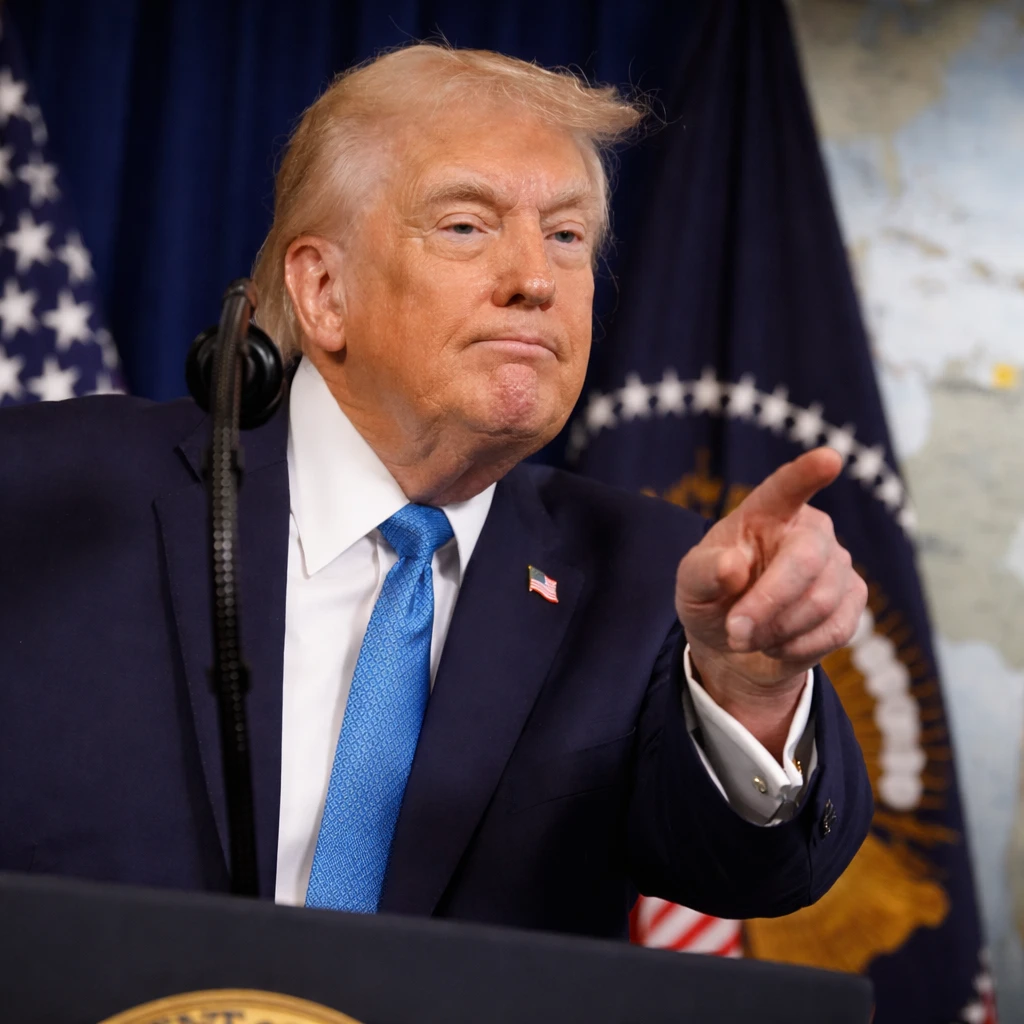

President Donald Trump’s recent military operation that resulted in the arrest of Venezuelan leader Nicolás Maduro prominently invoked the Monroe Doctrine, a principle that has influenced U.S. foreign policy for over two centuries. Originally introduced by President James Monroe in 1823, the doctrine was crafted to oppose European colonial ambitions and interference across the Western Hemisphere. This foundational policy has since been repeatedly referenced by successive U.S. presidents to rationalize involvement and influence in the Americas.
On a recent Saturday, President Trump cited this enduring doctrine as part of the rationale behind the capture of a foreign leader who now faces criminal prosecution within the United States. Trump even humorously remarked that some were dubiously calling it “the Don-roe Doctrine,” signaling both a personal adaptation and invocation of the policy’s historical significance. Political scholars are currently reassessing the Monroe Doctrine's legacy in light of the Trump administration’s contemporary foreign policy maneuvers, especially in regards to the administration’s declared intent to exert control over Venezuela until Maduro is replaced with more favorable leadership.
Understanding the Monroe Doctrine
James Monroe’s 1823 address to Congress articulated a policy designed to deter European powers from re-establishing colonial control or interfering in newly independent nations of the Americas. In exchange, the United States committed to avoiding entanglement in European conflicts and affairs. This policy emerged when many Latin American countries were newly sovereign after liberation from European empires. Monroe aimed not only to block European re-colonization efforts but also to affirm U.S. influence throughout the hemisphere.
Jay Sexton, a history professor at the University of Missouri and author of “The Monroe Doctrine: Empire and Nation in Nineteenth-Century America,” noted Venezuela’s historical significance in this context. “Venezuela has frequently been the pretext or trigger for numerous corollaries to the Monroe Doctrine,” Sexton explained, highlighting the country’s turbulent internal divisions and complex relations with rival foreign powers. From the 19th century continuing through the Trump administration, Venezuela’s political status has repeatedly intersected with U.S. strategic considerations.
The Roosevelt Corollary and Evolution of U.S. Policy
While initially disregarded by European governments, the Monroe Doctrine was eventually leveraged to justify multiple U.S. interventions in Latin America. The first major test occurred in the 1860s when France installed Emperor Maximilian in Mexico; post-Civil War U.S. pressures compelled France to withdraw.
The policy was further expanded with President Theodore Roosevelt’s 1904 corollary, which advocated for U.S. intervention in Latin American countries deemed unstable. Roosevelt’s approach backed Panama’s secession from Colombia, facilitating control over the Panama Canal Zone. During the Cold War, the Monroe Doctrine was reframed as a tool against communism, evident in the U.S.’s 1962 demand for Soviet missile withdrawal from Cuba and the Reagan administration’s opposition to Nicaragua’s Sandinista government.
University of Texas professor Gretchen Murphy observed the parallels in Trump’s invocation of the doctrine, aligning it with earlier uses by Roosevelt and others. Murphy emphasized that Roosevelt’s rationale extended to policing Latin American governments to ensure alignment with U.S. commercial and strategic interests, beyond merely defending sovereignty against European interference. She stated, “Trump is following a familiar pattern—invoking the Monroe Doctrine to legitimize interventions that may undermine genuine democracy while serving various interests, including economic ones.”
Trump’s Interpretation and Application
President Trump articulated concerns about Venezuela under Maduro, accusing the regime of hosting adversaries and acquiring offensive weaponry that imperil U.S. interests. Trump characterized these actions as violations of long-standing American foreign policy principles, dating back over two centuries. He vowed that under his administration’s national security strategy, American dominance in the Western Hemisphere “will never be questioned again.”
Further stressing regional priorities, Trump emphasized the desire for stability, friendly neighbors, and energy security—highlighting Venezuela’s substantial energy resources as vital both domestically and globally. These factors underpin parts of the administration’s assertive stance towards Caracas.
Emergence of a 'Trump Corollary'
The administration’s national security strategy explicitly refers to a “Trump Corollary” to the Monroe Doctrine, aiming to restore and maintain American preeminence in the Western Hemisphere. Trump justified the U.S. operational role in Venezuela as consistent with this approach, arguing that prolonged neglect by previous administrations allowed security threats to grow unchecked.
Historian Sexton outlined the evolution of presidential corollaries to the Monroe Doctrine, suggesting that Trump’s policies represent a modern iteration or separate doctrine entirely. Unlike post-World War II presidents who issued their own corollaries—such as Truman and Nixon—Trump appears to be forging a distinct doctrine emphasizing unwavering American dominance locally.
The White House’s December security strategy painted European allies as comparatively weak while reaffirming U.S. military presence in the region. It detailed military actions against drug trafficking in the Caribbean and eastern Pacific as part of this “Trump Corollary,” aimed at narcotics interdiction and migration control. The strategy signals an expansive rethinking of U.S. military roles in the area, marking the deepest regional military footprint in generations.
Sexton also warned that the Maduro capture and potential extended U.S. engagement in Venezuela could divide supporters of Trump’s “Make America Great Again” coalition. Specifically, it might provoke tensions similar to those arising from the administration’s prior strikes on Iran’s nuclear facilities, particularly among isolationist factions within the base resistant to extended foreign interventions.
Unlike quick, targeted strikes, these operations in Venezuela may engender complex, lasting involvement not entirely aligned with the administration’s stated goal of ending “forever wars.”