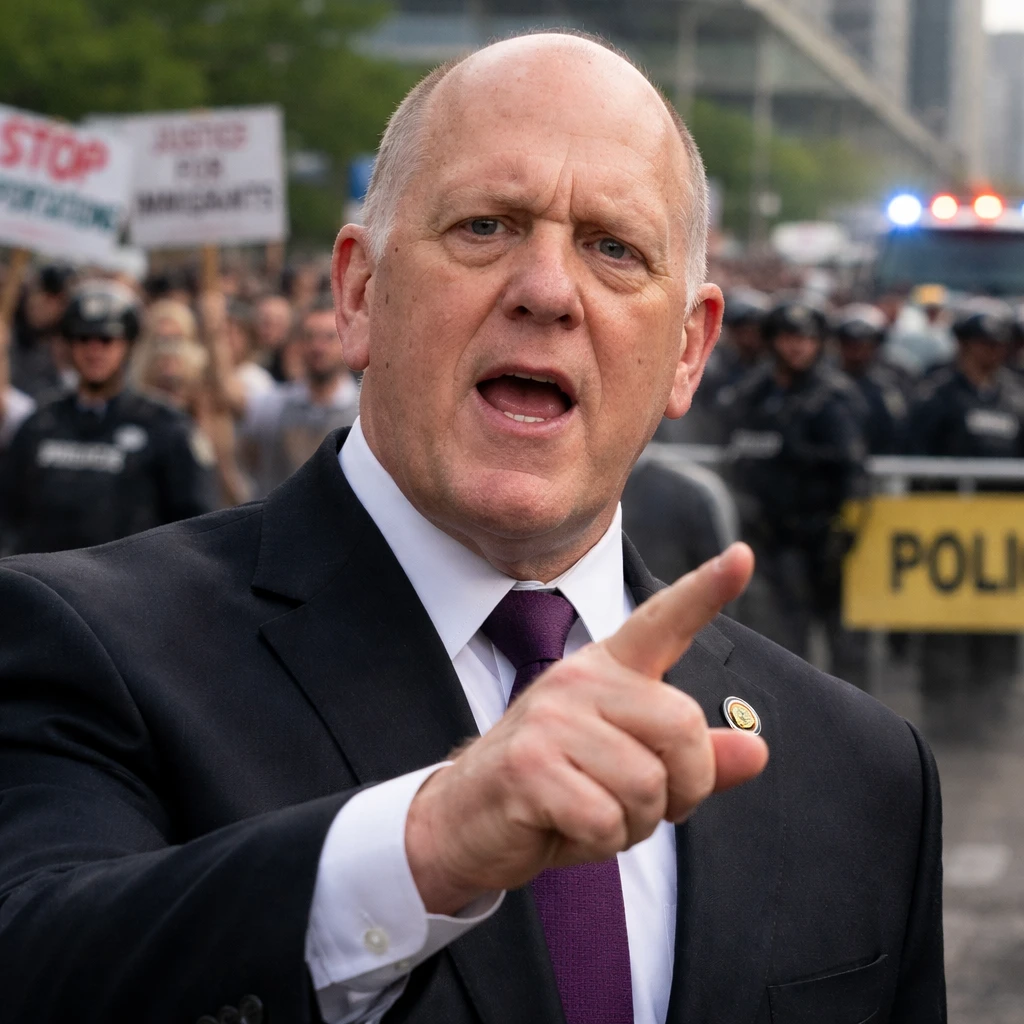
President Donald Trump revealed plans for Tom Homan, his appointed border czar, to travel to Minneapolis this week. This trip follows the death of an ICU nurse on Saturday in the Midwestern city, which has emerged as a central location of resistance to Trump’s stringent immigration policies and enforcement measures. The situation in Minneapolis comes amid escalating protests catalyzed by video evidence and eyewitness testimonies that question the official accounts issued by the Trump administration regarding Alex Pretti’s fatal shooting.
Homan’s visit coincides with mounting bipartisan demands for an impartial investigation into immigration enforcement strategies. These calls have intensified in the wake of another fatal shooting by immigration agents in Minneapolis, involving a different resident who was in her vehicle weeks prior. Understanding Homan’s background is essential to grasp the significance of his presence in the Twin Cities during this tense period.
Tom Homan, 64, embarked on his immigration enforcement career in 1984, initially serving as a Border Patrol agent. Upon the establishment of U.S. Immigration and Customs Enforcement (ICE) in 2003, Homan transitioned to the new agency, eventually leading ICE’s Enforcement and Removal Operations division during the Obama presidency. This unit is responsible for locating and deporting individuals with outstanding removal orders. Throughout his tenure, Homan maintained a relatively low profile but remained influential.
Despite his strong support for President Trump’s immigration agenda and vocal criticisms of President Joe Biden’s policies, some observers regard Homan as a more moderate voice within the enforcement community. He was notably associated with operations that led to family separations, reflecting the administration’s tough stance on immigration enforcement. His effectiveness in these roles was recognized with a Presidential Rank Award in 2015.
Following his retirement party in January 2017, an impromptu request from President Trump’s incoming Homeland Security Secretary, John Kelly, persuaded Homan to continue his service at ICE. After considering the offer, Homan accepted and became a key figure throughout Trump’s four years in office. Notably, the Obama administration reached a peak in deportations with 432,000 removals in 2013, whereas during Trump’s first term, deportations never exceeded 350,000 annually.
Upon his designation as border czar, Homan was perceived as an official who shared Trump’s ideological approach and possessed substantial practical experience in immigration policy enforcement. He publicly framed illegal immigration as a clear-cut issue and unapologetically supported policies targeting all individuals residing in the country without legal authority, rather than limiting focus to those with criminal records, public safety risks, or recent border crossings.
In a 2018 interview, Homan stated, “If you’re in the country illegally, you should be concerned,” comparing the risks of deportation to penalties for speeding or tax fraud. He acknowledged the personal difficulty of enforcing such policies, noting his empathy for affected families but emphasizing his obligation to carry out his duties. Furthermore, he indicated in separate discussions that resuming workplace enforcement operations, largely halted under the Biden administration, would be necessary.
Homan also committed to executing what he described as the largest deportation initiative in U.S. history by 2024. On the Fox News program “Sunday Morning Futures” that year, he emphasized prioritizing individuals deemed threats to public safety and national security, asserting that enforcement would proceed in a humane manner. He dismissed claims regarding mass neighborhood raids or the establishment of detention camps as “ridiculous.”
Addressing concerns about family separations, Homan insisted deportations could be conducted without dividing families, stating that families can be deported together. Despite these assertions, recent reports from Minnesota document ICE actions detaining individuals with legal immigration status, no criminal records, and even U.S. citizens, indicating enforcement practices that conflict with stated policy priorities.
Homan confronted allegations of corruption in September when reports surfaced that he accepted $50,000 from undercover FBI operatives posing as business personnel seeking government contracts, prompting a bribery investigation. This inquiry was subsequently closed by the Department of Justice under the Trump administration. The White House defended Homan, with Press Secretary Karoline Leavitt characterizing the situation as a politically motivated entrapment attempt by the Biden administration targeted at a prominent Trump supporter poised for a governmental role.
January 26, 2026
News & Politics
Tom Homan to Visit Minneapolis Amid Controversy Over Immigration Enforcement and Related Violence
Former ICE Leader’s Trip Aligns with Rising Demands for Investigations into Immigration Tactics Post-Tragic Shooting

Avery Klein
Senior Equity Analyst
Summary
Following the fatal shooting of an ICU nurse in Minneapolis, President Donald Trump has announced that Tom Homan, his designated border czar and former ICE official, will visit the city. This development arrives alongside growing unrest in Minneapolis related to immigration enforcement and increasing bipartisan calls for independent inquiry into federal immigration tactics. Homan, known for his longstanding career in immigration enforcement and his pivotal role during the Trump administration, faces a complex environment as demonstrations challenge official narratives and seek accountability.
Key Points
Tom Homan, former head of ICE Enforcement and Removal Operations, is visiting Minneapolis amid heightened tensions following a nurse's death linked to immigration enforcement actions.
Minneapolis has become a focal point for protests and scrutiny over immigration enforcement tactics, prompting bipartisan calls for independent investigations.
Homan has a four-decade career in immigration enforcement, combining staunch support for stringent immigration policies with criticism from opponents and some view as a moderate voice within the administration.
Risks
- Heightened civil unrest in Minneapolis and similar urban centers due to controversial immigration enforcement and related use of force could impact public safety and local economies.
- Political pressure for investigations into immigration enforcement may affect ICE operations and federal immigration policy implementation, influencing sectors related to labor and legal services.
- Allegations of corruption involving key immigration officials may undermine public trust and complicate enforcement agency leadership, potentially disrupting administrative functions in immigration and border management.
Disclosure
This article is based solely on the information provided and contains no speculative content or additional facts beyond the source material.