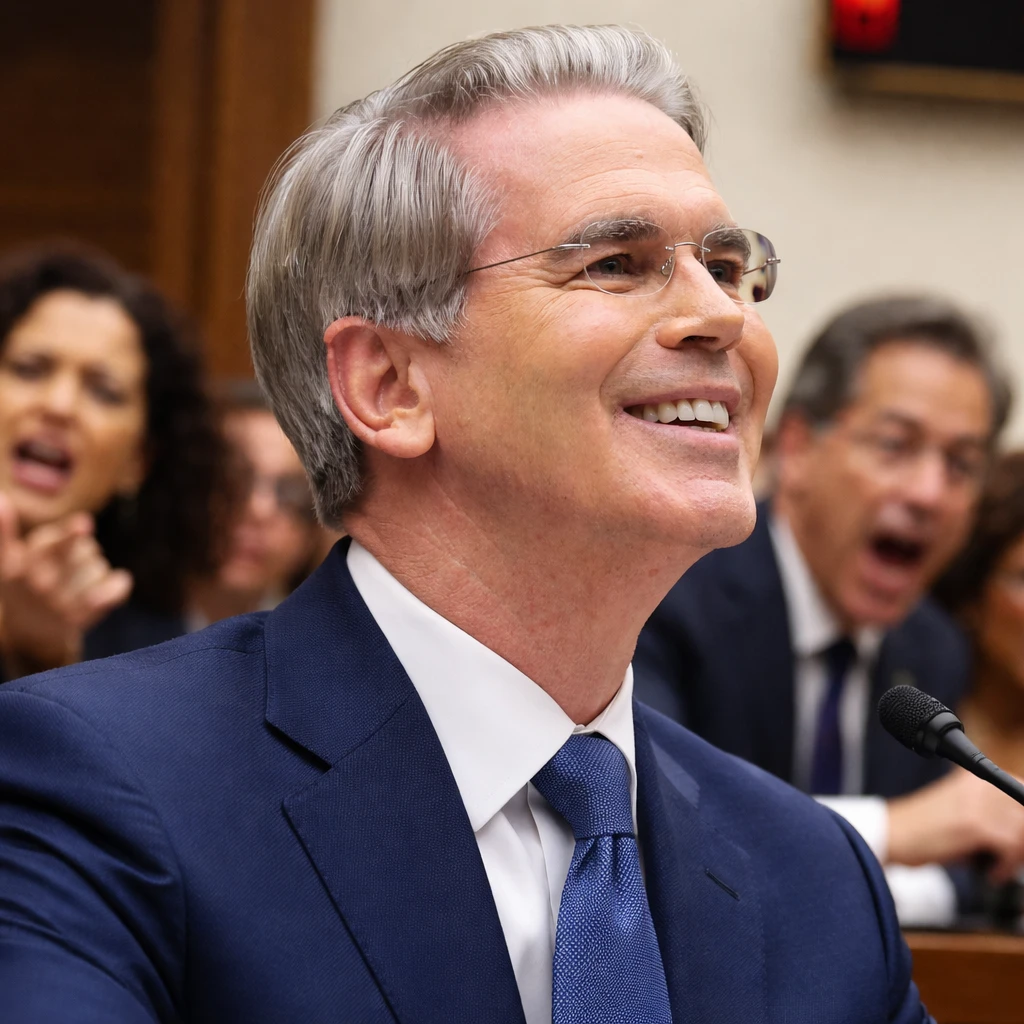

On Wednesday in Washington, the normally controlled setting of a Treasury Secretary’s congressional hearing transformed into a backdrop for multiple verbal disputes as Secretary Scott Bessent repeatedly clashed with Democratic legislators. The House Financial Services Committee’s meeting, centered on the oversight of financial regulations and the annual report from the Financial Stability Oversight Council, diverged from typical protocol with exchanges characterized by raised voices and sharp rebuttals.
The discussions touched on a variety of topics, including the influence of undocumented immigrants on nationwide housing affordability—a subject that sparked a direct exchange between Bessent and Representative Sylvia Garcia of Texas. When Garcia raised questions, Bessent dismissed her concerns by labeling her "confused," prompting an immediate retort from Garcia demanding respect and cautioning against belittling remarks.
Further agitation arose when Representative Stephen Lynch from Massachusetts inquired about the status of investigations into cryptocurrency companies. Bessent’s interruptions frustrated Lynch to the point that he called for decorum from the chairman, insisting that responses be relevant to maintain the hearing’s seriousness. Bessent countered, arguing that the questions themselves needed to meet a standard of seriousness.
California Democrat Maxine Waters intervened during a debate about tariffs and inflation, appealing to committee leaders to quiet Bessent amid back-and-forth accusations regarding the nature of price increases impacting consumers.
A particularly heated moment occurred when Representative Gregory Meeks of New York confronted Bessent on the topic of an investment by the Abu Dhabi royal family in the Trump family’s cryptocurrency firm, World Liberty Financial, dating back to the previous year. Meeks vocally accused Bessent of acting as an enabler for the President, resorting to profane language while urging him to stop "being a flunky." The Treasury Department had not issued any comments responding to these confrontations as of the end of the session.
Graham Steele, a former assistant secretary for financial institutions during Janet Yellen’s tenure as Treasury Secretary, remarked on the unusual nature of Bessent’s conduct. Steele noted that Treasury officials typically avoid direct political combat on Capitol Hill, even when addressing contentious policy discussions. He recalled that while past secretaries occasionally faced tense questioning, these interactions rarely became personal attacks. The role requires a judicious balance between supporting the White House and maintaining the Treasury’s reputation internationally.
Steele emphasized that prior exchanges he witnessed, such as those involving climate change debates, maintained a professional tone that was absent in Bessent’s recent confrontations. The combative style marks a significant departure from tradition.
Bessent’s confrontational rhetoric is not isolated to the recent hearing. In prior public statements, he has disparaged Democratic figures with provocative language, calling California Governor Gavin Newsom “economically illiterate,” likening him to a fictional serial killer, and referring to Massachusetts Senator Elizabeth Warren as an "American Peronist" following her criticism of American financial support for Argentina during the Trump administration.
David Lublin, chair of the government department at American University’s School of Public Affairs, views Bessent’s aggressive posture as reflective of the current political climate influenced by former President Trump’s preference for staunch defenders. Lublin noted that the conventional respect historically afforded to Congress has eroded significantly in recent years.
Lublin pointed out that Bessent’s rare public commentary on monetary policy, typically under the Federal Reserve’s domain, coupled with his support for the President's right to influence central bank decisions, signals a notable shift. This dynamic represents a cabinet secretary openly endorsing presidential efforts that potentially undermine established economic institutions.
Bessent is set to face further congressional scrutiny on Thursday before the Senate Banking, Housing and Urban Affairs Committee, where he will again address the Financial Stability Oversight Council’s annual report and respond to lawmakers’ questions.