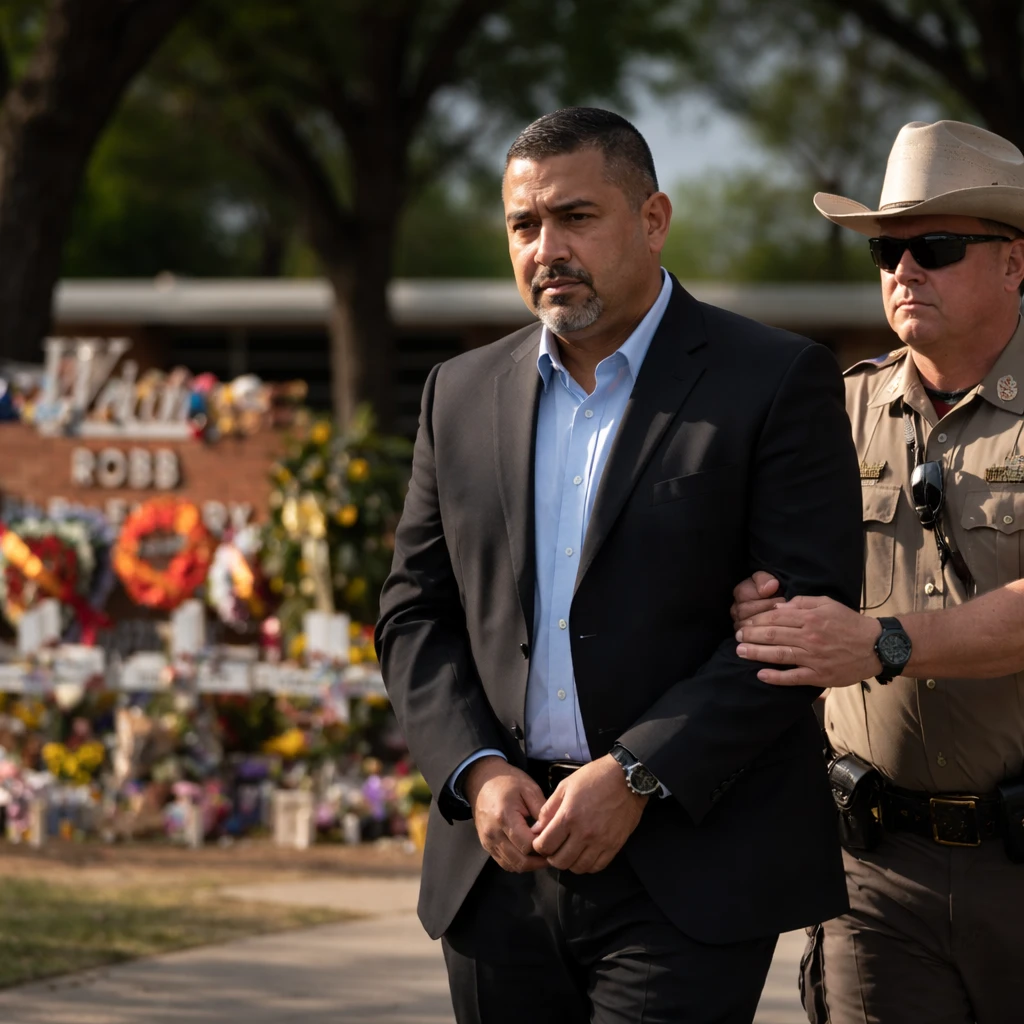

On Monday in Corpus Christi, Texas, the trial commenced for Adrian Gonzales, a former police officer assigned to Uvalde schools, who stands accused on 29 counts of child abandonment or endangerment. The charges arise from Gonzales’ role during the 2022 Robb Elementary School shooting, a devastating event during which a teenage gunman claimed the lives of 19 students and two teachers. Gonzales was among the earliest responders to the incident, yet authorities delayed more than an hour before confronting and neutralizing the assailant, Salvador Ramos.
The Uvalde tragedy prompted the deployment of nearly 400 law enforcement personnel spanning local, state, and federal agencies. Despite this substantial response, tactical teams did not breach the classroom for 77 minutes following arrival, allowing the gunman to inflict fatal injuries. Investigations later revealed Ramos exhibited an obsession with violence and seeking notoriety in the months preceding the attack.
Adrian Gonzales and Pete Arredondo, the former Uvalde schools police chief, were among the initial law enforcement officials at the scene. Notably, they are the only two officers currently facing criminal proceedings regarding the delayed intervention. Arredondo’s trial remains unscheduled. Gonzales has entered a plea of not guilty, and his legal representation maintains that he endeavored to save children during the crisis.
Initial public statements from Uvalde police and Texas Governor Greg Abbott claimed that law enforcement swiftly acted to kill Ramos, thereby saving lives. These assertions rapidly unraveled as family members described pleading for police to enter the building, and 911 recordings surfaced with students desperately seeking assistance. The indictment alleges that Gonzales’ failure to engage or implement active shooter protocols placed children in imminent danger. The charges state that despite hearing gunfire and being informed of the shooter’s location, Gonzales did not advance toward the threat to distract or delay Ramos as trained.
Reviews conducted at state and federal levels cited systemic shortcomings including inadequate training, communication failures, leadership deficiencies, and technological gaps within law enforcement responses. These inquiries questioned the prolonged delay before officers moved to confront the shooter. The state report indicates that Gonzales informed investigators he participated in evacuating students remaining in classrooms once police realized their presence.
Among the victim families, some have advocated for additional indictments. Velma Lisa Duran, whose sister Irma Garcia was one of the slain teachers, criticized the overall police response, emphasizing a collective failure that resulted in loss of life. Prosecutors confront substantial challenges in securing convictions in such cases, given the frequent reluctance of juries to convict officers for inaction, as observed following the 2018 Parkland, Florida school shooting. That case involved sheriff’s deputy Scot Peterson, who was acquitted in 2023 despite charges that he failed to confront the attacker.
Gonzales’ defense team successfully requested that the trial be relocated approximately 200 miles southeast from Uvalde to Corpus Christi, arguing the potential for an impartial jury was compromised. Prosecutors did not oppose this move. The trial is anticipated to span up to three weeks, beginning with jury selection.
Uvalde, a community of approximately 15,000 residents, continues to bear visible reminders of the tragedy. Robb Elementary remains closed but intact, accompanied by memorials such as 21 crosses and floral tributes near the school entrance, a downtown plaza monument, and murals honoring victims on surrounding buildings. Family members, including Jesse Rizo—whose nine-year-old niece Jackie was among those killed—stressed the importance of representing the victims during the proceedings despite the distance to Corpus Christi.
The charges against Gonzales carry potential penalties of up to two years imprisonment upon conviction. The trial will examine the officer’s decisions and conduct amid one of the deadliest school shootings in United States history, alongside broader implications for law enforcement protocols and accountability.