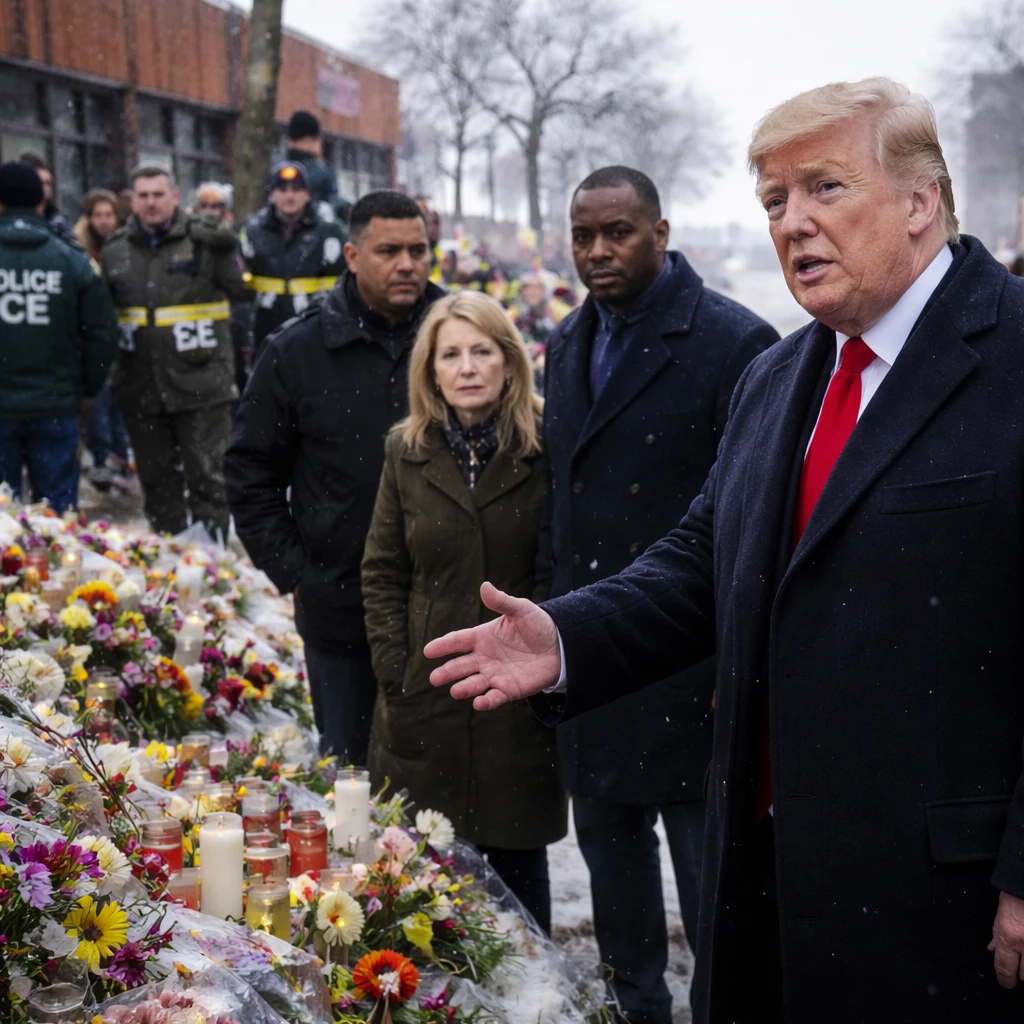

In the wake of the second fatal shooting by federal agents in Minnesota this month, President Donald Trump adjusted his policy and rhetoric toward state Democratic officials and immigration enforcement efforts on Monday. This shift came after considerable backlash and concern, including from members of his own party, regarding the administration's forceful actions against undocumented immigrants and responses to protests opposing these measures.
The pivot follows the death of Alex Pretti on Saturday, an incident involving federal agents that cast doubt on the administration's aggressive deportation strategy and its handling of dissent. Critics questioned the approach's appropriateness and raised alarms about the use of lethal force, challenging narratives presented by White House officials.
This episode adds to a series of occasions where President Trump initially embraced a maximalist and confrontational position before moderating or reversing course. For example, earlier in the month, Trump threatened military action against Iran over the regime's suppressive response to antigovernment protests. Despite reports by human rights organizations of significant casualties, Trump indicated restraint after Tehran communicated plans to halt numerous executions.
Similarly, the president initially announced plans for tariffs targeting European allies that resisted U.S. ambitions concerning Greenland — a move swiftly rescinded following the establishment of an undefined "framework" deal. This policy reversal occurred against the backdrop of a notable stock market downturn attributed to tariff-related investor concerns.
Turning to Minnesota, the White House modified the management of immigration enforcement operations. Trump adopted a notably tempered tone with Governor Tim Walz, a Democrat critical of federal immigration policies, after their conversation. The president described their exchange as placing them on a "similar wavelength," marking a departure from his usual combative style toward local Democratic leadership.
Some longstanding Trump supporters expressed discomfort with the federal agents' conduct in Minneapolis. The president had previously committed to unwavering enforcement, including mass deportations of undocumented immigrants, as a 2024 campaign centerpiece. His past remarks often included pointed attacks against Governor Walz and other Minnesota Democrats resisting his immigration policies.
In an operational development, Trump announced the deployment of border czar Tom Homan to supervise activities in Minnesota. A senior Border Patrol official, Greg Bovino, along with other agents, was expected to withdraw from Minneapolis starting Tuesday. Trump publicized these moves on social media, noting that Governor Walz welcomed Homan's appointment.
Minneapolis Mayor Jacob Frey confirmed that some federal agents would be pulled back following discussions with the president. Frey suggested the administration recognized the unsustainable nature of current federal operations in the city. A meeting between Homan and Frey was scheduled for Tuesday to discuss the situation further.
Republican voices voiced reservations about the latest Minneapolis shooting. Several high-ranking government officials had initially characterized Pretti as a domestic terrorist, even as available videos challenged this depiction. This discrepancy intensified scrutiny from within the GOP and among the wider political spectrum.
In a political repercussion, GOP gubernatorial candidate Chris Madel, an attorney from Minneapolis, ended his campaign in a surprise announcement. Madel criticized the immigration enforcement operation in the Twin Cities as an "unmitigated disaster" and expressed disillusionment with the Republican Party over its handling of the matter.
Meanwhile, Republican governors Greg Abbott of Texas and Phil Scott of Vermont advocated for a strategic reassessment. Abbott, a fervent Trump ally on immigration, suggested recalibrating federal actions in Minnesota during a conservative radio interview. Scott called for de-escalation, labeling the federal operations as a coordination failure at best, or at worst, deliberate intimidation resulting in American casualties.
The public exchange between Trump and Governor Walz stands in sharp contrast to previous rhetoric. Only one day prior, Stephen Miller, Trump’s deputy chief of staff, harshly criticized Walz on social media, accusing the governor of inciting attacks on immigration agents. The White House’s social media accounts further disparaged Walz with personal attacks.
In the aftermath of the shooting, high-profile administration figures labeled Pretti, a nurse at a Veterans Affairs hospital and intensive care unit staffer, as a "would-be assassin" and accused her of domestic terrorism. The White House did not clarify whether the president endorsed such characterizations or whether any retraction or apology might be issued. Press Secretary Karoline Leavitt emphasized that the incident was under investigation and affirmed the administration’s stance against harm to U.S. citizens.
Compared to other politically charged deaths, Trump's public response to the deaths of Pretti and Renee Good—both U.S. citizens killed by federal agents in Minnesota—has been measured and subdued. In contrast, he reacted swiftly and forcefully to the assassination of conservative activist Charlie Kirk and the shooting of National Guard members in Washington, describing those events in starkly condemnatory terms during national addresses.
Following the fatal shooting in Minneapolis, the president's communications have largely been confined to social media updates. Despite attempts to soften rhetoric during Monday’s remarks, White House spokesperson Leavitt continued to fault Governor Walz and other Minnesota Democrats for allegedly encouraging confrontations with federal officers engaged in lawful duties. She cited this dynamic as a factor leading to the incident over the weekend.
The controversies sparked by federal operations in Minnesota expose underlying tensions both within the Republican Party and between federal and local authorities regarding immigration enforcement, public safety, and political discourse. The situation remains fluid, with ongoing assessments and negotiations expected.