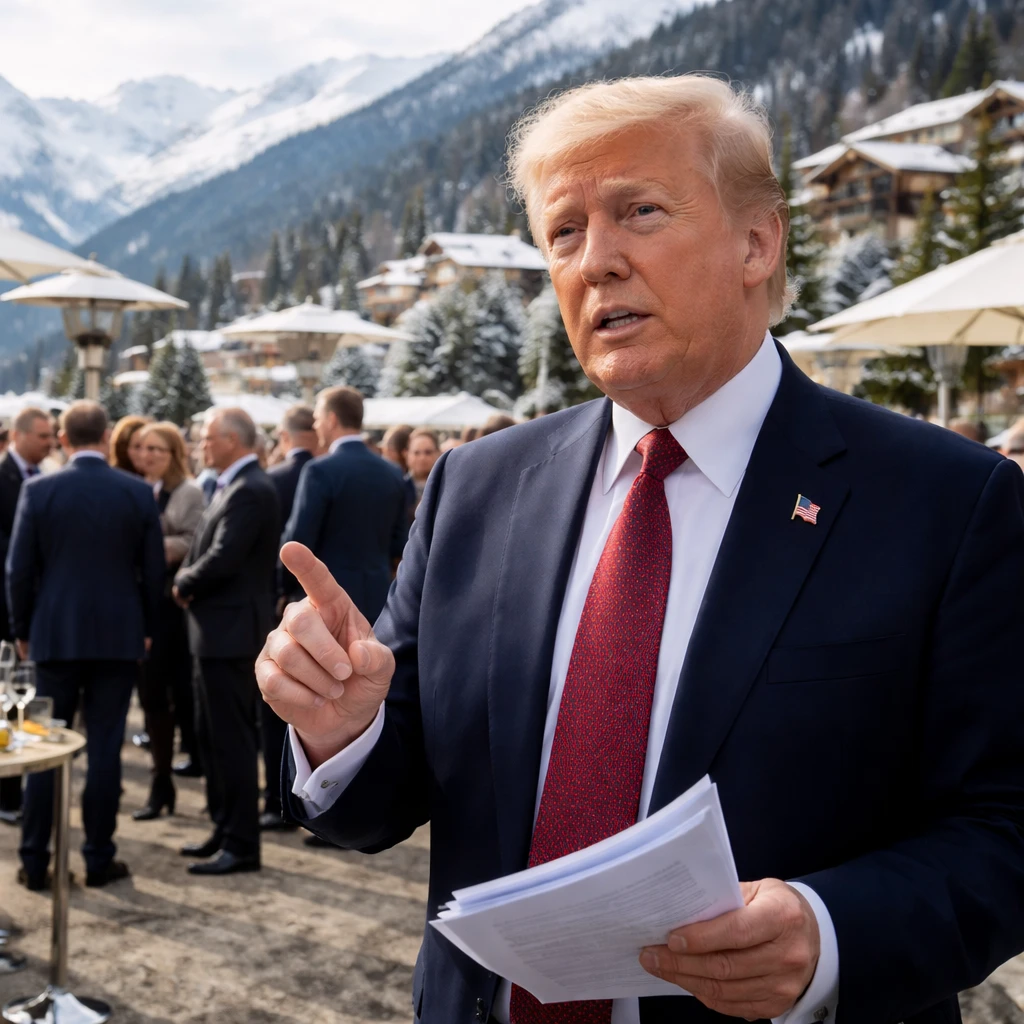

President Donald Trump is set to deliver a major speech on housing affordability this Wednesday at the World Economic Forum in Davos, Switzerland. Notably, this prestigious event is held in a locale synonymous with luxury, where vacation chalets can fetch prices upwards of $4.4 million, a stark contrast to the economic struggles faced by many Americans.
The timing coincides with the anniversary of Trump's return to office. The Davos forum convenes leaders from across the globe's wealthiest and most influential sectors, a circle in which Trump has increasingly positioned himself during his first year back as President. While his 2016 presidential campaign was marked by populist rhetoric about lowering living costs and connecting to working-class voters—symbolized by an iconic moment serving fast food at a drive-thru—his tenure has so far been more closely associated with engagement alongside billionaires and elites rather than direct outreach to the everyday American family.
Observers from progressive groups like Groundwork Collaborative note that Trump's focus appears firmly fixed on investors and billionaires, rather than on those grappling with high bills and shrinking purchasing power. Alex Jacquez, the group’s chief of policy and advocacy, highlighted this disconnect: "At the end of the day, it’s the investors and billionaires at Davos who have his attention, not the families struggling to afford their bills." This trend aligns with a broader shift in Trump's priorities since his return to the presidency, where foreign policy challenges—namely conflicts in Gaza, Ukraine, and Venezuela—have dominated his agenda. Among Davos topics, Trump's intrigue over acquiring Greenland has drawn substantial media and diplomatic attention, overshadowing his cost-of-living initiatives.
Regarding Greenland, Trump acknowledged resistance from Europe, commenting to reporters on Monday evening, "Let’s put it this way: It’s going to be a very interesting Davos." The White House has concurrently sought to steer narrative focus to affordability, responding to concerning polling data in a year marked by midterm congressional elections. Recent findings from the Associated Press-NORC Center for Public Affairs Research indicate nearly 60% of American adults believe Trump's policies have worsened the cost of living. Supporters within the Republican base similarly express dissatisfaction, with only 16% asserting significant progress on affordability, a notable decline from 49% recorded in April 2024.
Trump pins his economic optimism on attracting commitments from the ultra-wealthy and foreign investors, aiming to stimulate job creation. However, these overtures exist alongside broad tariffs that appear to have constrained labor markets and fueled inflationary pressures. Rally attendees at Trump’s renewed campaign events are encouraged to trust his business acumen and network will ultimately benefit working-class Americans. Yet political analysts caution that voters prioritize economic realities more than affiliations with billionaires, who themselves remain widely unpopular. Frank Luntz, a Republican strategist, underscored the crucial importance of affordability in voter decision-making, noting the widespread unpopularity of billionaires and their limited resonance with average voters.
Since Trump's initial term beginning in 2017, data from the Federal Reserve reveals the nation's wealthiest 0.1% have more than doubled their wealth by $11.98 trillion, reaching $23.46 trillion. In stark contrast, the bottom half of U.S. households have seen a comparatively modest net worth increase of $2.94 trillion over the same period. Housing affordability remains at the forefront of public concerns. Trump's recent proposals include purchasing $200 billion in mortgage debt to lower interest rates and banning large financial entities from buying homes. Critics argue these policies do not address the fundamental issues in housing markets, namely a prolonged shortage of home construction coupled with rapidly rising home prices relative to wages.
Throughout his first year, Trump has emphasized policies that favor wealthy investors, believing their capital injections will stimulate broader economic growth. His administration has advanced initiatives favorable to billionaires, including regulatory relaxations, reduced IRS enforcement activities, and targeted tax cuts. These moves have aimed to secure large-scale investments but have drawn criticism regarding inequality. Darrell West, a senior fellow at the Brookings Institution, notes that the interests of the ultra-wealthy—primarily tax relief and deregulation—often conflict with policies that would provide meaningful assistance to working-class Americans.
Trump has also promoted tax breaks on tips and overtime remuneration as part of the "One Big Beautiful Bill," a measure proposed to benefit workers. Nonetheless, analyses by the Congressional Budget Office suggest that middle-class families would realize modest average savings between $800 and $1,200 annually, while the wealthiest 10% would gain substantially higher benefits, averaging $13,600 in tax relief. Further, the Tax Policy Center estimates millionaires may see tax savings of approximately $66,510 this year alone.
The President’s close ties with billionaires are evident in frequent public appearances and collaborations involving prominent industry leaders. His travels and negotiations alongside wealthy investors from both the United States and abroad have been heralded as drivers for expanding factory jobs and economic opportunity for middle-class Americans. At a high-profile dinner with technology magnates such as Bill Gates, Tim Cook, Sergey Brin, and Mark Zuckerberg, Trump expressed admiration for their intellect and presence, highlighting the unique gathering of what he described as a "high-IQ group."
White House representatives have defended this approach, contrasting it with prior administrations that, they claim, alienated the business sector. Spokesman Kush Desai asserted that Trump’s pro-growth policies and relationships with industry leaders have led to massive investment commitments promising job creation. In a recent publicized event, Trump celebrated a $6.25 billion charitable donation from Michael Dell to investment accounts benefiting children, framing it as a dialogue on economic inequality, while simultaneously showcasing his access to billionaire support.
Trump routinely engages with billionaires and CEOs through phone calls and meetings to discuss subjects ranging from business initiatives to political strategy and projects such as his proposed White House ballroom. Public addresses often include references to notable figures like Jensen Huang of Nvidia, whose net worth is estimated at $162 billion. Members of Trump’s inner circle include billionaire figures like Commerce Secretary Howard Lutnick and Special Envoy Steve Witkoff, both with multi-billion-dollar net worths. Trump also involved Elon Musk in efforts to reduce government payrolls before their public disagreements and subsequent reconciliation.
White House Press Secretary Karoline Leavitt recently characterized Trump’s own billionaire status as a factor in his broad voter appeal, citing his business experience and economic understanding as reasons for his reelection. The dynamic between appealing to high-net-worth individuals while addressing the economic concerns of the broader population remains a defining challenge for Trump’s administration and political future.