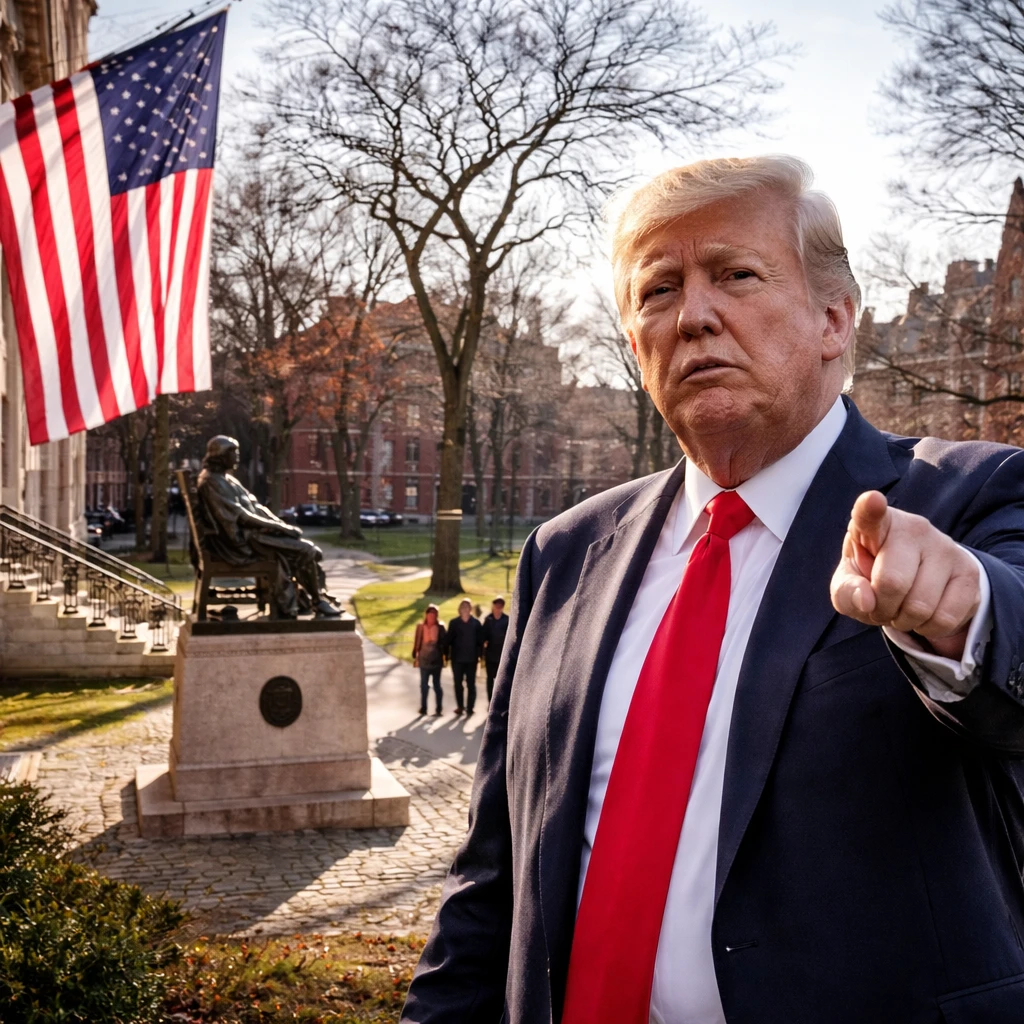

President Donald Trump has significantly increased his financial demand from Harvard University to $1 billion, marking a notable escalation in the ongoing conflict between the administration and the Ivy League institution. This new demand doubles the previous amount sought and signals a hardened stance as talks show no signs of resolution.
On Monday night, Trump took to his social media platform, Truth Social, to publicly express his dissatisfaction with Harvard's conduct during the dispute, describing the university as "behaving very badly." He insisted that any agreement must include a direct payment to the federal government, a condition Harvard has resisted, and indicated that his administration seeks to sever future engagements with the university.
These comments were in direct response to a report suggesting that Trump had softened his position by dropping financial payment demands from Harvard, a claim the president categorically denied. Harvard officials have not issued a statement addressing these developments.
Earlier sentiments from Trump had conveyed optimism about reaching an agreement. Last June, he stated that a deal appeared imminent and praised Harvard for having acted "extremely appropriately" during negotiations. The prospective agreement at that time would have required Harvard to allocate $500 million toward the establishment of multiple trade schools, rather than making a direct payment to the government.
However, this proposal has since been dismissed. Trump criticized the trade school plan as "convoluted" and deemed it "wholly inadequate," effectively indicating the collapse of that arrangement.
The dispute is part of a broader campaign by the Trump administration targeting elite universities including Harvard. Notably, Harvard has experienced substantial cuts to its federal research funding and efforts by the administration to restrict admissions of foreign students — actions initiated after the university resisted several government demands starting last April. The White House has cited Harvard's tolerance of anti-Jewish bias on campus as justification for these measures.
Harvard has challenged these actions through multiple lawsuits, arguing that the administration is unfairly penalizing the institution for opposing its policy views. In December, a federal judge reversed the government’s funding cuts, criticizing the administration's antisemitism rationale as a "smokescreen."
Additional elements of the administration's approach to higher education also face challenges. A program inviting universities to join a "compact" offering funding priority in exchange for compliance with administration policies failed to attract any participants. Moreover, the government withdrew its defense of a Department of Education directive threatening to cut funding to institutions implementing diversity, equity, and inclusion initiatives.
Upon commencing his second term, President Trump prioritized targeting influential universities, accusing them of being dominated by liberal ideologies and anti-Jewish bias. The suspension of critical research funding jeopardizes the scientific and medical research infrastructure that these institutions support.
Some universities have negotiated settlements to restore funding, with agreements occasionally involving direct payments to the government. For instance, Columbia University agreed to a $200 million payment, while Brown University committed $50 million toward the development of state workforce groups.