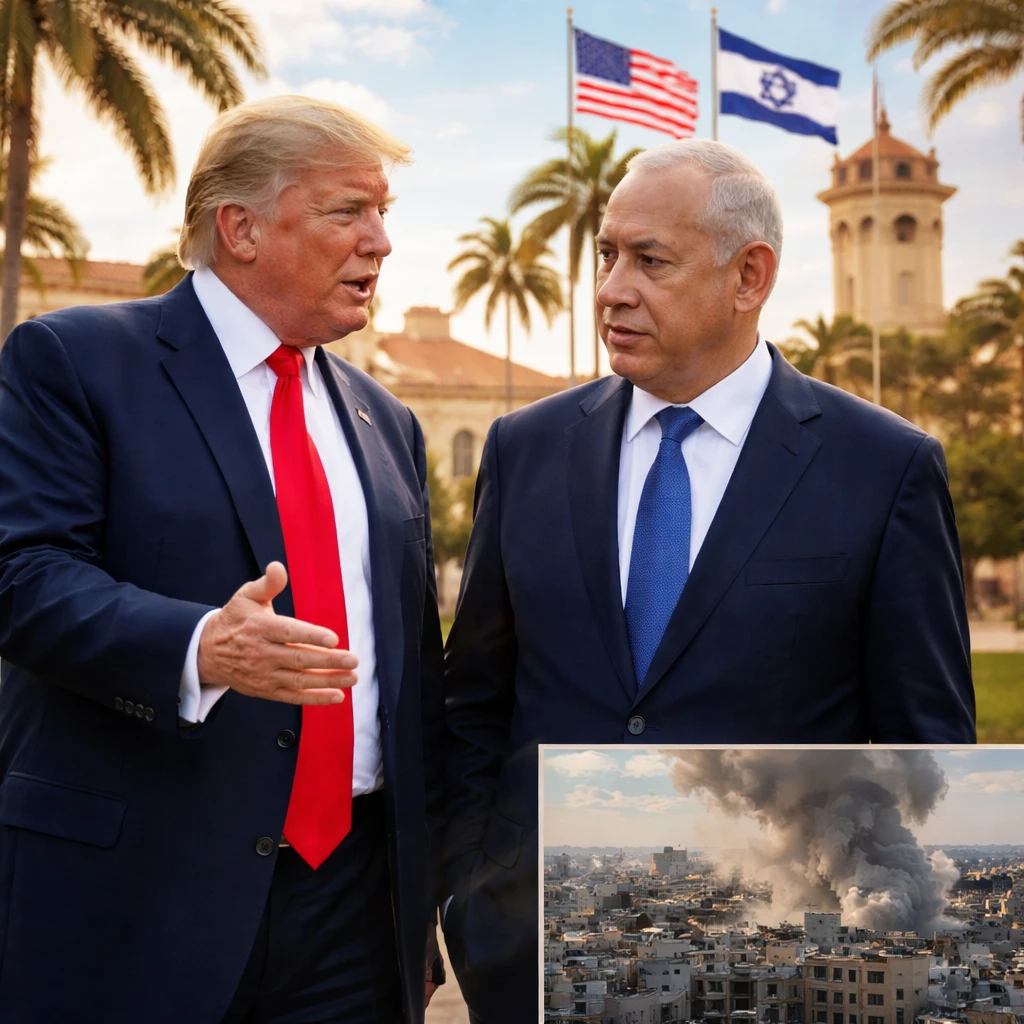

At Mar-a-Lago in Palm Beach, Florida, President Donald Trump plans to meet Israeli Prime Minister Benjamin Netanyahu on Monday, seeking to inject new impetus into the U.S.-brokered ceasefire in Gaza which faces challenges as it moves towards a complex second stage. The meeting offers Trump a platform to capitalize on his rapport with Netanyahu to accelerate the peace process, amid criticisms directed at Israel's leader for not advancing the ceasefire efforts rapidly enough.
The ceasefire, an initiative championed by Trump, has generally endured, yet recent weeks have seen a slowdown in progress, with both Israel and Hamas accusing each other of breaches. Divergent views have also emerged among the United States, Israel, and Arab nations on the appropriate way forward. The initial phase of the truce commenced in October, closely following the second anniversary of the Hamas-directed attack on Israel, which resulted in approximately 1,200 Israeli deaths. Since then, nearly all 251 hostages taken during that assault have been released alive or deceased.
Attention now turns to a more intricate second phase. Central to this phase is Trump's 20-point plan, sanctioned by the U.N. Security Council, outlining a comprehensive framework intended to terminate Hamas' governance over Gaza. The plan envisions establishing a demilitarized Gaza overseen by an international body termed the Board of Peace, chaired by Trump himself.
This Board of Peace would supervise Gaza's reconstruction efforts, which are expected to unfold under a renewable two-year U.N. mandate. It also anticipates Palestinians forming a "technocratic, apolitical" committee to manage daily civil affairs under the Board’s guidance. Furthermore, the plan advocates for normalized relations between Israel and Arab countries, coupled with a potential pathway toward Palestinian statehood. Other elements include disarmament of Hamas and the establishment of the International Stabilization Force, a proposed multinational security entity tasked with maintaining peace.
However, significant reservations remain. Observers note that Netanyahu opposes or does not endorse several key components of the second phase. Mona Yacoubian, director and senior adviser of the Middle East Program at the Center for Strategic and International Studies, describes the endeavor to secure Netanyahu's agreement as a "really tall order" for President Trump. She emphasizes that the dynamics of pressure applied, as well as potential clashes over broader regional strategies, will be critical to observe.
The agenda during the Mar-a-Lago meeting might also address issues beyond Gaza, including Iran’s nuclear developments. Trump continues to assert that U.S. military operations in June successfully eliminated Iran’s nuclear capability, a statement underscoring ongoing regional security concerns.
Recent efforts by U.S. special envoy Steve Witkoff and presidential advisor Jared Kushner, involving talks in Florida with representatives from Egypt, Qatar, and Turkey—key ceasefire mediators—highlight the diplomatic activity underpinning the process. Despite these dialogues, two central obstacles impede advancement to the next phase. Firstly, Israel has been slow in vetting and approving candidates for the Palestinian technocratic committee from mediator-submitted lists. Secondly, Israel has maintained military strikes in Gaza concurrently with ceasefire negotiations.
The planned International Stabilization Force remains unrealized and contentious. A Western diplomat, speaking anonymously, points to a ‘‘huge gulf’’ in expectations; where the U.S. and Israel envision the force having a commanding security role including Hamas disarmament, some other regional and European stakeholders fear such authority might resemble an occupying entity. Hamas remains adamant about retaining the right to armed resistance as long as Israeli occupation persists but has expressed willingness to consider "freezing or storing" its arms. One U.S. official mentioned discussions of possible financial incentives for weapons surrender, reflecting earlier proposals akin to a "buy-back" scheme.
The issue of Gaza’s reconstruction presents yet another complex hurdle. Israeli bombardments and ground operations have left extensive destruction in multiple Gaza cities. Arab nations such as Egypt, Qatar, Saudi Arabia, and Turkey advocate for negotiations that incorporate Hamas’ disarmament and further Israeli withdrawal before progressing to reconstruction and deployment of the stabilization force. This stance appears at odds with some U.S.-proposed plans to initiate rapid temporary housing construction for Palestinians within Israeli-controlled zones in southern Gaza.
According to a U.S.-prepared map obtained by TradeIQAI, an area marked as a “UAE Temporary Emirates housing complex” lies within Israeli-controlled Gaza territories. This is surrounded by a “U.S. planned community area.” While an Arab official acknowledged awareness of the map, he characterized it as a suggestion jointly presented to the UAE and other nations on behalf of the U.S. and Israel. The UAE has not confirmed any commitment to these reconstruction projects nor specified if funding would be conditional on political developments such as Palestinian statehood recognition or Hamas disarmament.
This planned summit marks the first in-person meeting between Trump and Netanyahu since the latter’s visit to Israel in October for the ceasefire launch. Netanyahu’s previous visit to Mar-a-Lago was in July 2024 during Trump’s reelection campaign period.
With numerous unresolved issues and stakeholder discord, the outcome of the Mar-a-Lago talks will be critical in determining the trajectory of the Gaza ceasefire and broader Middle Eastern peace efforts.