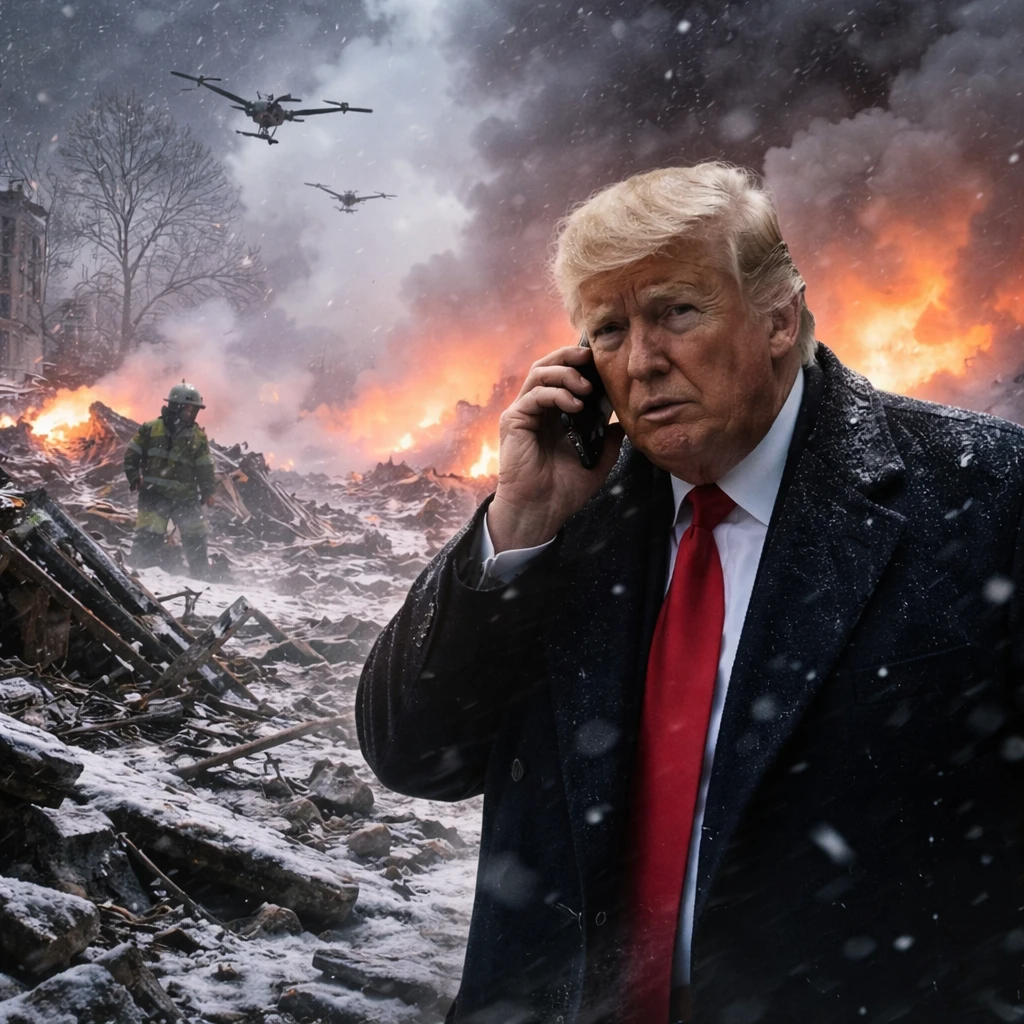

In a recent declaration, U.S. President Donald Trump stated that he personally requested Russian President Vladimir Putin to suspend targeting Ukraine's capital, Kyiv, for a period of one week to help citizens endure the intensified winter cold. Trump claimed that Putin agreed to this pause, although no official confirmation has come from Russian authorities.
The appeal for a temporary halt in strikes centers on Russia's ongoing bombardment of critical infrastructure in Ukraine, which has severely disrupted heating and power supply amid a particularly unforgiving winter season. Trump emphasized the humanitarian concern by highlighting the need to protect residents from the "extraordinary cold." He noted during a White House Cabinet meeting that the ceasefire would aid not only Kyiv but other towns and cities also impacted by the conflict.
Despite Trump's announcement, Kremlin spokesperson Dmitry Peskov declined to comment on discussions concerning any mutual suspension of attacks focused on energy facilities. The uncertainty leaves the veracity of the claimed agreement unclear.
Kyiv braces for a harsh cold spell beginning Friday, expected to extend into the following week. Trump expressed satisfaction about the supposed agreement, stating that many had doubted that Putin would comply with his request, yet he asserted that the Russian leader had indeed consented.
The strategy of targeting Ukrainian infrastructure has been characterized by Ukrainian officials as an effort to "weaponize winter," aiming to deprive civilians of heat and water in hopes of undermining public resistance against Russia's full-scale invasion initiated in February 2022.
Human rights groups reported that the past year was the deadliest for Ukrainian civilians since the conflict began, as Russia heightened aerial attacks behind the front lines. The United Nations Human Rights Monitoring Mission documented 2,514 civilian deaths and over 12,000 injuries, marking a significant increase from previous years.
During the overnight hours, a Russian drone strike in the southern Zaporizhzhia region resulted in three civilian deaths by setting fire to an apartment building. Emergency responders also battled fires throughout the night in Dnipropetrovsk's central zone, where two more individuals were injured.
Ukrainian President Volodymyr Zelenskyy cautioned that intelligence points to preparations by Moscow for another large-scale assault. Earlier raids have involved hundreds of drones as well as cruise and ballistic missile launches aimed largely at Ukrainian energy infrastructure, seeking to disrupt power availability across the nation.
Zelenskyy criticized the continued Russian assaults as undermining peace efforts, stating that each attack diminishes the credibility of ongoing diplomatic negotiations scheduled for the upcoming weekend and brokered by the United States.
In an effort to counteract Russian drone usage, Ukrainian Defense Minister Mykhailo Fedorov disclosed engagement with SpaceX to address reports that Russian attack drones have employed the Starlink satellite network operated by the company. With around 10,000 satellites constituting Starlink's global internet coverage, Fedorov mentioned coordinated steps underway to resolve the issue, expressing gratitude to SpaceX leadership for prompt responsiveness.
SpaceX, under Elon Musk's leadership, has navigated a complicated role by providing connectivity to Ukraine while simultaneously restricting the system's military applications, according to company statements. The Russian drone assaults continue to cause widespread hardship in Ukraine as they disrupt essential utilities during the coldest winter in years, with forecasts warning temperatures could plunge to minus 30 degrees Celsius (minus 22 Fahrenheit) in certain areas.
Negotiations between Ukraine and Russia are slated to resume shortly, though skepticism remains regarding Moscow's genuine commitment to peace. The European Union's top diplomat criticized Russia for treating the talks without seriousness and called for increased pressure on Moscow to encourage concessions. The increased attacks on civilian populations, she suggested, are indicative of Russia's inability to make progress on the battlefield.
The involvement of European leaders in the peace process has been emphasized, as the continent views the conflict's resolution as critical to its own security outlook. Despite leading peace efforts in the past year, the U.S. administration's role faces concerns over balancing European interests.
Recent data from an international think tank reveals the war's staggering toll with an estimated two million soldiers killed, injured, or missing on both sides by spring, with Russian military fatalities reaching unprecedented levels for a major power in modern conflict history. Ukrainian Defense Minister Fedorov reported over 6,000 drones launched by Russia in the past month alone, highlighting Russia's ongoing advancement in drone technology and tactics, which has prompted Ukraine to adjust its air defense approaches.
Concurrently, both countries have engaged in exchanges of fallen soldiers' bodies; Russia reportedly returned approximately 1,000 bodies to Ukraine, while Ukraine has handed over 38 Russian soldiers' remains.
The war, now approaching its fourth year, remains characterized by relentless hostilities, extensive civilian suffering, and fragile diplomatic efforts seeking to halt the bloodshed and establish a lasting peace.