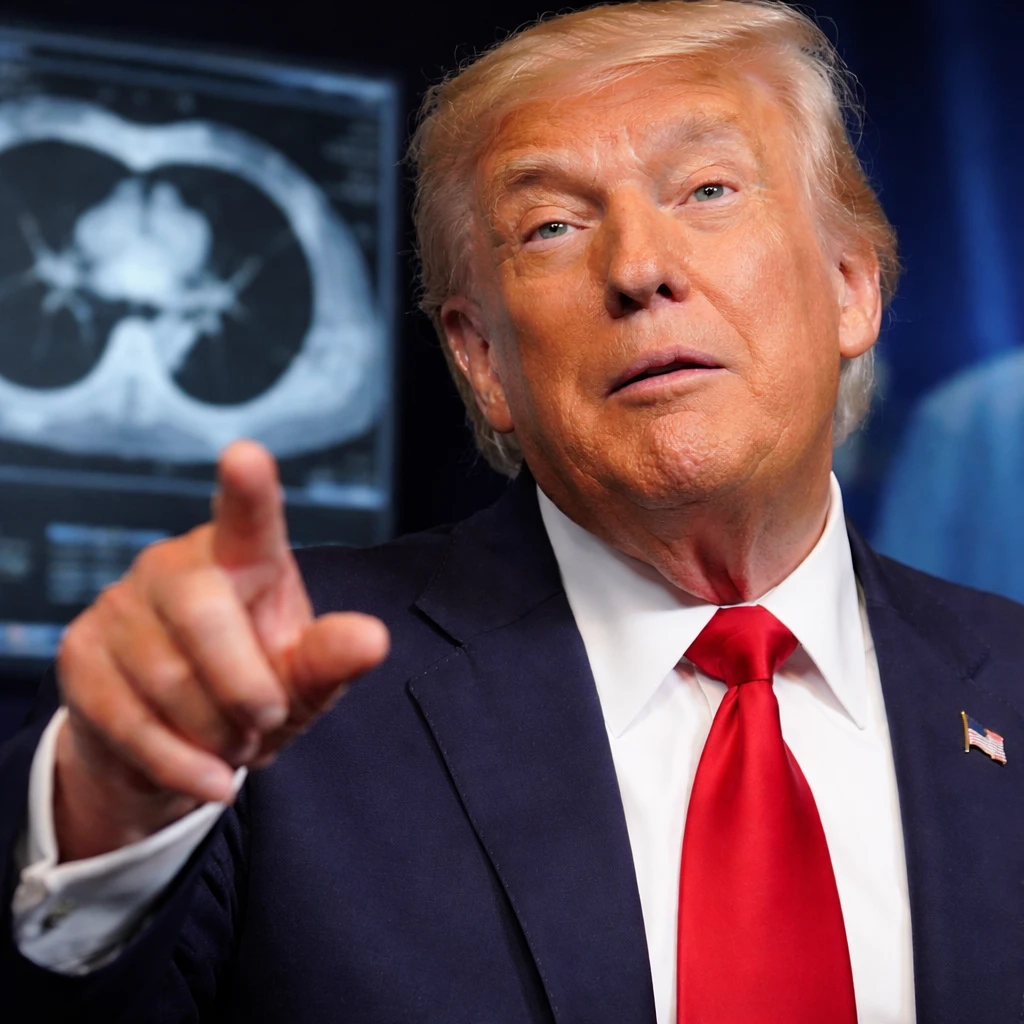

President Donald Trump spoke candidly about his health and energy levels in an interview published recently, offering new insight into a medical examination he underwent in October. During this advanced screening at Walter Reed National Military Medical Center, Trump clarified that he had a computed tomography (CT) scan, not a magnetic resonance imaging (MRI) scan as previously described. He acknowledged in the interview that undergoing this imaging procedure inadvertently fueled public speculation about the state of his health.
The president's personal physician, Navy Captain Sean Barbabella, elaborated in a statement issued by the White House that this medical assessment was part of a routine evaluation to ensure Trump's optimal health ahead of a planned visit to Walter Reed intended for meeting staff and soldiers. The White House had initially described the imaging as "advanced" without providing further specifics until the president himself shared these details in the interview.
Barbabella explained that either a CT scan or MRI was recommended to decisively exclude cardiovascular complications, with the final results showing no abnormalities, confirming Trump's health to be "perfectly normal." The CT scan used for the examination offers faster diagnostic imaging than an MRI but typically yields less tissue detail.
President Trump expressed some regret about undertaking the test, stating he believed it unintentionally gave critics perceived grounds to question his health. He commented, "In retrospect, it’s too bad I took it because it gave them a little ammunition. I would have been a lot better off if they didn’t, because the fact that I took it said, 'Oh gee, is something wrong?' Well, nothing’s wrong."
At 79 years old, Trump is the oldest individual to be inaugurated as president, which has drawn intensified scrutiny over his physical and cognitive fitness, especially since he has openly questioned the fitness of his predecessor, Joe Biden. Biden, 82, faced similar examination concerning age and mental acuity during his final year. Trump’s health has also been under observation due to visible bruising on his right hand and swelling around his ankles.
The White House disclosed that Trump suffers from chronic venous insufficiency, a common condition in older adults characterized by impaired circulation causing blood to pool in the lower legs. Trump told the interviewer that he briefly tried compression socks to mitigate this swelling but discontinued their use because he found them uncomfortable.
Regarding the bruising on his hand, White House press secretary Karoline Leavitt attributed it to frequent handshaking combined with aspirin intake, a medication Trump consumes regularly to reduce heart attack and stroke risk. Trump revealed he takes a higher aspirin dose than medically advised, citing personal superstition developed over 25 years and describing the importance of “thin blood” for heart health. According to Barbabella, the daily dose is 325 milligrams.
Trump addressed footage capturing him with closed eyes during White House meetings, denying that he has fallen asleep, instead attributing this to blinking or resting his eyes momentarily. He described closing his eyes as relaxing and reaffirmed that he has traditionally had limited nighttime sleep but starts his workday early at the White House residence, moving to the Oval Office around 10 a.m. and continuing work into the evening.
The president dismissed concerns about his hearing, acknowledging only occasional difficulty hearing amid background noise. He emphasized that his energy stems from his genetics, stating, “Genetics are very important. And I have very good genetics.”