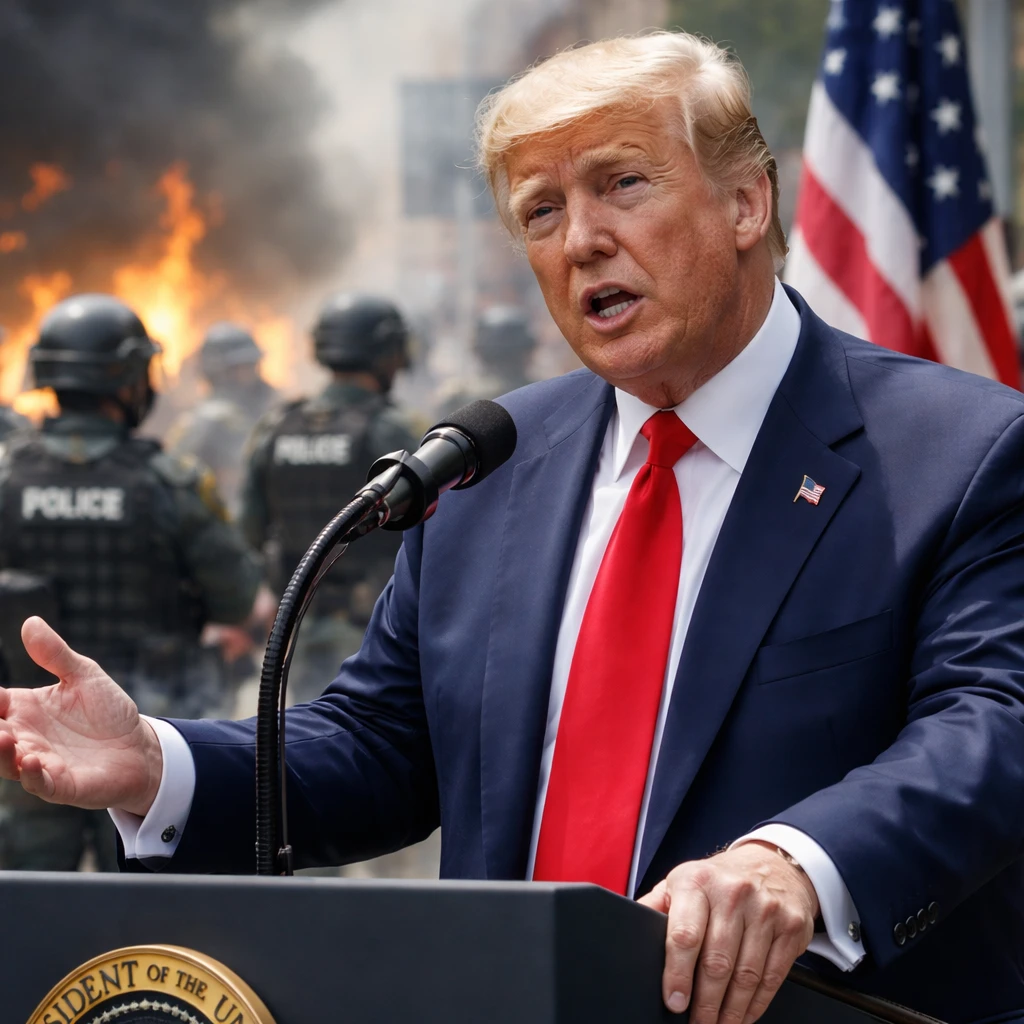

Trump Directs Limited Federal Intervention in Protests Within Democratic Cities
January 31, 2026
News & Politics

Trump Directs Limited Federal Intervention in Protests Within Democratic Cities

Federal involvement contingent on local requests amid federal immigration enforcement controversies

Summary

President Donald Trump announced a directive limiting federal intervention in protests taking place in cities governed by Democratic officials, emphasizing federal assistance will only be rendered upon request from local authorities. The order includes robust protection of federal properties under attack and emphasizes continued stringent immigration enforcement, particularly in Minnesota where tensions have escalated following fatal police actions and legal challenges.

Key Points

President Trump has ordered Homeland Security Secretary Kristi Noem to withhold federal intervention in protests within Democratic-controlled cities unless such cities formally request assistance.
The administration continues to prioritize the protection of federal properties during protests, with directives for ICE and Border Patrol to enforce this protection robustly.
Legal challenges and public protests have intensified in Minnesota following fatal shootings involving federal officers, leading to increased scrutiny of immigration enforcement efforts in the region.

President Donald Trump stated on Saturday that he has instructed Homeland Security Secretary Kristi Noem not to deploy federal assistance to protests in cities under Democratic leadership unless those cities formally request such aid. He conveyed this directive through his social media platform, declaring unequivocally that federal authorities will refrain from involvement in what he described as "poorly run Democrat Cities" facing protests or riots, except where local government solicits help.

Although Trump did not elaborate on how this guidance would influence the activities and operations of U.S. Customs and Immigration Enforcement (ICE), Department of Homeland Security (DHS) officers, or other federal entities, he stressed the commitment to vigorous defense of federal buildings. He referenced individuals attacking these facilities as "highly paid Lunatics, Agitators, and Insurrectionists" and promised strong protection measures.

Additionally, Trump mentioned that he had instructed ICE and Border Patrol to adopt a forceful stance in safeguarding federal properties. This development follows an administration pattern of deploying National Guard members and federal law enforcement agents to Democratic-led metropolitan areas such as Washington, Los Angeles, Chicago, and Portland, Oregon.

However, the directive comes amid rising political opposition and public disapproval of these enforcement tactics, particularly in the Minneapolis–Saint Paul area of Minnesota. The state's Attorney General, Keith Ellison, along with the mayors of Minneapolis and Saint Paul, have contested the federal immigration enforcement escalation, asserting that it infringes upon constitutional rights.

A federal judge has thus far declined to issue an injunction against the ongoing enforcement operations as litigation proceeds, despite appeals from state and local officials seeking an immediate halt or restriction to these actions. The Department of Justice, representing federal interests, has characterized the lawsuit as "legally frivolous."

The situation in Minnesota has been tense, exacerbated by recent fatalities involving federal officers shooting two individuals: Renee Good on January 7 and Alex Pretti on January 24. These incidents have prompted demonstrations both locally and nationwide against federal immigration enforcement intensification.

In response to these developments, Trump dispatched Border czar Tom Homan to Minneapolis. Homan’s mission reportedly includes the possibility of scaling back immigration enforcement resources in Minnesota, contingent upon cooperative engagement from state and municipal authorities.

Risks
  • Potential continuation or escalation of tensions between federal authorities and local governments in Democratic-led cities, which could affect law enforcement operations and public safety strategies.
  • Legal uncertainties around the constitutionality of federal immigration enforcement actions in states like Minnesota, possibly influencing resource allocation and enforcement policies.
  • Widespread protests and civil unrest related to federal immigration enforcement may impact local economies, public services, and political stability in affected urban areas.
Disclosure
This article is based entirely on the information provided without additional speculation or external data. All facts and details presented reflect the stated statements and documented events within the source material.
Search Articles
Category
News & Politics

News & Politics

Related Articles
FDA Initiates Review of BHA Food Additive Safety

The U.S. Food and Drug Administration (FDA) has announced plans to conduct a comprehensive reassessm...

Partisan Divide Deepens as White House Excludes Democratic Governors from NGA Meeting

The longstanding bipartisan forum of the National Governors Association (NGA) is facing disruption a...

Using Fireplace Ashes in Your Garden: Benefits and Considerations

Amidst a notably cold winter leading to increased fireplace use, many homeowners are seeking sustain...