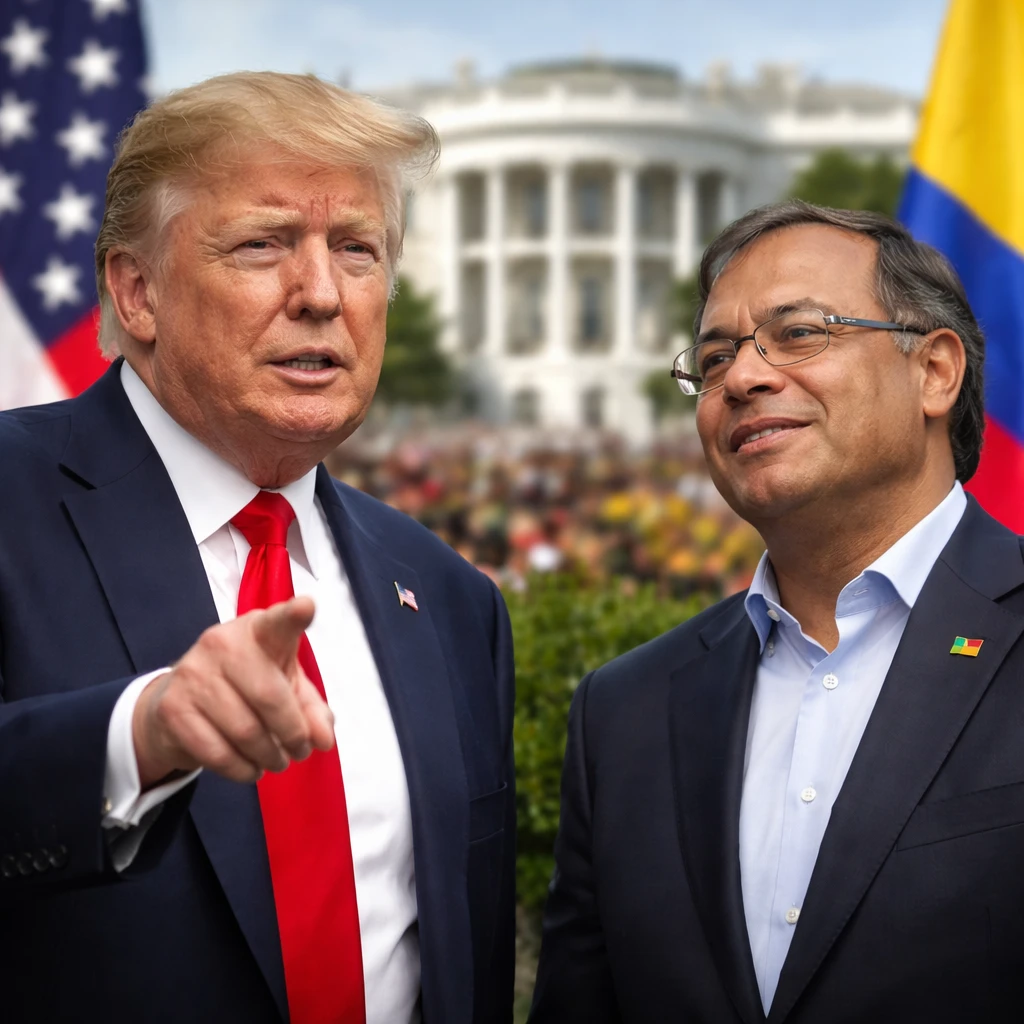
In an unexpected turn on Wednesday, President Donald Trump softened his rhetoric concerning Colombia's President Gustavo Petro. The U.S. leader announced via his social media platform that they had shared a congenial phone dialogue, during which Petro explained the complex issues surrounding drug trafficking and other disagreements previously reported between their countries. Trump expressed appreciation for Petro's tone and conveyed anticipation for an upcoming face-to-face meeting, indicating that this engagement would take place at the White House.
This conciliatory message arrives just days after Trump made disparaging remarks about Petro in connection with U.S. military operations aimed at removing Venezuelan President Nicolás Maduro. Trump accused Colombia of significant internal issues, explicitly stating, "Colombia is very sick too," and alleged that President Petro was involved in producing and trafficking cocaine to the United States.
On Sunday, while speaking to reporters aboard Air Force One, Trump predicted that Petro's involvement in drug trafficking would be short-lived. Responding to questions about possible U.S. military intervention, Trump expressed openness to the idea with a simple affirmation.
Later on Wednesday, President Petro addressed a large gathering of protesters he mobilized in Bogotá to oppose perceived U.S. military aggression. He disclosed that his phone conversation with Trump lasted approximately an hour, centering on two main topics: the situation in Venezuela and drug trafficking concerns.
During his remarks, Petro accused Colombian political figures with alleged narcotics ties of misrepresenting his record to the U.S. president, thereby influencing Trump's negative view of him. He asserted these individuals bear responsibility for the current diplomatic tension, which he characterized as verbal and preliminary in nature.
The recent thaw in Trump's approach contrasts sharply with Petro's prior condemnation of the U.S. operation in Venezuela. Petro described the intervention as an egregious violation of Latin American sovereignty and likened it to historical atrocities, citing Nazi Germany's 1937 bombardment of Guernica as a point of comparison.
Historically, Colombia has been a loyal partner to the United States in Latin America, particularly in efforts to combat drug trafficking. For three decades, the countries have collaborated closely to arrest traffickers, counter insurgent groups, and foster rural development.
Despite this longstanding alliance, tensions escalated over recent months. The U.S. government imposed sanctions last October on Petro, members of his family, and governmental officials due to allegations of involvement in the international drug trade. Colombia continues to be recognized as the world's largest cocaine producer.
As part of a broader campaign against Venezuelan President Maduro, Trump authorized numerous lethal strikes targeting alleged drug smuggling vessels in the Caribbean and extended these operations to intercept ships originating from Colombian waters in the eastern Pacific.
Moreover, in September, the United States designated Colombia as a nation failing to cooperate in the drug war, a status not assigned to Colombia in almost three decades. This led to a considerable reduction in American aid, despite Colombia's prior position as the primary recipient of U.S. assistance in the region.
Trump's earlier critical comments included direct allegations that President Petro oversaw "cocaine mills and cocaine factories," indicating severe accusations about his involvement in narcotics production and trafficking.