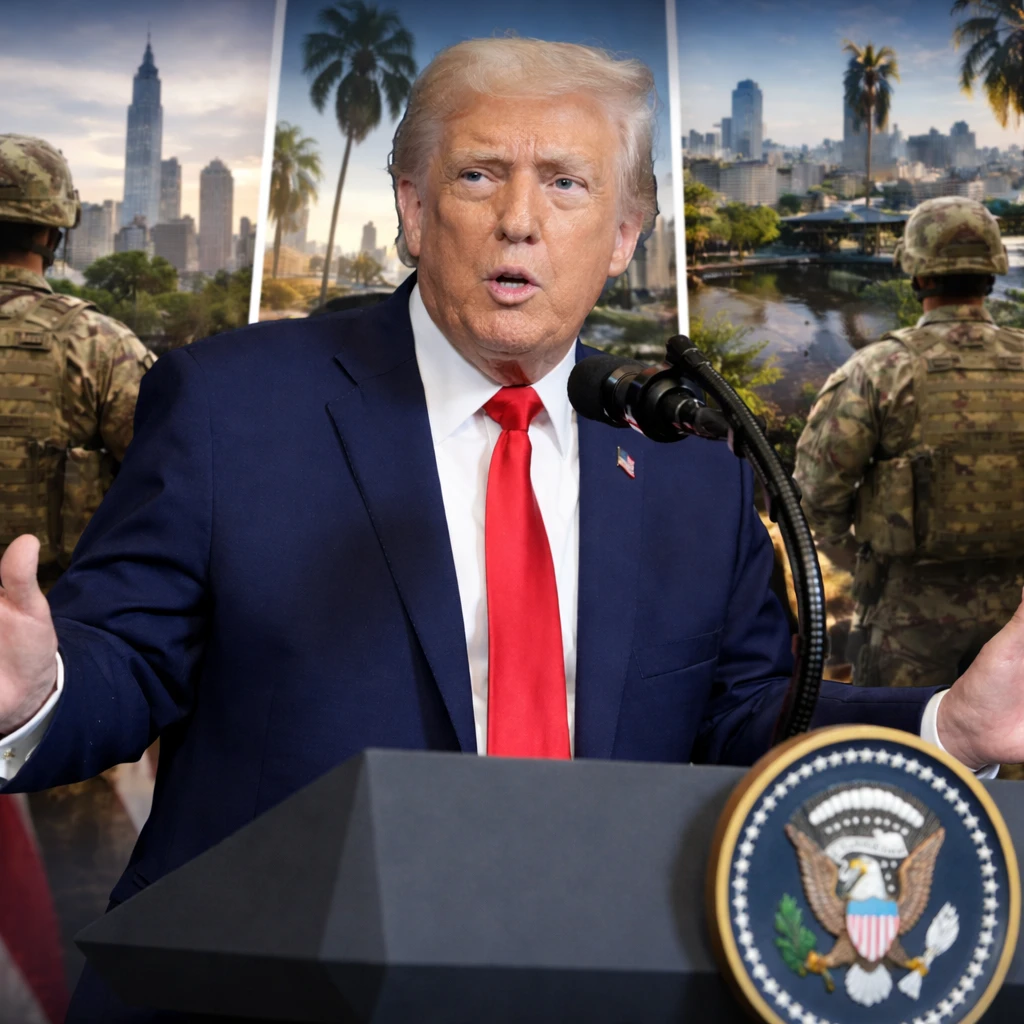

In a recent statement, President Donald Trump announced the temporary cessation of National Guard operations in three major U.S. cities: Chicago, Los Angeles, and Portland, Oregon. This development follows a series of legal impediments that have stalled the broader initiative aimed at enhancing law enforcement through a National Guard presence.
Trump conveyed on social media his intention to withdraw the Guard troops for the time being, while suggesting a potential reemergence of a more forceful presence if crime rates surge again. He emphasized the pause was temporary, indicating that the troop deployments might return in "a much different and stronger form" at a later period.
Earlier this year, National Guard troops had already been withdrawn from Los Angeles after their initial deployment earlier in the year which formed part of a wider strategy focused on reducing crime and managing immigration. Although troops had been dispatched to Chicago and Portland, they were never actively deployed on the streets due to ongoing legal challenges that prevented full mobilization.
Trump has repeatedly positioned his stringent crime crackdown as a key element of his agenda for a second term in office and has contemplated invoking the Insurrection Act to overcome judicial blockades imposed by his political adversaries.
Back in November, the U.S. Northern Command had indicated adjustments to operations in these cities, describing the shift as "shifting and/or rightsizing" while assuring a continued and enduring Guard presence across Chicago, Portland, and Los Angeles.
The initiative to deploy National Guard troops in these predominantly Democrat-led urban centers has consistently encountered judicial scrutiny. In December, the Supreme Court declined to facilitate the administration’s plan to deploy troops in the Chicago area as part of its immigration enforcement measures. While not a definitive rulings, this refusal marked a rare setback for the president’s law enforcement ambitions at the highest judicial level.
In Washington, D.C., the Attorney General, Brian Schwalb, moved to halt the deployment of over 2,000 guardsmen, further adding to the mounting legal resistance. Similarly, federal judges blocked the deployment of hundreds of National Guard troops sent to Portland from California and Oregon from engaging in street-level duties. Ultimately, a three-day trial culminated with a permanent injunction barring National Guard operations in Portland.
Los Angeles saw the removal of California National Guard troops from city streets by December 15 following a court decision. However, a related appellate court ruling put on hold a directive mandating the return of Guard control to California Governor Gavin Newsom after they were federalized in June. Recently, the Trump administration discontinued pursuing a stay on the part of the court order concerning Guard control, effectively allowing the reintegration of these troops under state jurisdiction.
California Attorney General Rob Bonta heralded this as a significant legal victory, criticizing the prior federalization as politicization of military forces. He underscored the constitutional principle separating military and civilian spheres and reinforced the apolitical nature of the armed forces.
In a related deployment, the Tennessee National Guard was ordered to assist Memphis in addressing crime concerns starting September. This move was supported by Tennessee’s Republican Governor Bill Lee and the state’s senators. Nonetheless, a Tennessee judge blocked this deployment in response to a lawsuit brought by Democratic state and local officials opposing the Guard’s use for such purposes.
Throughout this process, the Trump administration has balanced efforts to implement its tough stance on urban crime with continual judicial oversight and opposition, leading ultimately to the present suspension of the National Guard’s role in these key metropolitan areas.