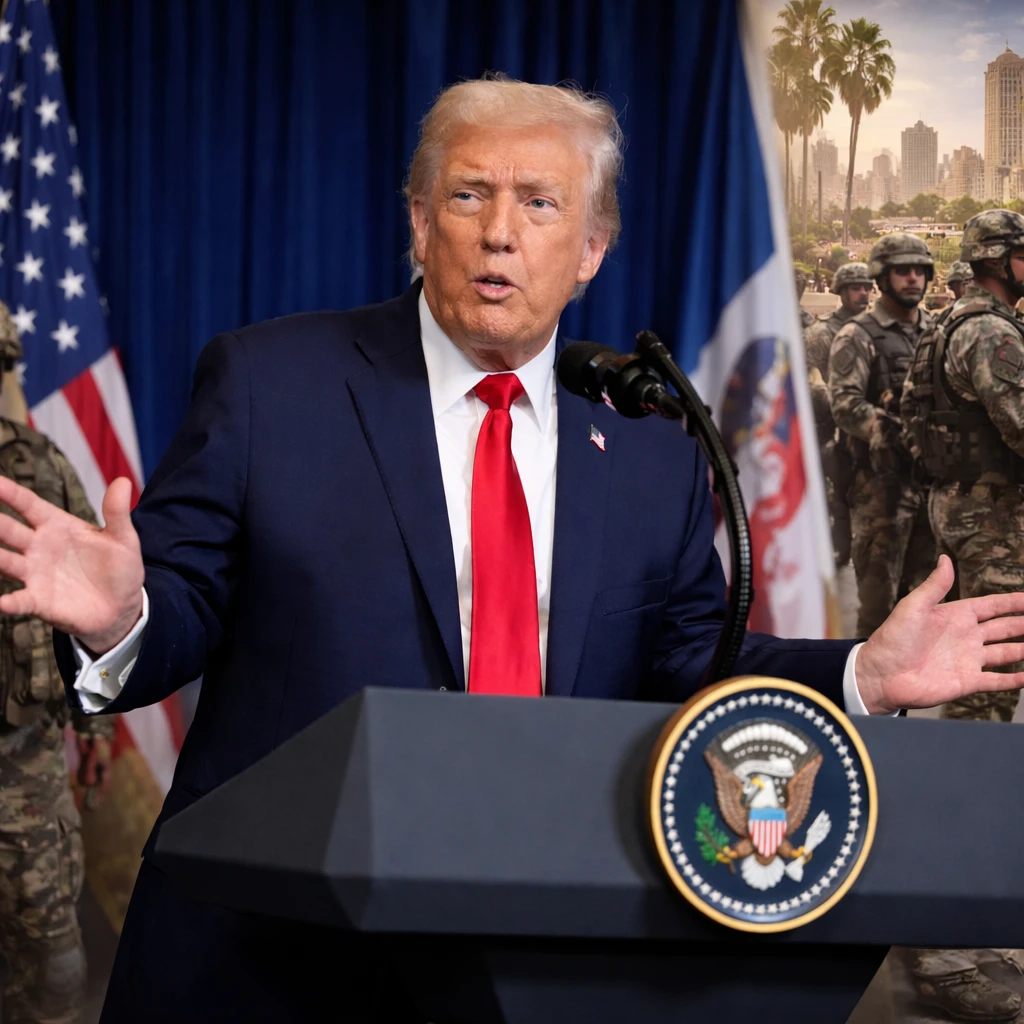
President Donald Trump announced on Wednesday that he is currently shelving plans to dispatch National Guard troops to the cities of Chicago, Los Angeles, and Portland due to legal barriers thwarting implementation. He conveyed on social media that the federal government might return with a "much different and stronger" approach if crime surges again, emphasizing this is only a matter of time.
Typically, state governors maintain command over their respective National Guard units, but Trump had ordered deployments in these metropolitan areas against the preferences of state and local executives. He justified these actions as part of an expansive offensive targeting immigration enforcement, crime reduction, and managing protests.
Addressing crime control forms a critical pillar of Trump’s agenda for his second term, and he has contemplated invoking the Insurrection Act to prevent judicial interference obstructing his operational plans. According to the president, public safety is expected to play a pivotal role in the upcoming midterm elections.
Following initial deployments mid-year, National Guard personnel had already exited Los Angeles. However, their presence in Chicago and Portland was limited, as legal disputes held up deployments, and the troops never actively patrolled the streets in those cities.
When the Chicago deployment was legally contested, a Department of Justice lawyer clarified that the National Guard’s mission would focus on protecting federal properties and personnel rather than serving as the comprehensive solution to urban crime issues.
Local officials from Portland’s mayor’s office attributed crime reductions in their city to efforts by municipal police and public safety programs. Similarly, Chicago officials underscored this sentiment, noting that the city recorded 416 homicides in 2025 — the lowest since 2014.
Trump’s initiative to federalize National Guard units in Democratic-led cities has faced continual legal opposition. In December, the Supreme Court declined the federal administration’s request to deploy the Guard in the Chicago metropolitan area, marking a significant and unusual rebuff from the nation’s highest court.
Illinois Governor JB Pritzker publicly stated on social media that Trump’s attempt to militarize American cities through the National Guard failed in court, compelling a retreat. Meanwhile, hundreds of National Guard troops from California and Oregon had been mobilized in Portland, but federal judges barred them from street operations and ultimately issued a permanent injunction ending their deployment after a three-day trial in November.
Oregon Governor Tina Kotek declared her office had received no formal notification regarding the federal Guard troops’ return, emphasizing that their deployment in Portland never had legal justification and that complying with judicial rulings represents a victory for state residents and the rule of law.
Trump’s federalization efforts started in Los Angeles in June, following protests responding to increased immigration enforcement arrests. The initial sizeable deployment included approximately 4,000 National Guard members and 700 Marine infantry tasked with securing federal facilities and providing protection during immigration arrests. This force diminished over time until only several hundred remained.
These troops were withdrawn from street patrols by December 15 following a judicial decision that also returned command authority to California Governor Gavin Newsom. Though an appellate court temporarily stayed the remainder of the order, leaving federal control intact, the Trump administration declared on Tuesday it would cease pursuing this stay.
The federal Ninth Circuit Court of Appeals directed the Trump administration on Wednesday to cede National Guard control back to Newsom. Responding, Newsom remarked via social media that the federal takeover had been unlawful from the outset and welcomed the administration’s concession.
National Guard troops will maintain their presence in several other cities. In Washington, D.C., a federal appellate court paused a lower court ruling that sought to end the Guard deployment, which has been ongoing since August under a declared "crime emergency." In September, Trump also activated Tennessee’s National Guard in Memphis to address crime, supported by Republican leaders including the governor. A state judge blocked the deployment following a lawsuit by Democratic officials but stayed that decision during the state’s appeal, allowing the operation to continue.
Separately, in New Orleans, approximately 350 National Guard members deployed by Trump arrived in the historic French Quarter on Tuesday. They are scheduled to remain in place through Mardi Gras to support security efforts, with backing from both the state’s Republican governor and the city’s Democratic mayor.
This multifaceted situation highlights the ongoing tensions between federal initiatives aimed at addressing urban crime and immigration enforcement and the legal and political resistance from state governments and the judiciary. With courts frequently intervening, the administration’s strategies face both operational challenges and significant scrutiny regarding authority and civil-military relations at the local level.