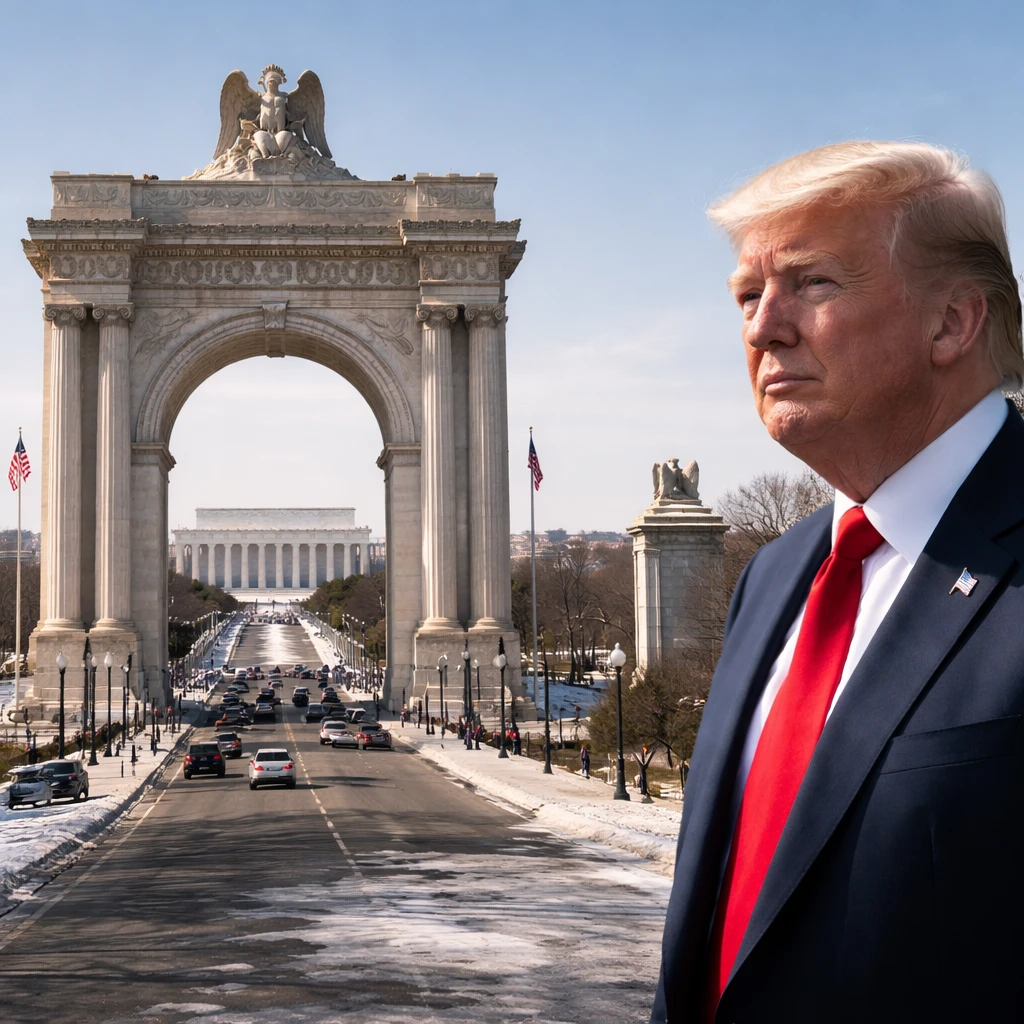

President Donald Trump has articulated his intention to erect a towering arch near the Lincoln Memorial in Washington, D.C., contending that the city has sought such a monument for nearly two centuries. During a recent flight to Florida, Trump explained that an initial effort to establish such a landmark was halted by the outbreak of the American Civil War, and a later attempt around 1902 also failed to materialize.
He specifically cited the existence of four eagle statues as evidence of previous plans to build an arch, but historical investigations reveal that these statues are, in fact, decorative elements on the Arlington Memorial Bridge, constructed well after the Civil War ended. Furthermore, the closest Washington previously had to an arch was a temporary wooden and plaster structure created in 1919 to commemorate the end of World War I. This temporary monument was dismantled shortly thereafter.
The president remarked, "For 200 years they've wanted to build an arc," referring to an arch, and pointed out that Washington, D.C., unlike many other major cities worldwide, lacks such a feature. However, Chandra Manning, a history professor at Georgetown University, challenged this narrative by noting the condition of Washington in the 19th century. According to Manning, the city was still developing functional infrastructure, including housing, roadways, and complete government buildings, and thus was not focused on ornamental commemorations or arches prior to the Civil War.
Trump applied a similar historical justification for undertaking a $400 million renovation project involving the demolition of the White House's East Wing ballroom, asserting that there had long been a desire for a large formal event space within the presidential residence. This claim, however, lacks documentary support indicating public demand for such a ballroom, though space constraints at the White House have been a known issue.
On the proposed arch, Trump expressed aspirations for the monument to be "the most beautiful in the world," and hinted at grand proportions. The arch is planned to be located near the Arlington Memorial Bridge, a structure spanning the Potomac River. At a dinner event to solicit donations for the aforementioned ballroom renovation, Trump unveiled models for the arch, showing three sizes crowned by a Lady Liberty statue. He indicated a preference for the largest model, and media reports suggest that he is considering a height of approximately 250 feet, potentially surpassing the scale of the Lincoln Memorial and approaching that of the Capitol building, which stands at 288 feet.
The president revealed that a committee is being formed to evaluate the arch design, and emphasized that the monument would be "substantial." He also compared the planned arch to the Arc de Triomphe in Paris, which serves as a tribute to soldiers from the French Revolution and Napoleonic wars. It is noted that the Parisian monument stands at 164 feet, significantly shorter than the proposed height of the Washington arch.
The arch would form part of a broader wave of construction projects initiated during Trump’s presidency, aiming to imprint his legacy on the capital’s landscape. This includes the ballroom renovation, a two-year closure and renovation of the Kennedy Center amid controversies arising from artistic community pushback, the redevelopment of the White House’s Rose Garden inspired by the Mar-a-Lago estate’s aesthetics, and interior redecoration efforts in various White House rooms.
Additional modifications under Trump’s tenure include the installation of a Walk of Fame featuring portraits of past U.S. presidents along the Colonnade, large flagpoles on the north and south lawns, and elaborate ornamental additions to the Oval Office. These changes illustrate the administration’s commitment to altering traditional appearances in favor of a distinctive presidential style.
The arch project also aligns with Trump’s declared goal to enhance and beautify public spaces within Washington, addressing issues such as neglected grassy areas, damaged signage, and deteriorated street medians. Furthermore, the administration has deployed the National Guard to assist in dispersing homeless encampments in targeted locations. Harrison Design, a local architecture firm, is involved in the project’s development, though no official timeline has been set for construction commencement. The desired unveiling date for the arch is intended to coincide with the nation’s 250th anniversary celebrations.
When questioned about the historical references to the four eagle statues, the White House provided images showing eagle sculptures positioned at the corners of the Arlington Memorial Bridge, though no additional historical context was supplied. A White House spokesperson reiterated the position that Americans have wanted an arch in the capital for nearly two centuries and praised the proposed monument as a bold vision with lasting impact.
However, detailed historical records contradict the president’s timeline. The Arlington Memorial Bridge was proposed in 1886, approved by Congress in 1925, and constructed between 1926 and 1931. Designed to signify national reunification after the Civil War, the bridge linked the Lincoln Memorial to the Arlington Estate of Confederate General Robert E. Lee, now the Arlington National Cemetery site. The placement and orientation of eagle sculptures on the bridge sparked notable debate during its planning stages.
Washington’s only prior arch-like structure was the temporary Victory Arch erected in 1919 to celebrate the end of World War I, which was dismantled within a year. A 2000 proposal for a peace arch in Washington was abandoned following the events of September 11, 2001.
Manning, also a former National Park Service ranger, expressed skepticism about a longstanding American tradition of commemorative arches, suggesting the concept is more of a foreign import rather than a common U.S. practice.