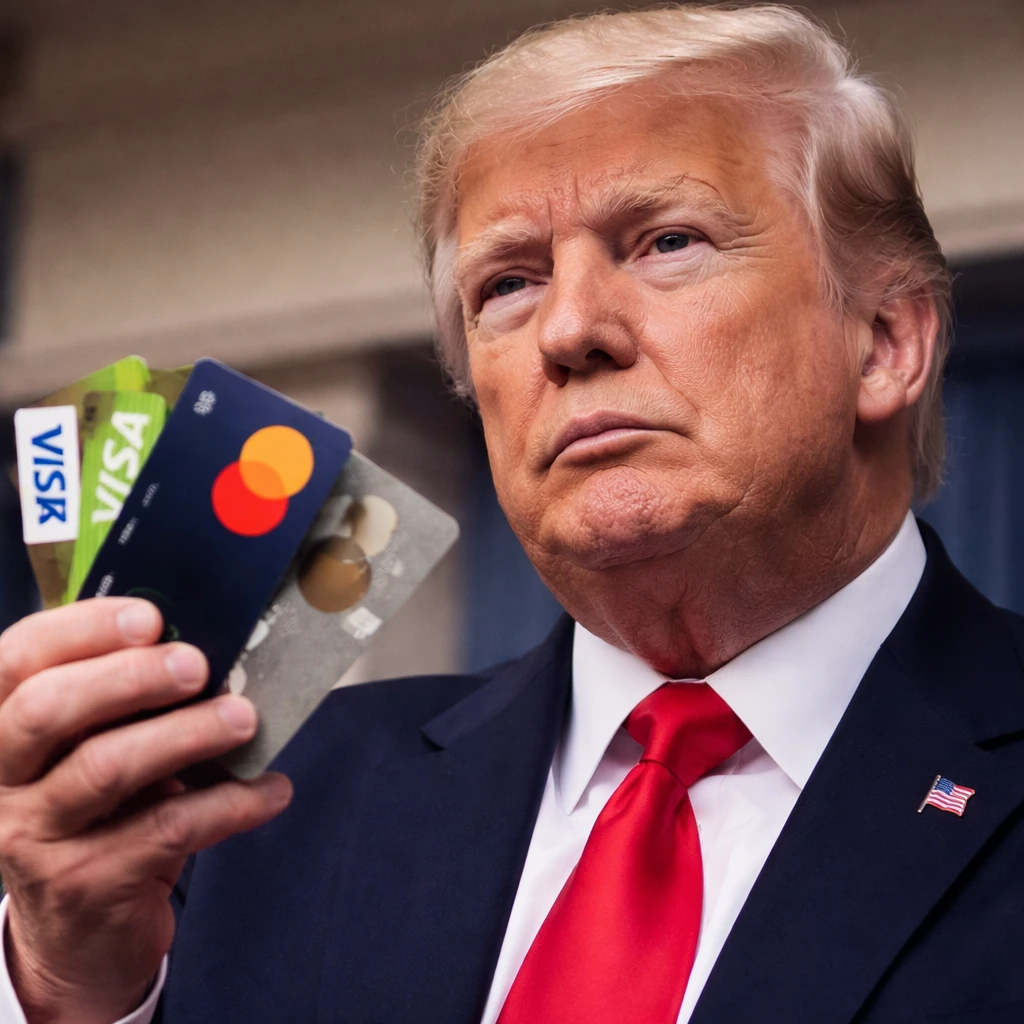

In a renewed policy initiative, President Donald Trump has announced his intention to enforce a 10% interest rate cap on credit cards for a one-year period, a measure expected to significantly lower consumer expenses on credit card interest. The proposal was shared by the president through a post on his social media account late Friday, though the exact mechanism—whether through executive action or legislation—remains unspecified. Senator Roger Marshall (R-Kansas) confirmed discussions with President Trump regarding this initiative and expressed commitment to advancing related legislation with full presidential backing. The goal is to enact this cap by January 20, which marks the first anniversary of Trump's current term in office.
Despite the president's previous alignment with the credit card industry and Wall Street, this proposed cap has drawn immediate pushback from these sectors. Major banking institutions and credit card companies, who have contributed significantly to Trump's 2024 campaign and generally support his agenda, have voiced concern about the potential repercussions. They argue that a ceiling on credit card interest rates might disproportionately impact economically vulnerable populations by limiting or removing their access to credit lines, potentially steering them toward costlier financial services such as payday loans or pawn shops.
"We will no longer let the American Public be ripped off by Credit Card Companies that are charging Interest Rates of 20 to 30%," Trump declared on his Truth Social platform.
Previous research analyzing this campaign promise estimated that capping credit card interest rates at 10% could save American consumers approximately $100 billion annually in interest payments. While acknowledging that such a limit would substantially affect the credit card industry's revenues, the findings suggest companies would remain profitable, though offerings such as customer rewards might be curtailed.
Data from the Consumer Financial Protection Bureau indicates nearly 195 million Americans held credit cards in 2024, collectively subjected to $160 billion in interest charges. Credit card debt reached an unprecedented $1.23 trillion in the third quarter of the previous year, according to the New York Federal Reserve.
The prevailing average credit card interest rates range from 19.65% to 21.5%, reflecting a decline over the past year following the Federal Reserve's benchmark rate reductions; however, these rates remain near historic highs since federal monitoring began in the mid-1990s. Compared to roughly a decade ago, when average rates were near 12%, the current rates represent a significant increase.
Despite its often pro-industry stance, the Trump administration has not resisted major credit card industry consolidations, including the Capital One and Discover Financial merger finalized in early 2025, creating the nation's largest credit card provider. Additionally, the Consumer Financial Protection Bureau, responsible for overseeing credit card company conduct, has largely been inactive during the president's tenure.
The American Bankers Association and related groups issued a joint statement opposing the president's interest rate cap plan, warning that such measures would likely redirect consumers toward more costly, less regulated alternatives.
Bank representatives consistently maintain that lowering card interest rates would reduce credit availability for higher-risk customers. Historical precedent was noted following congressional caps on debit card fees, which led to the removal of associated rewards and benefits—a trend only recently reversing with new card offerings.
Existing federal laws cap interest rates for particular groups and financial products, such as the Military Lending Act prohibiting rates exceeding 36% for active duty service members, and national credit union regulations setting a maximum of 18% on credit union card interest rates.
Credit card firms generate income from merchant fees, customer fees, and interest on outstanding balances. Some analysts and progressive policymakers argue that merchant fees alone should allow banks to sustain profitability under an interest rate ceiling.
Brian Shearer, director of competition and regulatory policy at the Vanderbilt Policy Accelerator and author of the relevant study, contends, "A 10% credit card interest cap would save Americans $100 billion a year without causing massive account closures, as banks claim. That’s because the few large banks that dominate the credit card market are making absolutely massive profits on customers at all income levels."
Yet, past examples such as Arkansas demonstrate that stringent interest caps can restrict access to credit for less creditworthy individuals, as banks are unable to price risk accurately. Specifically, Shearer's research suggests a 10% cap would reduce lending opportunities for consumers with credit scores below 600.
The White House has yet to clarify how the president intends to implement the cap or if discussions with credit card companies have occurred. Meanwhile, bipartisan legislative measures aiming to impose similar caps have emerged. Senators Bernie Sanders (I-Vermont) and Josh Hawley (R-Missouri) proposed a bill in February to establish an immediate 10% cap for five years, hoping to capitalize on the presidential promise to build wider support.
Opposing viewpoints highlight that President Trump's deregulation efforts may actually facilitate higher credit card fees by big banks, according to Senator Sanders.
Additional representatives, including Alexandria Ocasio-Cortez (D-New York) and Anna Paulina Luna (R-Florida), have introduced comparable legislation. Notably, Ocasio-Cortez frequently attracts criticism from Trump, while Luna is regarded as a close ally.