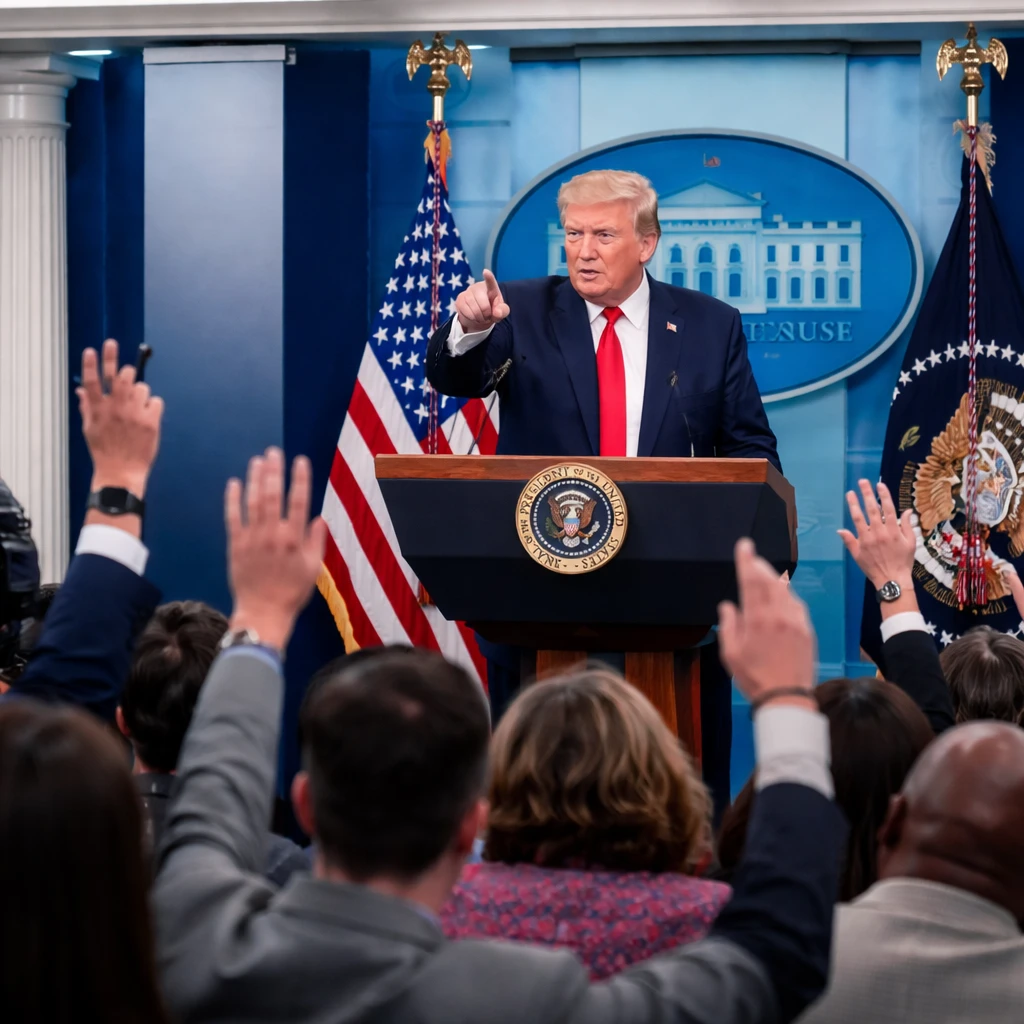

President Donald Trump convened a lengthy and meandering press conference on a Tuesday afternoon at the White House, devoted largely to revisiting his administration's performance over the past year since he resumed office. The event extended for over 100 minutes, characterized by spontaneous digressions, critiques of political adversaries, and intermittent interactions with the press corps.
Opening with a detailed presentation, Trump displayed photographs purportedly depicting individuals detained by immigration enforcement officers in Minnesota, inviting scrutiny of his administration's immigration crackdowns. "I'm doing this because I believe we have plenty of time," the president remarked, initiating a disjointed narrative that would continue throughout the briefing.
This elaborate address unfolded amid a climate of international uncertainty and significant domestic unease. Recently, President Trump instigated controversy within NATO by threatening tariffs aimed at European allies as part of his campaign to acquire Greenland. Concurrently, the administration prepared to potentially deploy 1,500 active-duty troops in response to unrest in Minneapolis, invoking the possibility of enforcing the Insurrection Act.
Scheduled just hours before Trump's departure to Europe to engage with world leaders, the briefing preceded discussions certain to involve his ambitions regarding Greenland, the proposed international peacemaking entity, and various global challenges.
Within the Republican ranks, there is mounting pressure for the president to directly address voter concerns about economic affordability in anticipation of pivotal midterm elections. Trump acknowledged this within the briefing, emphasizing, "One of the reasons I'm holding this news conference is because we've taken a mess and made it really good. It's going to get even better."
The president proceeded to exhibit a considerable array of mugshots of those arrested during immigration actions, narrating the nature of their alleged offenses to the gathering journalists. At one point, he queried the assembled media, "You're not getting bored with this, right?" Noting what seemed like a waning audience, he commented on limiting his show to around 100 mugshots before discarding the images onto the Briefing Room floor beside his podium.
Following this, Trump engaged with a large binder clip, humorously stating that it nearly injured him and that he would not "show the pain." He then tossed the binder clip to the floor as well. Later, he lifted a voluminous document labeled "Accomplishments," suggesting that fully recounting its contents would require more than a week. As he proclaimed, "It's big stuff too. We have the hottest country in the world," he deposited the stack onto the floor with a resonant thud.
Trump emphasized his long-standing role as his own most effective promoter, tracing this capacity back to his real estate career, where he frequently contacted reporters to publicize projects and proposals. He conceded that some of his economic messaging has failed to resonate completely, stating, "Maybe I have bad public relations people, but we're not getting it across."
Throughout the briefing, Trump diverged into several tangential narratives. Discussing immigration enforcement, he made a comparison between the immigrants removed under his administration and the Hell’s Angels motorcycle gang, implying the immigrants were more dangerous but then paused to praise the Hell’s Angels, noting their support for him and their protection during his campaigns.
The president also recounted his signing of an executive order intended to revive mental health institutions and asylum facilities, sharing a personal recollection of his mother pointing out a psychiatric institution while they walked to a Little League baseball game, describing it as a place housing "very sick people."
Reflecting on spiritual matters, Trump responded affirmatively when asked if he believed God was proud of him, adding with a soft laugh, "I think God is very proud of the job I've done, and that includes for religion." This remark aligns with his previous suggestions that divine intervention played a role in his political comeback and thwarted an assassination attempt.