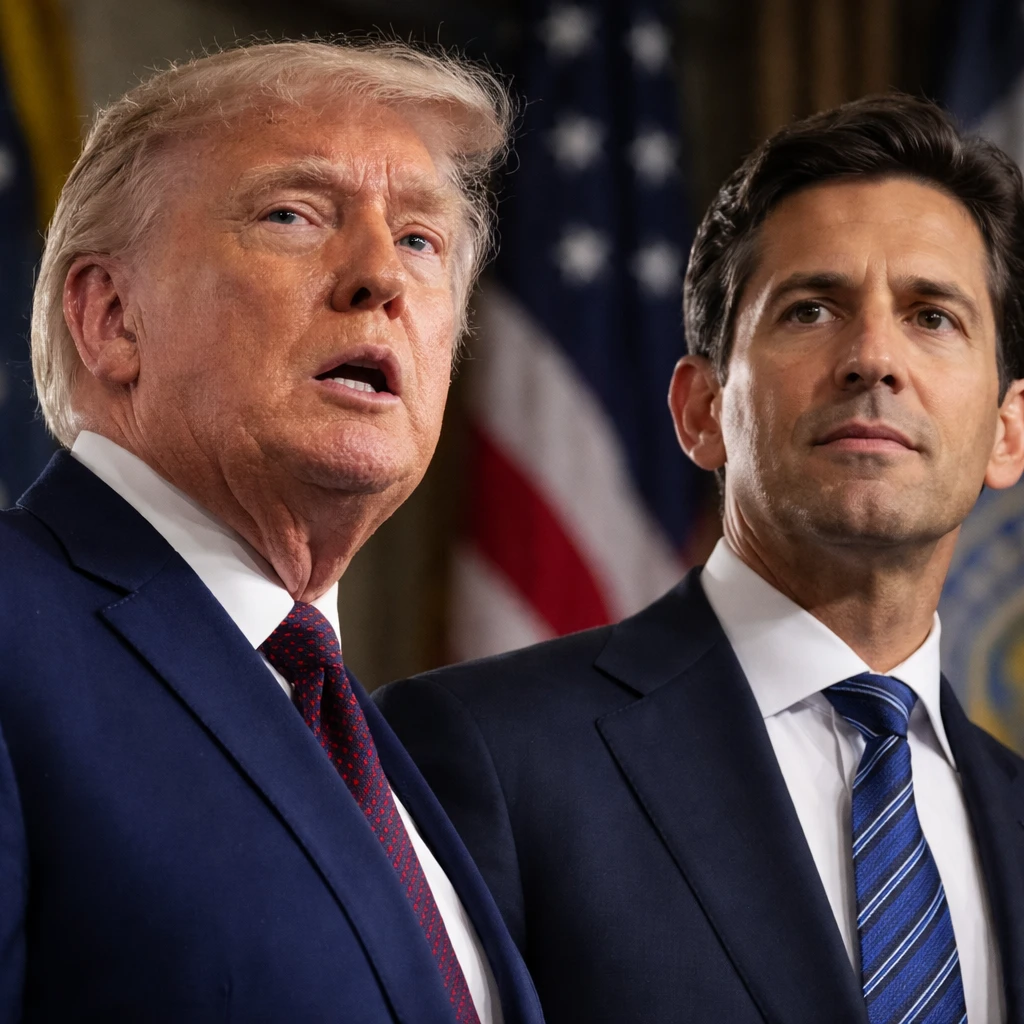
President Donald Trump declared on Friday his plan to nominate Kevin Warsh as the next chair of the Federal Reserve, aiming to replace incumbent Jerome Powell upon the completion of Powell's term in May. Trump had appointed Powell in 2017, but has criticized him in recent months for not reducing interest rates as aggressively as Trump desires.
On his social media platform, Truth Social, Trump expressed strong confidence in Warsh, saying, “I have known Kevin for a long period of time, and have no doubt that he will go down as one of the GREAT Fed Chairmen, maybe the best.” He added that Warsh possesses a commanding presence and promised that Warsh “will never let you down.”
The nomination, which will require Senate confirmation, marks a return to the Federal Reserve for Warsh, 55, who served on the Fed’s board from 2006 to 2011. When he was appointed governor at age 35, he was the youngest ever to hold the position. Currently, Warsh contributes as a fellow at the Hoover Institution, a conservative think tank, and lectures at the Stanford Graduate School of Business.
Warsh's profile as a candidate is somewhat unexpected relative to President Trump's preferences, as Warsh has traditionally been a monetary hawk, favoring higher interest rates to rein in inflation. This contrasts with Trump’s stated position that key rates should be around 1%, significantly lower than the current rate near 3.6%, a stance that diverges from mainstream economic consensus.
As a Fed governor, Warsh opposed several low-rate policies enacted during and subsequent to the 2008-09 financial crisis and Great Recession. Then, he frequently voiced concerns that inflation would escalate despite it remaining low for several years post-recession.
In more recent years, Warsh has expressed support for lowering interest rates in his speeches and commentary, indicating a possible alignment with Trump’s monetary policy objectives.
Warsh emerged as the nominee from a pool including Trump’s chief economic adviser Kevin Hassett, investment manager Rick Rieder, and sitting Fed governor Christopher Waller.
Should Warsh be confirmed, his chairmanship represents a significant step toward enhancing White House influence over the Federal Reserve, an institution designed to function with political independence. Trump’s frequent public criticisms of the Fed’s monetary policy prompted debate about this independence. The announcement followed an extensive and public vetting process, underscoring the importance Trump places on the Fed’s leadership role and its economic impact.
The Federal Reserve chair holds substantial responsibility, overseeing efforts to manage inflation while promoting maximum employment. The Fed also performs as the primary regulator of banks nationwide. Decisions regarding interest rates influence overall borrowing costs including home mortgages, auto loans, and credit card rates.
Currently, Warsh would occupy a seat on the Fed’s board temporarily held by Stephen Miran, a White House nominee appointed in September. Once seated, Warsh could be elevated to the chairmanship upon Powell’s departure in May.
Despite Warsh’s earlier conservative stance, he has recently voiced support for several of President Trump’s economic policies. In a Wall Street Journal column from January 2025, Warsh wrote favorably about the administration’s deregulatory agenda, describing it as disinflationary if fully implemented. He noted government spending reductions, inspired by the Department of Government Efficiency, as factors reducing inflation pressures. Such decreases in inflation could create room for the Fed to lower interest rates, aligning with Trump's policy goals.
Since his re-election campaign, Trump has sought to exert greater control over the Fed’s leadership. In August, he attempted to remove Lisa Cook, one of the seven board governors, aiming to secure a sympathetic majority. Cook filed suit to maintain her position, with the Supreme Court recently indicating a likelihood of allowing her to remain pending legal proceedings.
Research into central bank independence suggests that autonomous monetary policy entities have stronger records in controlling inflation. Politicians often prefer lower interest rates to stimulate growth and employment but risk fostering higher inflation. Trump has expressed a desire to appoint a Fed chair committed to reducing rates to lower federal borrowing costs and mortgage rates, although the Fed does not set these costs directly. He declared in December via social media the necessity of lower borrowing costs, further stating that anyone dissenting from this view would not be appointed as chair.
Even if confirmed, Warsh would confront constraints in achieving aggressive interest rate cuts. The Federal Open Market Committee (FOMC), comprised of 19 members with 12 voting members at any meeting, controls such decisions. Presently, the committee is divided between officials prioritizing inflation control through steady rates and those concerned about a weakening labor market advocating for lower rates.
Furthermore, significant rate reductions for political reasons could be counterproductive. Financial markets may respond negatively, with investors selling Treasury securities, pushing long-term interest rates higher. This situation could increase mortgage rates and thereby undermine Warsh’s intended accommodative policy.
The idea of Warsh as Fed chair was considered during Trump's first term, but Powell was ultimately chosen. Warsh’s familial ties include his father-in-law Ronald Lauder, heir to the Estee Lauder business and a notable Trump ally.
Before his Federal Reserve tenure, Warsh served as an economic adviser during the George W. Bush administration and worked as an investment banker at Morgan Stanley. Collaborating closely with then-Chair Ben Bernanke during the 2008-09 financial crisis, Warsh was described by Bernanke in his memoirs as a trusted adviser with valuable political and financial acumen. However, Warsh notably warned in 2008 against further rate reductions, concerned that they could trigger inflation, a phenomenon that did not manifest after the Fed lowered rates to near zero.
In later years, Warsh has expressed strong criticisms of the Fed’s current direction, calling for “regime change” and challenging Chair Powell's engagement on topics like climate change and diversity issues, which Warsh asserts fall outside the Fed’s mandated responsibilities.
His critiques imply that his potential leadership would signify a marked shift for the Federal Reserve. In a July interview with CNBC, Warsh described existing Fed policy as flawed, emphasizing that the institution has evolved substantially since his earlier tenure. He attributed significant blame to the Fed’s recent policies for enabling substantial inflation increases in 2021-22, a policy failure he characterized as divisive for the nation.
The implications of Warsh’s appointment will extend across multiple facets of the economy and may influence markets dependent on interest rates such as housing, automotive finance, and credit sectors.