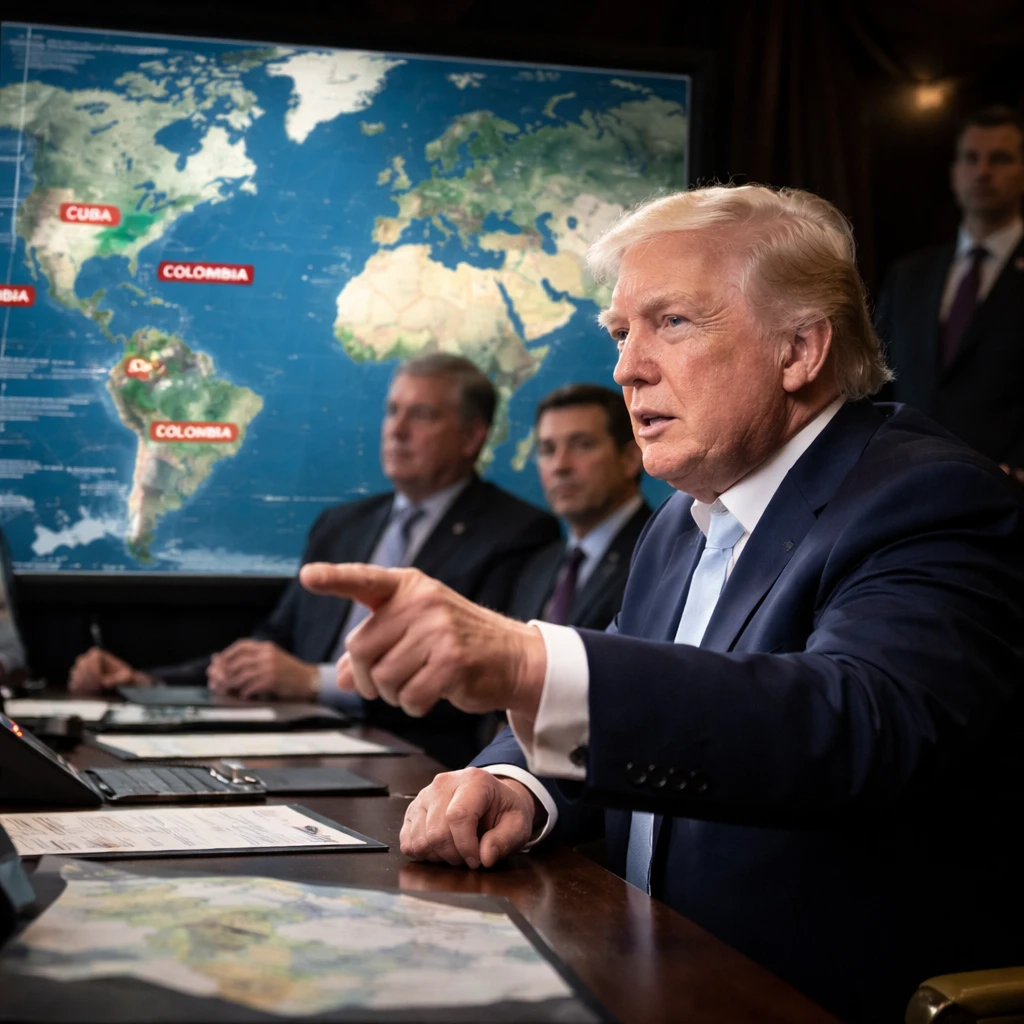

Following a recent daring US military maneuver in Venezuela, President Donald Trump reiterated on Sunday his proposition that the United States should assert control over the Danish territory of Greenland, citing national security imperatives. Concurrently, he issued a stern warning of potential military action against Colombia, accusing its leadership of facilitating the global cocaine trade. Meanwhile, Secretary of State Marco Rubio characterized the Cuban Communist regime as facing significant difficulties.
These remarks from Trump and Rubio, coming shortly after Nicolás Maduro's removal from power in Venezuela, underscore Washington's intention to adopt a more expansive role across the Western Hemisphere.
With implications that are both implicit and forceful, Trump’s declarations have unsettled both allies and adversaries in the region, provoking widespread speculation worldwide about which nation could be next in the scope of US strategic interest.
Addressing journalists aboard Air Force One en route back to Washington from Florida, Trump emphasized Greenland’s strategic importance, stating, "Greenland is currently surrounded by Russian and Chinese naval vessels. We need Greenland for national security reasons, and Denmark appears unable to provide for this." When asked by The Atlantic earlier on Sunday about how the recent Venezuela operation might forecast US intentions for Greenland, Trump responded ambiguously, "They will have to see for themselves. Honestly, I don't know."
The administration's National Security Strategy, unveiled last month, underscores reestablishing "US preeminence in the Western Hemisphere" as a principal objective for President Trump's prospective second term.
Trump has referenced historical doctrines, including the 19th-century Monroe Doctrine, which denounced European colonialism in the Americas, and the Roosevelt Corollary, historically invoked to justify US support for Panamanian independence from Colombia—a move that facilitated US control over the Panama Canal Zone. In a lighter vein, Trump remarked on rebranding the Monroe Doctrine as the "Donroe Doctrine," alluding to its origination under President James Monroe in 1823, which aimed primarily to oppose European interference in the Americas.
In Denmark, these developments have caused palpable concern. Denmark, holding sovereignty over Greenland, a large island rich in minerals, has faced unease due to the US military action in Caracas and Trump’s comments. Danish Prime Minister Mette Frederiksen issued a statement asserting that Trump has "no right to annex" Greenland and reminded him that Denmark and the US, both NATO allies, already provide the United States with substantial access to Greenland through existing security agreements. She strongly urged the United States to discontinue threatening a historically close ally and a people who have unequivocally expressed their unwillingness to be sold.
Further diplomatic resistance emerged as Denmark co-signed a European Union declaration emphasizing respect for the Venezuelan people’s right to self-determination, contrasting with Trump's promise to “govern” Venezuela and his pressure on interim president Delcy Rodríguez to align accordingly.
On social media, Trump’s dismissal of Denmark’s efforts to bolster Greenland’s security — notably suppressing the significance of their addition of a dog sled to their defense capabilities — provoked irritation among Danes and Greenlanders alike. A post by Katie Miller, a former Trump administration official turned podcaster and spouse to deputy chief of staff Stephen Miller, displayed a stylized map of Greenland colored with American stars and stripes and the caption "SOON," further inflaming Danish officials. Jesper Møller Sørensen, Denmark’s chief envoy in Washington, publicly reaffirmed his country’s insistence on full respect for Denmark's territorial integrity in response.
Trump has long expressed interest in asserting US jurisdiction over Greenland, though this topic had receded from headlines in recent months. He revived attention to this issue less than two weeks ago by announcing his intention to appoint Louisiana Governor Jeff Landry as a special envoy tasked with efforts to make Greenland part of the United States. Governor Landry indicated his voluntary role would support Trump's agenda in this regard.
Meanwhile, escalating unease is notable in Cuba, a key Venezuelan ally and trade partner, as Rubio delivered a stringent warning to Havana. Speaking on NBC’s “Meet the Press,” Rubio stated that Cuban officials accompanied Maduro prior to his capture, with Cuban guards serving as his primary protectors, not Venezuelan aides. He added they oversaw internal intelligence activities within the Maduro government, monitoring potential traitors.
Cuban state media reported that 32 Cuban officers died during the US military operation. Trump asserted that Cuba’s economy, already weakened by decades-long US sanctions, is deteriorating further in the wake of Maduro’s ouster, remarking, “It’s falling. It’s going down fast.”
Additionally, Trump directed a pointed admonition toward Colombia and its leftist President Gustavo Petro. On returning to Washington Sunday night, Trump accused Colombia’s leadership of operating under a "sick man" who promotes cocaine production and sales to the US market. The Trump administration sanctioned Petro, his family, and a government associate in October 2023 for alleged involvement in the international drug trade. Colombia remains the focal point of the global cocaine supply chain.
Beginning with intensified US military strikes against suspected Venezuelan drug-smuggling vessels last year, the operation expanded to target maritime routes associated with Colombia on the eastern Pacific. Moreover, the US for the first time in nearly three decades designated Colombia as non-cooperative in the war on drugs, reducing US aid accordingly.
Trump expressed skepticism regarding Petro’s tenure, stating, “He’s not going to last long. Colombia has cocaine mills and labs. We aren’t going to let that happen.” When queried about potential US military action in Colombia, Trump replied, “Sounds good to me.”
Correspondents Andrea Rodríguez in Havana and Darlene Superville aboard Air Force One contributed to this report.