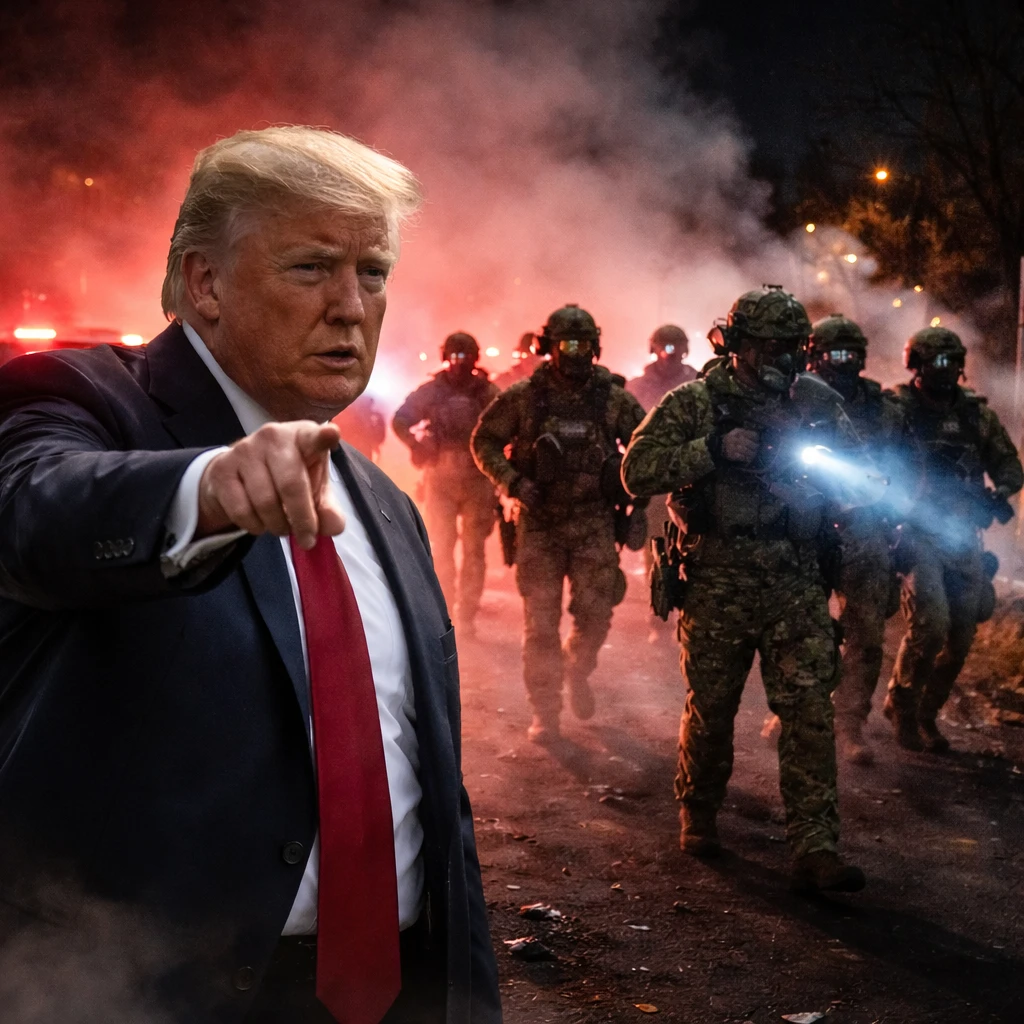

In the midst of sustained civil unrest connected to federal immigration enforcement actions in Minneapolis, President Donald Trump announced his intention to potentially invoke the Insurrection Act to deploy troops to the city. This announcement came on Thursday, following a recent violent encounter involving federal immigration officers.
The president's warning was voiced shortly after a federal immigration officer shot and injured a Minneapolis resident who had reportedly assaulted the officer with a shovel and broom handle. This event occurred against a backdrop of heightened tension and public outrage triggered by the fatal shooting of Renee Good by an Immigration and Customs Enforcement (ICE) agent in the same city.
President Trump issued a social media statement asserting that if Minnesota's political leaders failed to enforce the law and stop what he characterized as attacks by "professional agitators and insurrectionists" on ICE personnel carrying out their duties, he would proceed with activating the Insurrection Act. He emphasized that this federal law had historical precedent, noting its use by previous presidents to address domestic disturbances, and pledged to swiftly end what he described as a "travesty" unfolding in Minnesota.
Historically, the Insurrection Act has been invoked more than twenty times, including notable usage during the Los Angeles unrest in 1992 under President George H.W. Bush, where state authorities requested federal assistance to restore order.
The Department of Homeland Security (DHS), under which ICE operates, reported arresting over 2,000 individuals in Minnesota since early December. Despite the controversy and protests, DHS affirmed its commitment to continuing its enforcement efforts without backing down.
Minneapolis has witnessed recurring protests, particularly following the initial shooting of Good on January 7. Demonstrators have routinely confronted federal officers who have engaged in immigration crackdowns extending to arrests in homes and vehicles. Clashes often result in confrontations, with protesters demanding the removal of ICE agents from the city.
On a recent Wednesday evening, protests escalated near the site of a separate federal officer-involved shooting. Law enforcement officers equipped with gas masks and helmets deployed tear gas to disperse a crowd after rocks were thrown and fireworks launched by demonstrators. Minneapolis Police Chief Brian O’Hara declared the assembly unlawful and called for dispersal. By the next morning, only a few protesters and officers remained at the site.
Mayor Jacob Frey characterized the federal operation as an "invasion" by a force significantly larger than the city’s police department, which comprises approximately 600 officers. He expressed concern over the fear and anger caused among Minneapolis residents as a result of the federal presence.
The sequence leading to Wednesday’s shooting, as detailed by DHS, began when federal law enforcement attempted to stop a driver from Venezuela residing in the U.S. without authorization. The individual fled, crashed into a parked vehicle, and then fled on foot. Upon confronting the person, two others emerged from nearby apartments and reportedly assaulted the officer. Fearing for his life amid the attack by three individuals, the officer discharged his weapon in what DHS described as a defensive action.
The two individuals involved in the assault were subsequently taken into custody. The victim of the shooting was reported to be hospitalized with injuries not considered life-threatening. The incident occurred roughly 4.5 miles from the location of Good’s fatal shooting. Police Chief O’Hara’s briefing corroborated the account given by Homeland Security authorities.
Governor Tim Walz addressed the situation, describing Minnesota as engulfed in chaos and labeling the federal actions a campaign of organized brutality rather than routine immigration enforcement.
The ICE officer responsible for Good’s death, Jonathan Ross, reportedly sustained internal bleeding during the incident, according to a Homeland Security source who spoke anonymously. The agency did not disclose details regarding the severity or treatment of his injuries.
Good was shot in the head after three ICE officers surrounded her vehicle near her residence on a snowy street. Video footage shows an officer ordering Good to exit her vehicle, seizing the door handle, and subsequently firing at least three close-range shots as the vehicle moved forward. Homeland Security Secretary Kristi Noem claimed Good used her car as a weapon against the officer, an assertion challenged by Minnesota officials. Ross's attorney has declined to comment on the matter.
Good’s family has retained legal counsel previously involved in prominent civil rights settlements, signaling forthcoming legal action. The firm notably represented George Floyd’s family in a historic $27 million settlement related to Floyd's death during a law enforcement encounter in Minneapolis in 2020.
Throughout these developments, the Associated Press reached out to Governor Walz’s and Mayor Frey’s offices seeking comment but no immediate responses were noted at publication.