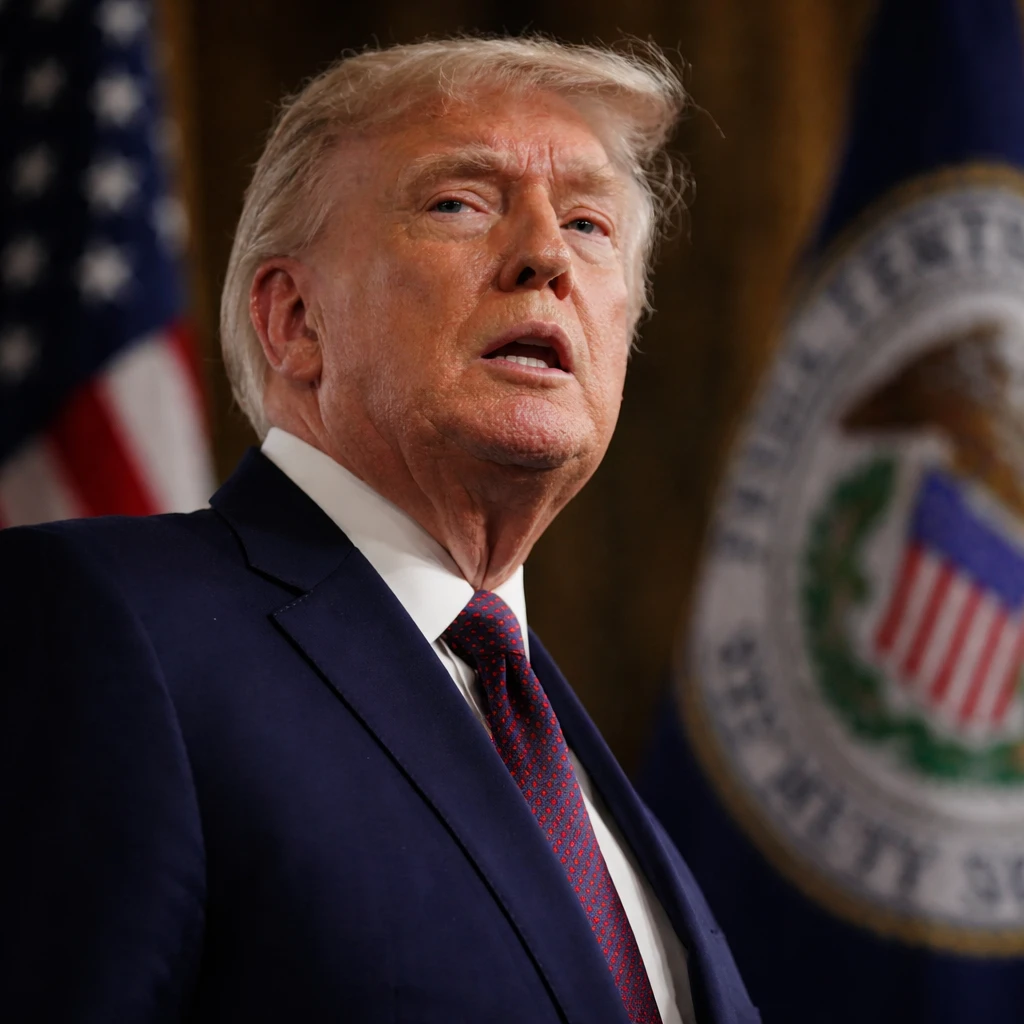

President Donald Trump declared on Thursday night that he will announce his selection for the chairman of the Federal Reserve the following morning, marking a pivotal moment that may test the Federal Reserve's independence from political influence. The current chair, Jerome Powell, whose term is set to conclude in May, has faced sustained public criticism from Trump throughout the past year, primarily over divergent views concerning the direction of interest rate adjustments.
Trump has consistently urged Powell to implement more significant reductions to the Fed's benchmark interest rates, aiming to accelerate economic expansion. Contrarily, Powell has maintained a more measured stance, considering prevailing inflationary pressures elevated, a condition exacerbated by the president’s tariff policies.
As Trump attended a screening of the documentary "Melania" about the First Lady, he informed reporters, "I’ll be announcing the Fed chair tomorrow morning. It’s going to be, somebody that is very respected, somebody that’s known to everybody in the financial world. And I think it’s going to be a very good choice. I hope so." Details regarding the nominee remain closely guarded.
The search for a new Fed chair has been led by Treasury Secretary Scott Bessent. Among the four finalists identified are Kevin Warsh, a former Federal Reserve governor; Christopher Waller, a current Fed governor; Rick Rieder, a BlackRock executive; and Kevin Hassett, the director of the White House National Economic Council. Initially, Hassett was speculated to be the leading candidate, but recent statements from Trump indicate a preference to retain Hassett in his present role.
Trump's cryptic commentary on Thursday hinted, "a lot of people think that this is somebody that could have been there a few years ago," which has fueled conjecture around Warsh, who was considered during the 2017 selection process that ultimately appointed Powell.
The relationship between Trump and the Federal Reserve has become increasingly strained, highlighted by Trump's remarks on the costs associated with renovating the Fed's headquarters. These tensions escalated to the point where the Justice Department issued subpoenas to the Federal Reserve earlier in the month. In response, Powell issued a rare video statement emphasizing the importance of maintaining the Federal Reserve's independence, saying, "The threat of criminal charges is a consequence of the Federal Reserve setting interest rates based on our best assessment of what will serve the public, rather than following the preferences of the president."
Throughout the process, Trump has heavily implied that his nominee would champion substantial cuts in interest rates, a move intended to influence monetary conditions affecting inflation rates, money supply, and employment. However, Powell’s position on the Federal Reserve's board extends beyond his chairmanship, with a term lasting until 2028, potentially enabling him to remain on the board despite the conclusion of his chair term. This scenario could complicate Trump's efforts to influence the Fed's strategic direction, as the composition of the seven-member board also includes appointees from President Joe Biden, who renominated Powell for a second term as chair.
If Powell chooses to stay on the board, procedural complexities might arise, potentially limiting Trump's capacity to appoint new board members. Thus, Trump’s options may narrow to selecting a new chairperson from existing governors or replacing Stephen Miran, the current leave-holder of a governor’s seat, whose term is due to end imminently. Miran is on leave from his role as chair of the White House Council of Economic Advisers while temporarily serving on the Fed board.
During a news conference the previous day, Powell refrained from confirming his intentions to remain on the board but highlighted the importance for any future Fed chair to maintain a balance between independent judgment and public accountability. He cautioned successors to avoid engagement with electoral politics, noting, "Don’t get pulled into elected politics — don’t do it," and underscoring that Congressional oversight serves as the principal mechanism for democratic accountability, stressing, "It’s not a passive burden for us to go to Congress and talk to people. It’s an affirmative regular obligation."