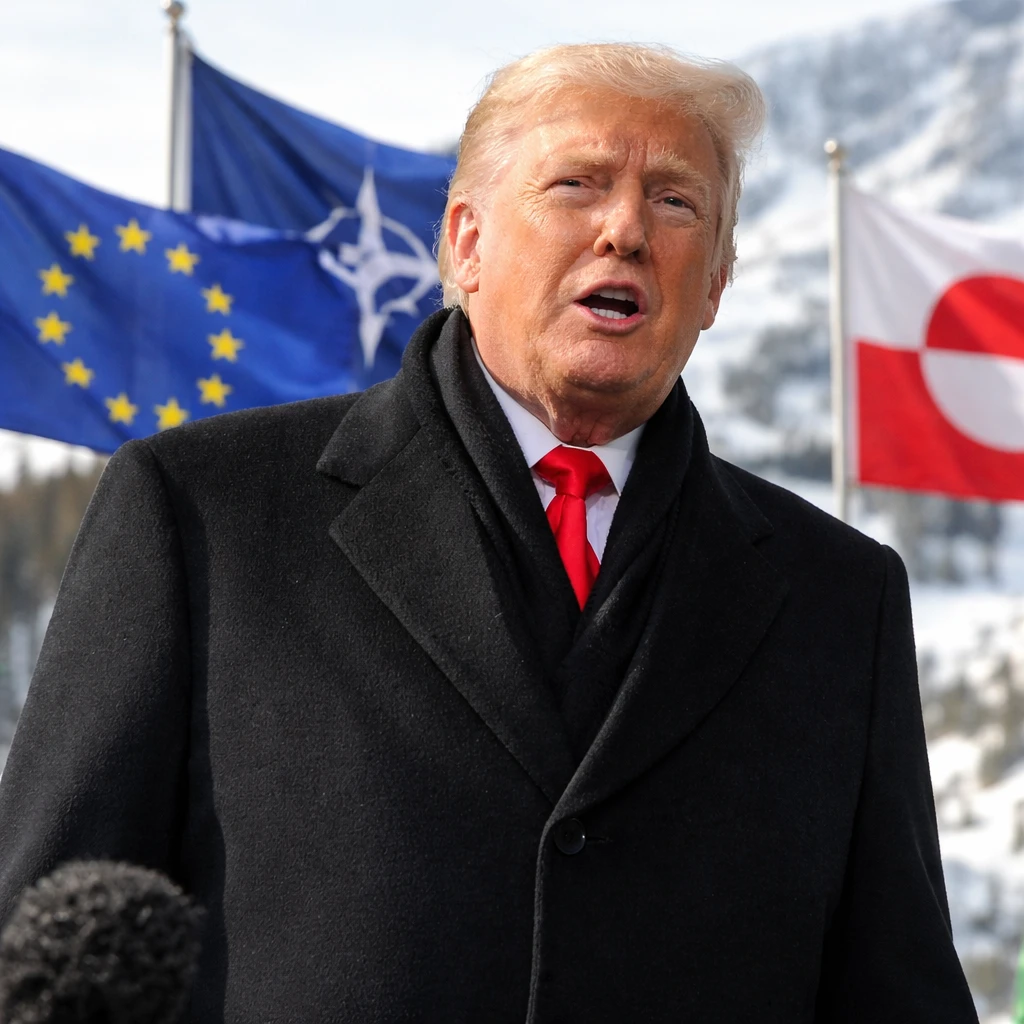

At the annual World Economic Forum held in Davos, Switzerland, President Donald Trump announced the cancellation of his proposed tariffs on eight European nations following a contentious proposal regarding U.S. acquisition of Greenland. Earlier in his address, the president emphasized Greenland's strategic value and the United States' interest in gaining full control, expressing intentions to secure the island "including right, title and ownership." However, he later posted on his social media platform that he had reached an understanding with NATO's chief on a "framework of a future deal" that addressed Arctic security concerns, signaling a de-escalation in tensions.
Trump highlighted ongoing discussions related to the Golden Dome missile defense initiative, a multibillion-dollar layered defense system that aims to incorporate weaponry in space. Despite previous threats, including earlier in the year when he indicated plans for significant import tariffs on multiple countries, his approach has shifted following diplomatic engagements and strategic reconsideration.
During his speech, the president critiqued Greenland's geographic characteristics, describing the territory as "cold and poorly located," while asserting that the United States had effectively safeguarded Europe during the Second World War. He characterized NATO’s demands from the U.S. as minimal considering decades of American efforts, stating, "It's a very small ask compared to what we have given them for many, many decades." Nonetheless, Trump warned that if negotiations failed, the U.S. might resort to "excessive strength and force," though he later assured he did not desire nor intend to employ such measures.
Frequent doubts expressed by the president about NATO's reciprocal defense commitments have partly fueled his assertive stance on Greenland. After the speech, NATO Secretary General Mark Rutte reaffirmed the alliance's commitment to the United States, assuring that allies would stand alongside Washington if attacked.
Trump’s threat to impose tariffs – starting at 10% and escalating to 25% by June – on Denmark and seven other European countries aimed to compel negotiation over the transfer of Greenland, which is a semi-autonomous Danish territory. Although the tariffs were intended to begin imminently, the president’s subsequent withdrawal avoided immediate imposition.
European leaders strongly opposed the notion that Greenland could be sold and rejected the tariff threats, emphasizing the island's position as off-limits for acquisition. Danish officials expressed readiness to address U.S. security concerns but maintained immutable positions regarding national sovereignty over Greenland.
In response to the uncertainty, Greenland’s government advised its residents to prepare for potential crises by maintaining adequate supplies of essentials such as food, water, and fuel. Residents like Tony Jakobsen in Nuuk took precautions by purchasing emergency items, interpreting the president’s rhetoric as threatening but hoped it would not escalate.
Prior to rescinding the tariffs, Trump's remarks directed at Denmark were notably critical, accusing the Danish government of ingratitude for U.S. protection during World War II. The president repeatedly confused Greenland with Iceland during his speech, despite the distinct status and location of the island. He characterized Greenland as part of North America and implied its secure control favored U.S. national interests. Regarding negotiations, Trump proposed opening immediate discussions about the island's acquisition but declined to specify a cost, instead emphasizing the broader price tied to safety and international security.
Additionally, the president contrasted the American economic outlook with Europe’s, stating that while the U.S. economy thrives, Europe is "not heading in the right direction." He expressed a wish for strong allies but underscored a preference to prevent weakening among allied nations. His arrival at the forum was delayed due to a minor Air Force One electrical issue, and his motorcade was met by both supporters and opponents along the route.
Following the address, Trump engaged in separate meetings with leaders from Poland, Belgium, and Egypt. Although the summit was meant to highlight plans to reduce U.S. housing costs as part of an effort to lower living expenses before midterm elections, Greenland and defense issues dominated discourse.
Greenland residents exhibited anxiety regarding the president’s focus on their homeland, with individuals like Johnny Hedemann calling Trump's remarks "insulting" and describing the island as more than an "ice cube." The threat of geopolitical pressure added to the challenges faced living in a demanding environment, contributing to a climate of uncertainty among the community.