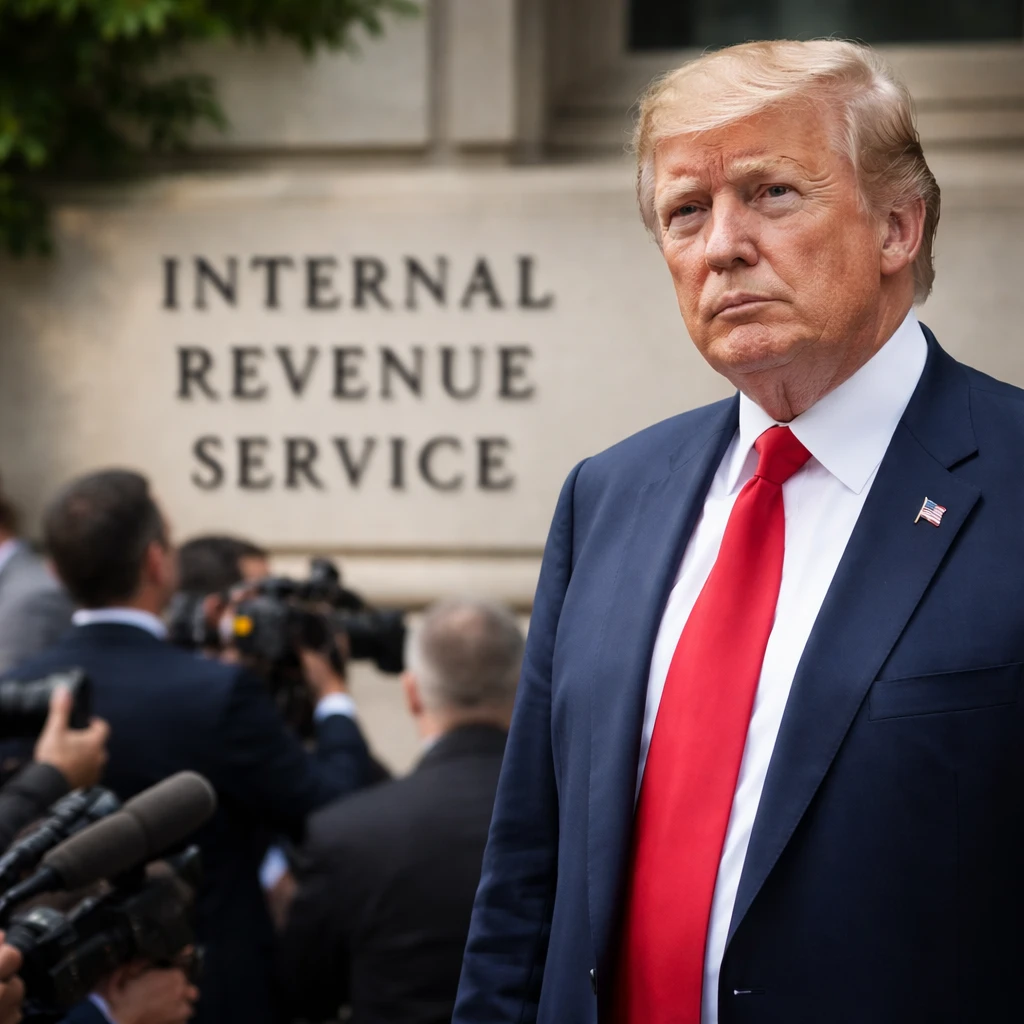

President Donald Trump, along with his sons Donald Jr. and Eric, filed a $10 billion lawsuit against the Internal Revenue Service (IRS) this past Thursday in a federal court in Florida. The suit addresses the unauthorized disclosure of Trump’s and the Trump Organization’s private tax records, alleging that the leaks inflicted significant reputational and financial harm, caused public embarrassment, distorted their business standing, and adversely impacted the public perceptions of both the president and his sons.
The leak of this sensitive financial information has brought forth complex legal and ethical questions among experts, particularly concerning whether a sitting president should pursue litigation against a government entity he administers. The allegations stem from breaches of what is considered some of the strictest confidentiality rules governing tax information under federal law, specifically Code 6103 of the IRS.
Charles Edward Littlejohn, a former IRS contractor employed by Booz Allen Hamilton, a national security and defense technology firm, pleaded guilty and was sentenced in 2024 to five years in prison for leaking tax information about Trump and others to media outlets between 2018 and 2020. Although specific media organizations were not mentioned in the complaint, the timeframe and description align with reports published by The New York Times regarding Trump’s tax returns and investigative stories by ProPublica concerning the taxes of wealthy Americans.
The New York Times exposed in 2020 that Trump paid merely $750 in federal income taxes the year he first took office and had zero federal income tax payments in some other years due to massive reported losses. Legal analysts acknowledge that Trump has a legitimate basis to challenge the IRS for this breach but question the rationale behind the $10 billion figure sought in damages as well as the strategic decision to proceed with such litigation. The IRS confidentiality statute provides a minimum legal remedy of $1,000 per violation, establishing a tangible basis for legal action.
Littlejohn also illicitly accessed tax documents of other billionaires, including Jeff Bezos and Elon Musk. This raises the potential for the case to set a precedent, encouraging other affluent individuals affected by these breaches to seek reparations from the government. David Gair, a tax attorney from Troutman Pepper Locke in Dallas who represents clients whose tax data was among those divulged, cites increased interest from potential claimants inspired by Trump's lawsuit, indicating a possibility of broader impacts within wealthy circles.
Amy Hanauer, executive director of the Institute on Taxation and Economic Policy, highlighted that legal remedies have been put in place for such violations: the responsible contractor has been imprisoned, the Trump administration’s Treasury Department terminated the contractor’s employer's contracts, and the IRS issued a rare public apology to affected taxpayers. The IRS has also pledged to enhance data protection procedures moving forward.
Hanauer cautioned that despite a fair judicial outcome potentially dismissing Trump’s claims as unfounded, there remains a significant risk that the IRS may opt for a settlement, resulting in a costly payout to Trump financed by taxpayers. When questioned about managing the apparent conflict of interest given his dual roles as claimant and head of the executive branch, Trump referred to a prior lawsuit he filed against the Department of Justice seeking about $230 million in damages for investigations into his 2016 campaign’s Russia ties and classified document retention at Mar-a-Lago in 2022.
He remarked sarcastically about the possibility of "settling with myself" and indicated an intention to donate any awarded sum to multiple charitable organizations, though the White House declined to specify which groups might benefit.
Representation for those impacted by the leaks emphasize that plaintiffs are not required to prove actual compensatory damages, although punitive damages are also sought by Trump. Gair noted that demonstrating real financial harm could prove challenging for the president given the Trump Organization's business deals post-election.
This lawsuit thrusts into the spotlight the complex interplay between executive authority, confidentiality obligations, and the evolving dynamics of legal recourse for unauthorized disclosures of high-profile financial information.