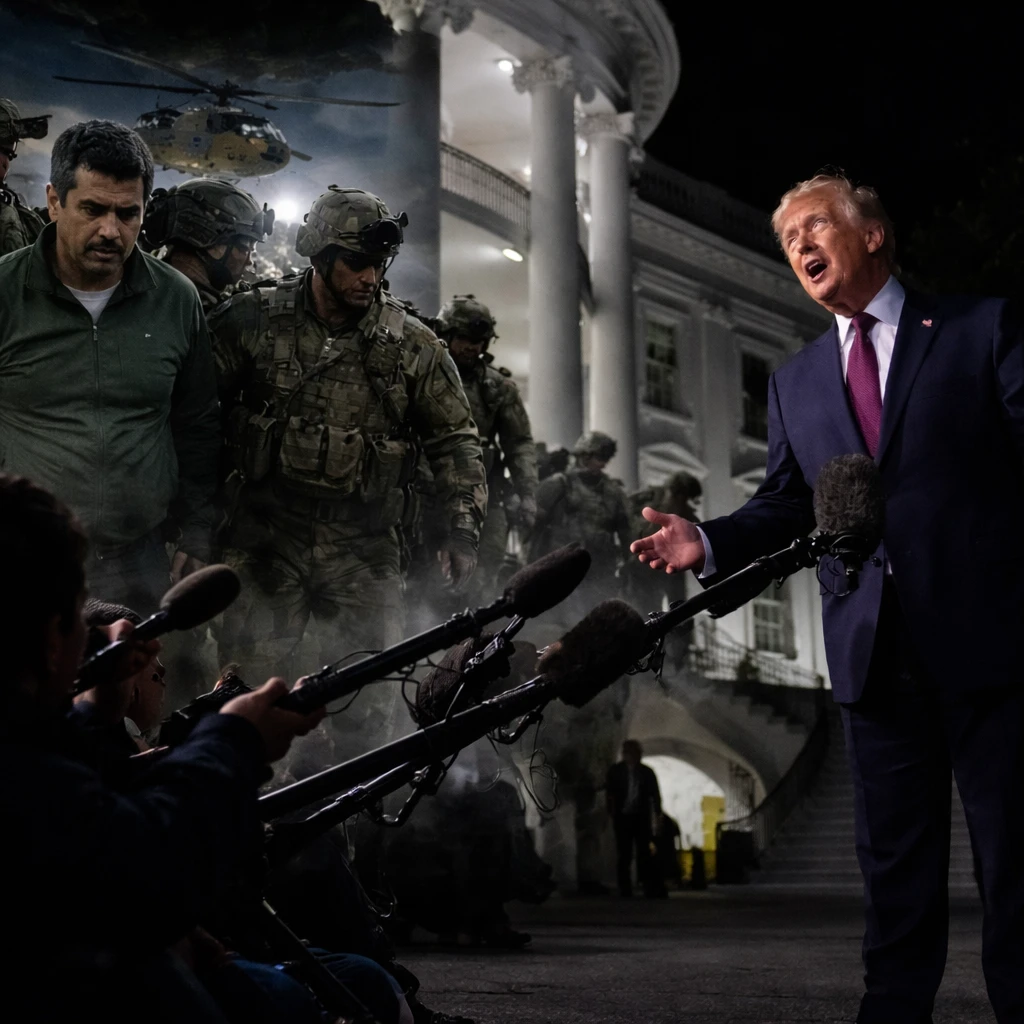

In a daring military undertaking, President Donald Trump orchestrated the capture of Venezuelan leader Nicolás Maduro, a figure long criticized by the Trump administration as a "narco-terrorist" and an "illegitimate" ruler. This operation, which successfully removed Maduro from power, reflects a renewed willingness on the part of the U.S. president to engage American forces in perilous missions that offer potential strategic rewards.
Speaking to The New York Times shortly after U.S. troops secured Venezuelan airspace, President Trump described the action as a "brilliant operation," underscoring his commitment to assert U.S. dominance in the Western Hemisphere. This mission followed on the heels of the administration's National Security Strategy released the previous month, which emphasized a more assertive American presence regionally.
Despite this tactical victory, the aftermath presents a landscape fraught with uncertainty. Key concerns arise surrounding who will assume control in the power void left by Maduro's ouster, especially given Venezuela's long-standing struggles with hyperinflation, improper supply of essential goods, and a depleted workforce, all occurring amid its extensive oil reserves.
Moreover, global observers watch closely to see how adversaries might respond or interpret this deployment of U.S. military might. Notably, China’s intentions toward Taiwan and Russia’s moves involving Ukraine and NATO’s eastern borders add layers of complexity to the geopolitical environment.
Assessing Trump's Strategic Risk
This operation signals a critical juncture in Trump’s second term foreign policy, highlighting a paradox where promises to avoid entanglements in foreign wars coincide with the willingness to authorize fraught military actions. Earlier in the year, Trump authorized strikes on Iranian nuclear sites, illustrating a pattern of using force against adversaries deemed threatening to U.S. interests.
Retired Navy Rear Admiral Mark Montgomery, an analyst with the Foundation for Defense of Democracies, noted the challenges awaiting the administration post-operation are more intricate than prior strikes, such as those against Iran. Montgomery emphasized the necessity for ongoing engagement to ensure Maduro's associates, implicated in similar illicit activities, do not retain power, anticipating they might resist due to limited alternatives for retreat.
International and Domestic Responses
While the Trump administration had escalated military presence in the Caribbean and targeted drug trafficking networks linked to Maduro’s regime, some global allies responded with apprehension. European leaders, including European Commission President António Costa and the EU foreign policy chief Kaja Kallas, expressed concerns regarding the operation, highlighting the need to uphold international law and the United Nations Charter, and advocated for restraint amid the unfolding situation.
Domestically, Democratic voices criticized the move as illegal and injurious to America's global reputation. Senator Ruben Gallego of Arizona argued the U.S. had shifted from being an international peacekeeper to assuming a more aggressive stance without clear justification. Concurrently, Russia condemned the intervention, labeling it as armed aggression and reaffirmed Venezuela’s sovereignty against foreign military interference.
Shaping Venezuela’s Future Leadership
The capture reflects sustained pressure from figures like Secretary of State Marco Rubio, who, along with other officials, had been calling for decisive action against Maduro for years. The Venezuelan community in South Florida lauded the operation as transformative for democracy in the hemisphere.
Attempts by Maduro to negotiate a graceful exit from power were reported but ultimately rebuffed by the White House over concerns about Maduro's legitimacy and links to narcotics trafficking. In the days preceding his capture, Maduro suggested openness to collaborating with the U.S. on drug control and inviting American investment in Venezuela's oil sector.
Trump has publicly declared Maduro’s tenure was nearing its end and underscored the need for vigilant involvement to prevent those linked to Maduro from simply transitioning into leadership roles. The administration faces decisions about endorsing recognized opposition figures, such as the exiled Edmundo González, or accepting transitional arrangements involving Maduro’s currently proposed successors.
On national television, President Trump emphasized a commitment to remain deeply involved in Venezuela’s future governance to avoid a recurrence of Maduro’s influence. This determination signals an ongoing U.S. role in steering the political trajectory of a critical nation in the Western Hemisphere.
With multiple stakeholders weighing in and the inherent challenges of stabilizing a nation marked by economic turmoil and political conflict, the United States enters a complex phase of diplomatic and strategic engagement following a bold but uncertain military success.