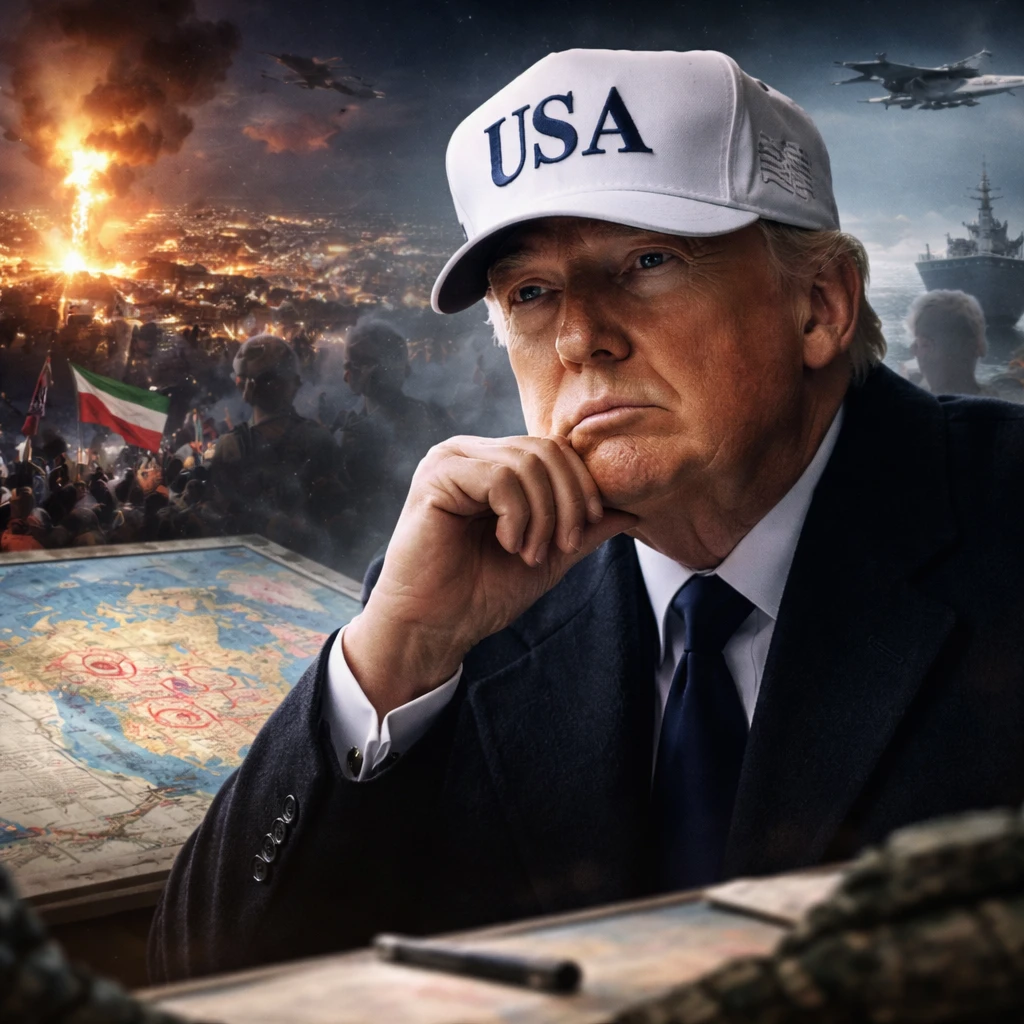

WASHINGTON — President Donald Trump is currently navigating a sensitive juncture regarding the potential use of military force against Iran, where a severe crackdown on anti-government protests has resulted in nearly 600 fatalities and thousands of detentions across the nation. Trump has repeatedly warned the Iranian leadership that any use of lethal force against protesters would cross a red line prompting possible military retaliation.
Despite the president’s warnings and a posture suggesting readiness for immediate action, the U.S. military forces have been placed in a state of readiness rather than active engagement, as reports indicate Iranian officials have expressed an interest in diplomatic talks with the White House. This cautious stance highlights an ongoing tension between military preparedness and diplomatic efforts.
White House Press Secretary Karoline Leavitt stated that the administration perceives a divergence between Iran's public rhetoric and the private messages it is receiving, suggesting an openness to dialogue. She emphasized that Trump remains willing to use military options if deemed necessary, underscoring the administration’s strategy of keeping all options open.
In a related move aimed at penalizing Tehran’s response to the unrest, President Trump announced via social media the immediate imposition of 25% tariffs on nations engaging in commerce with Iran. This measure marks Trump's first direct economic consequence targeting Iran tied to the protests, reflecting his tendency to employ tariffs as leverage in international relations. Countries affected by this tariff policy include China, the United Arab Emirates, Turkey, Brazil, and Russia, though further details from the White House regarding implementation remain sparse.
The specifics of Iran’s outreach to the U.S. have not been extensively disclosed, but Leavitt confirmed that President Trump's special envoy, Steve Witkoff, is involved in engagements with Tehran. Meanwhile, Vice President JD Vance, Secretary of State Marco Rubio, and key National Security Council members have convened to devise a range of policy options — spanning diplomatic initiatives to potential military strikes — to present for presidential consideration.
President Trump acknowledged that a meeting with Iranian representatives is being arranged but also warned that worsening conditions on the ground may necessitate swift action before any talks can proceed. The administration continues to monitor the situation closely.
Assessing the durability of the protests presents challenges due to Iran's enforcement of an internet blackout, which hinders information flow among cities and the coordination of demonstrators. Vali Nasr, a former State Department adviser and current Middle East studies professor, characterized the protests as spontaneous and leaderless, fueled by genuine popular anger but lacking the organizational structure typically required for sustained movements.
The president’s deliberations come amid additional global challenges. Recently, the United States conducted a significant military operation in Venezuela to detain Nicolás Maduro. Concurrently, there is a substantial U.S. troop presence in the Caribbean Sea. On another front, efforts continue to advance peace negotiations involving Israel, Hamas, and disputes between Russia and Ukraine.
Despite these competing priorities, some of Trump’s hawkish supporters urge decisive action to capitalize on Iran's perceived vulnerability. They argue that the current protests, sparked by economic collapse and longstanding grievances, represent a rare opening to challenge the entrenched regime of Supreme Leader Ayatollah Ali Khamenei. Iranian authorities have responded with harsh threats, including designating the U.S. military and Israel as legitimate targets should Washington intervene.
Advocates, such as Senator Lindsey Graham and former House Speaker Newt Gingrich, have publicly called on President Trump to act firmly in defense of the protesters and to leverage this moment to dismantle the Iranian dictatorship. They warn against the risk of missed opportunity and highlight parallels with reluctance to respond decisively in past international crises.
Iran has historically quashed mass movements, as seen with the Green Movement in 2009 and the "woman, life, freedom" protests following Mahsa Amini's death in 2022. The Trump administration is reviewing military options while pursuing ongoing dialogue with its national security team. Experts note, however, that repetitive official condemnations without concrete action may diminish the administration’s credibility, stressing that strategic unpredictability must not translate into inaction that potentially rescues an embattled regime.