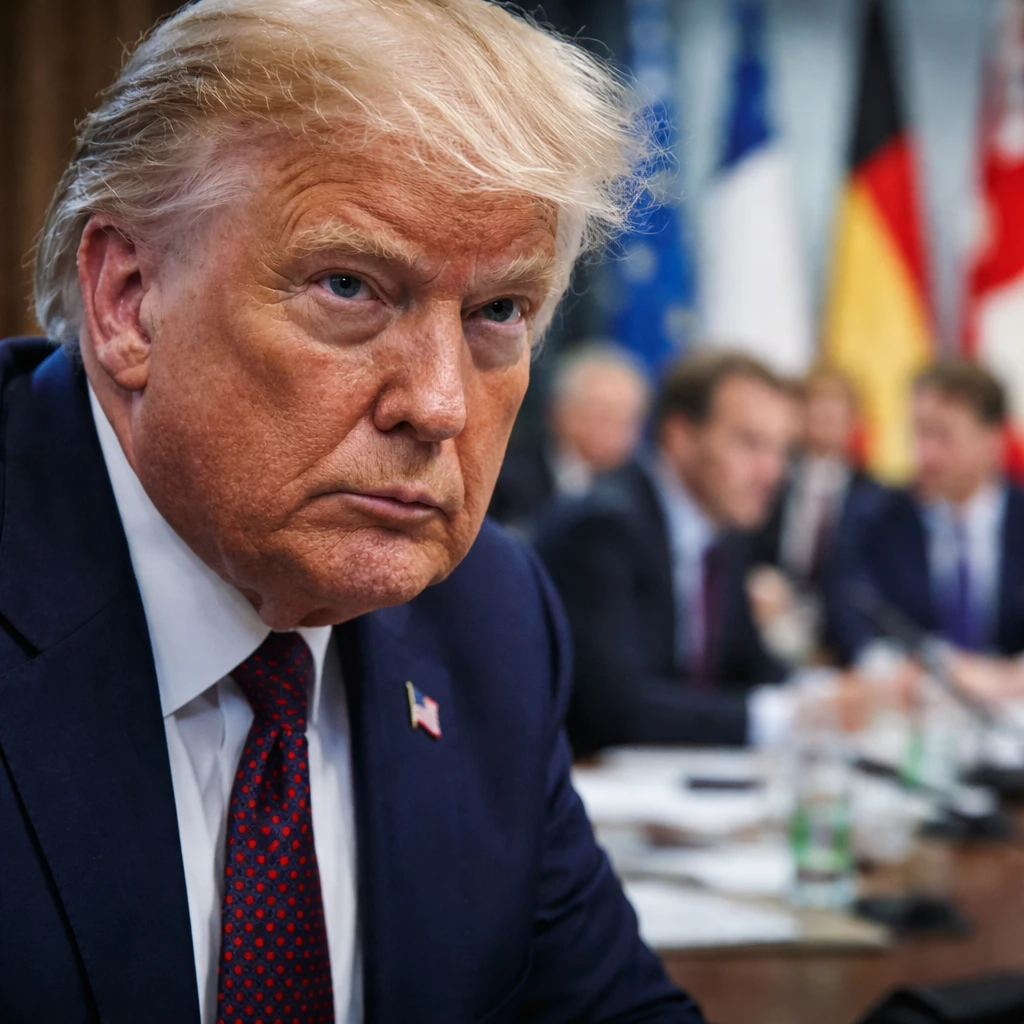

President Donald Trump's conduct on the world stage has been marked by abrupt gestures that both extend and retract diplomatic engagement. A striking example occurred when he rescinded Canadian Prime Minister Mark Carney’s invitation to join his Board of Peace. While this board, chaired by Trump, was initially created to manage ceasefire efforts in Israel's conflict with Hamas, it has evolved into an enigmatic entity, arousing suspicion among many Western allies who worry it might emerge as a rival to the United Nations.
At the World Economic Forum in Davos, President Trump recounted considering tariffs on Switzerland, which he ultimately reduced, citing a phone call in which the Swiss leader “rubbed me the wrong way.” In addition, before abandoning broad tariffs proposed on various European nations, Trump appealed to Denmark to acquiesce to a U.S. proposal to take control of Greenland, warning, “we will be very appreciative. Or you can say no and we will remember,” a comment that risks straining NATO ties.
Throughout his public tenure, Trump has not been known for diplomatic delicacy. However, recent weeks have underscored his clear intent to dismantle the post-World War II rules-based international framework that has guided U.S. foreign policy and influenced much of the Western world.
This established system has been criticized by Trump and his base as inefficient and disconnected from the urgent needs of populations experiencing swift economic alterations. In its place, Trump promotes a less predictable model, heavily dependent on the subjective judgments of a single leader whose decisions frequently pivot on personal interactions and sentiments.
Returning from Davos, Senator Lisa Murkowski of Alaska described the prevailing sentiment among allied nations as entering a "new world order," accompanied by uncertainty about U.S. intentions. She noted that allies express concern that unforeseen tariffs could arise from disagreements with the president, unsettling traditional partnerships and encouraging engagement with other countries out of doubt concerning America's reliability.
Trump’s approach to leadership reflects his 2016 campaign assertion that “I alone can fix” the nation’s challenges. Now in his second term, emboldened and assertive, he has embraced a winner-takes-all style that has pleased his supporters. Former adviser Steve Bannon characterized the president's tactics as a relentless pursuit of maximalist goals without encountering meaningful opposition—a situation reflected in a Republican-led Congress that has done little to restrain Trump.
However, international leaders, who have for much of his presidency sought workable relations, have become increasingly critical. Mark Carney has emerged as a figure advocating for countries to collaborate to counterbalance the U.S.’s unilateralism, promoting a coalition of "middle powers" who collectively can wield legitimacy and uphold rules against rising hard power.—a message at odds with Trump’s views.
Trump responded sharply to Carney’s remarks, emphasizing Canada’s dependence on the United States and withdrawing Carney’s Board of Peace invitation. Nonetheless, Carney remained firm, offering Canada as an example for navigating a turbulent global landscape and opposing a drift toward authoritarianism and exclusion.
In the United Kingdom, Prime Minister Keir Starmer condemned Trump’s comments that questioned NATO’s commitment to the U.S., recalling the significant sacrifices made by British troops under Article 5. Trump questioned the contributions of non-U.S. troops in conflict zones, provoking further criticism from allies.
Denmark, a nation Trump disparaged despite its high fatalities during coalition efforts in Afghanistan, found itself at the center of Trump’s Greenland proposal, exemplifying broader tensions. These developments have incited fears of enduring damage to the United States’ global standing and suggest that some countries may pivot towards strengthening alliances with China.
Former national security adviser Jake Sullivan remarked that China observes the U.S. president’s confrontations with allies as advantageous to its position. Trump echoed such sentiments by warning that China would capitalize on Canada's ties. Moreover, the Pentagon’s recent defense guidance has signaled a shift, indicating that allies should assume greater responsibility for their own security.
Senator Chris Coons spoke of Trump's inclination to relent only when met with firmness from countries like China, contrasting this with a lack of respect for entities such as the European Union, which refrained from retaliatory tariffs. His observations suggest that accommodating the president’s demands on unstable grounds, for example regarding Greenland, is unlikely to yield successful outcomes.
As these dynamics unfold, the global community confronts a period of adjustment and uncertainty in alliances and international governance amid a markedly individualized U.S. foreign policy approach.