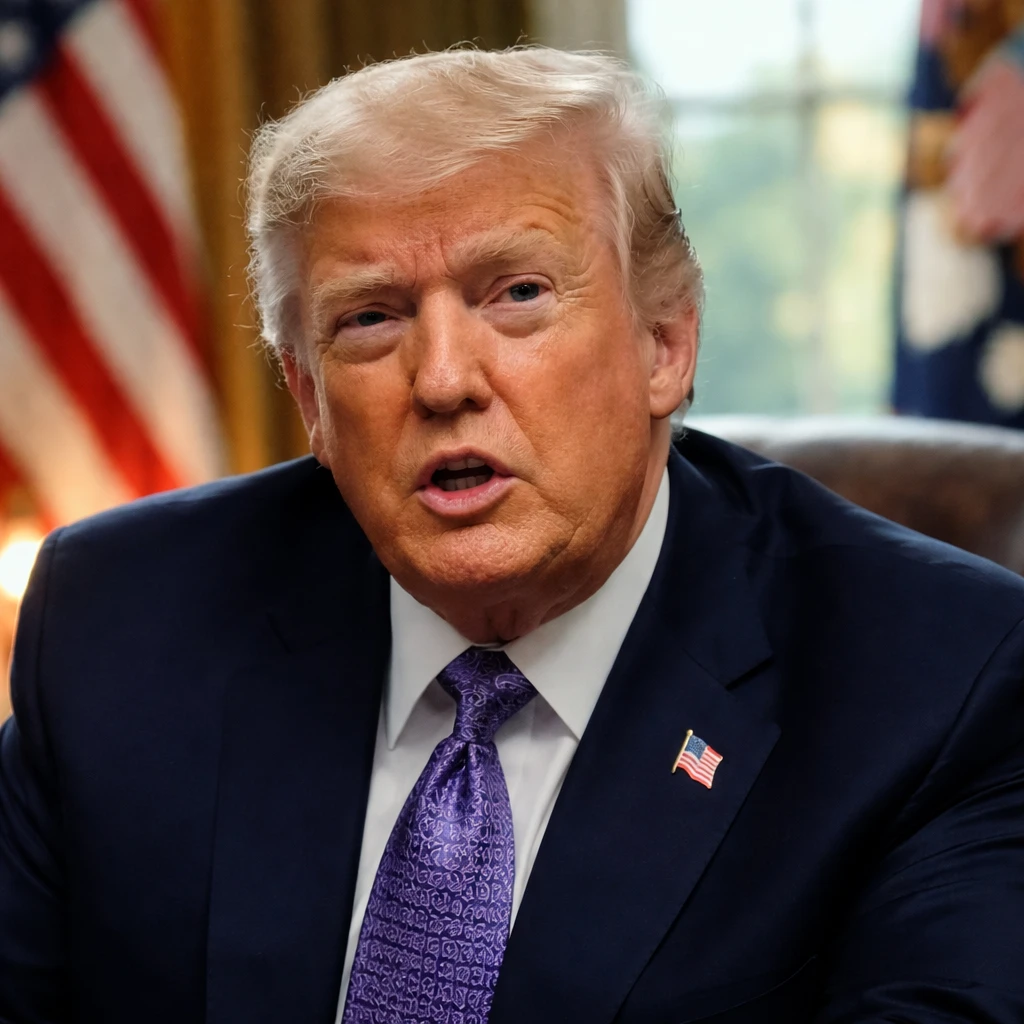

WASHINGTON — President Donald Trump’s tenure in his second term has been marked by a barrage of high-profile actions and statements that consistently capture national and international attention. From initiating a covert military maneuver in Venezuela to publicly inserting himself into NFL coaching decisions, Trump’s presidency is a demonstration of counter-norm presidential conduct aimed at sustaining his visibility.
The president's unrelenting engagement agenda ranges across multiple domains: threatening nations such as Iran, Denmark, Greenland, and Colombia; posing publicly with a Nobel Peace Prize awarded to another; contemplating the deployment of U.S. troops to Minneapolis during unrest; threatening political adversaries; and imposing sweeping tariffs. Such moves collectively display a presidency defined by a proclivity for disruption and spectacle.
Senator John Kennedy, highlighting Trump’s intense and provocative style, remarked, “The president exists loudly... He will play with fire. I haven’t seen him yet play with live hand grenades, but I’ve seen him come damn close.” This encapsulates the persistent and boundary-pushing attitude Trump brings to office, which appears to be an enduring feature of his leadership.
Throughout his second term, the president frequently concludes his social media posts with the phrase, “thank you for your attention to this matter,” deployed over 240 times, often in uppercase lettering and accompanied by several exclamation points. This signature signoff underscores his strategic focus on commanding public and media focus amid a turbulent political landscape.
Trump’s lifelong career has revolved around commanding attention, initially emerging through New York tabloids and subsequently reality television. His approach leverages the attention economy’s dynamics, where visibility itself becomes a form of currency, regardless of the positive or negative nature of the attention. Political strategist Ron Bonjean pointed out, “You’re never not going to hear from him,” underscoring Trump’s consistent visibility to the public.
The president’s engagement now transcends politics and extends into cultural arenas such as sports. In September alone, he attended three major sporting events in New York City, drawing extensive media coverage. His presence at the U.S. Open final, despite eliciting booing from the predominantly elite crowd, generated prominent coverage and disrupted the event’s schedule.
Social media platforms, which had previously distanced themselves from Trump—most notably through bans following the U.S. Capitol attack—have seen a shift in leadership dynamics. Platforms like Twitter, now renamed X under Elon Musk’s ownership, have become aligned or at least tolerant of Trump’s influence, thus facilitating his continued broad reach online. Top tech executives, including Musk and Meta’s Mark Zuckerberg, participated in Trump’s inauguration, signaling a notable change in relationships between the administration and Silicon Valley.
Trump’s social media presence now benefits from advances in artificial intelligence, enabling rapid production of memes and videos designed to maintain his media prominence. Some of these posts cross into crude and provocative visual territory, exemplifying an aggressive and uncensored communication style. Observers such as Nolan Higdon note this iteration of social media usage markedly contrasts with the first presidential term’s approach.
Trump’s close aides have displayed tolerance or even endorsement of his provocative postings; House Speaker Mike Johnson described certain controversial posts as satire, while Vice President JD Vance publicly defended depictions of Trump in religious imagery. Chief of Staff Susie Wiles characterized Trump as having an “alcoholic’s personality,” suggestive of relentless ambition and disregard for perceived limits.
The tactics extend into foreign policy and domestic governance. Trump employs social media as a tool to assert power, including warnings to states resisting his policies that federal aid could be withdrawn. His commentary precipitated diplomatic strain, especially with Greenland and Denmark, prompting debate over NATO’s stability. Such actions illustrate a presidency actively reshaping international relations through provocative communication strategies.
Notably, Trump faces persistent challenges with two issues: Jeffrey Epstein’s case and domestic affordability concerns. Initially dismissive, he eventually endorsed legislative efforts to publicize Epstein-related files, although delays by the Justice Department have drawn criticism from prominent Democrats. Likewise, his public communication on economic affordability has struggled to break through the distraction of his broader media presence, highlighted by incidents like a Michigan visit overshadowed by a vulgar gesture directed at a critic.
Public opinion polls reinforce this uneven impact. Trump’s approval ratings are notably low on healthcare matters, with only about 30% approval according to December polling data. His handling of immigration has also declined from earlier relative strength to around 40%, reflecting shifting perceptions in his second term. Concurrently, Democratic figures such as California Governor Gavin Newsom and New York City Mayor Zohran Mamdani are effectively leveraging digital platforms to gain traction, signaling evolving political engagement strategies across the spectrum.
Political analysts debate the enduring transformation Trump’s presidency represents. Former White House Press Secretary Ari Fleischer notes Trump as “the definition of unique,” asserting that future presidents—regardless of party—may adopt altered communication tempos, though likely slower than Trump’s breakneck pace. The durability of Trump’s unconventional model and its implications for the presidency remain central questions as the nation approaches the next electoral cycle.