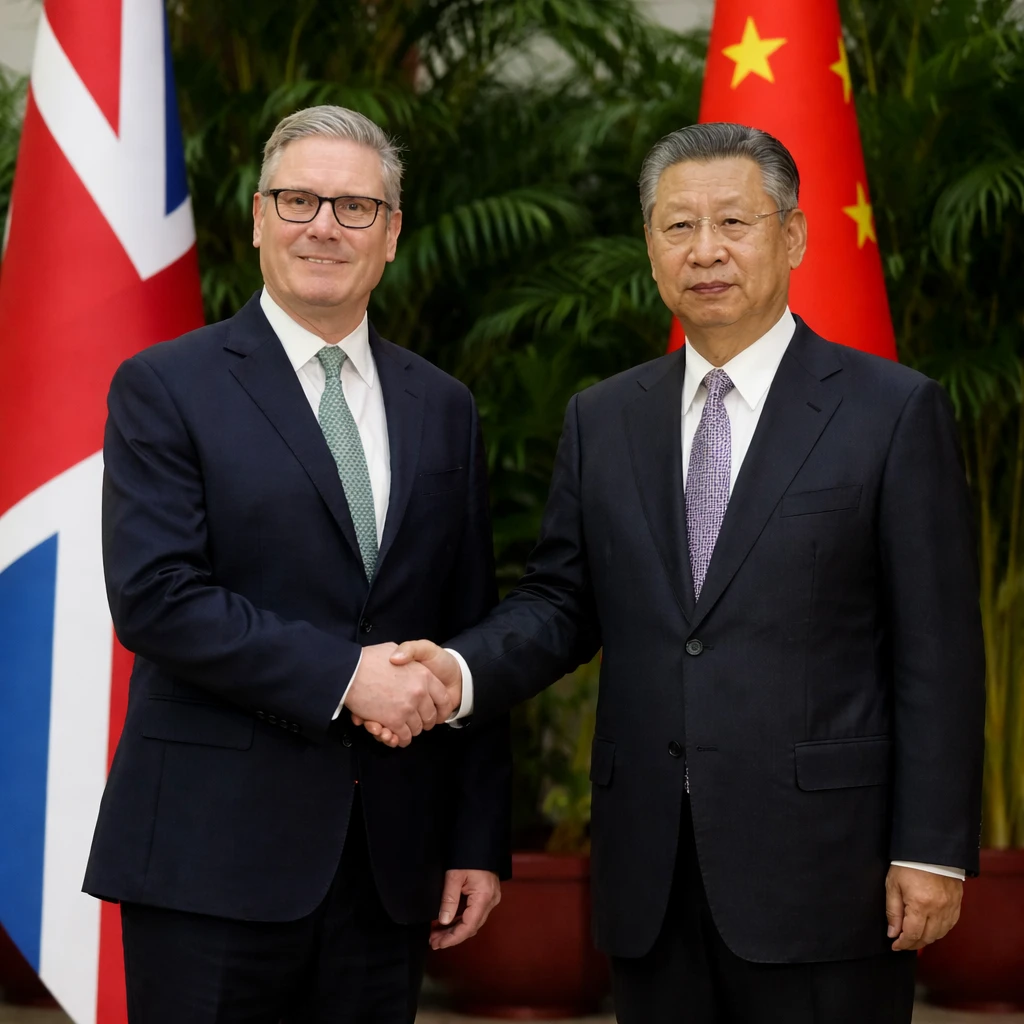

In the face of increasing global unpredictability, the United Kingdom and China took steps to bolster their bilateral relationship, with leaders from both countries advocating for a strategic partnership aimed at enhancing dialogue and cooperation. This initiative was set against a backdrop of complex international dynamics and follows a period marked by cooler interactions.
Prime Minister Keir Starmer and President Xi Jinping convened for an 80-minute discussion—twice the scheduled duration—in Beijing’s Great Hall of the People, signaling an intensified effort to address and improve relations. Although neither leader directly referenced the influence of former U.S. President Donald Trump, their conversations reflected a shared acknowledgment of the challenges to the prevailing post-Cold War international order.
President Xi highlighted the imperative for major powers to abide by international law to avoid a descent into global disorder, metaphorically referring to the potential outcome as a "jungle" scenario. He emphasized the importance of cooperation between China and the UK to maintain peace and stability worldwide. Echoing this sentiment, Starmer affirmed that partnership on global challenges such as climate change and maintaining stability amidst uncertainty is crucial and precisely aligned with shared objectives.
The two leaders addressed tensions that had previously marred relations. These included accusations of Chinese espionage activities within the UK, Beijing’s support of Russia in the conflict in Ukraine, and concerns over the diminution of freedoms in Hong Kong, the former British territory returned to China in 1997.
Starmer’s visit, notable as the first by a British prime minister in eight years, sought to reset the tone of UK-China relations, which Xi acknowledged had undergone "twists and turns" detrimental to both nations' interests. The UK government framed its ambitions for this renewed engagement as a desire for a "consistent, long-term, and strategic partnership" that would yield mutual benefits.
Following their discussions, Starmer expressed optimism regarding progress made, describing the current state of the relationship as "good" and "strong." The prime minister's itinerary included a planned visit to Shanghai and resulted in several significant agreements and business announcements. Key outcomes included the Chinese government reducing tariffs on Scotch whisky and the establishment of a 30-day visa-free travel arrangement for UK tourists and business visitors, which are expected to facilitate greater economic and cultural exchanges.
Addressing concerns raised by critics about security and human rights, particularly in light of a controversial Chinese embassy project in London, Xi acknowledged that meaningful progress often accompanies challenges. He stated that pursuing actions aligned with a nation’s and its people’s fundamental interests requires courage and perseverance despite difficulties.
Starmer, who has committed to safeguarding national security while fostering diplomatic engagement and economic cooperation with China, also directly raised human rights issues during his talks with Xi. He described their discourse on these topics as respectful. His administration is navigating a complex balance: seeking to open international opportunities without compromising security or values.
From a broader economic perspective, the UK’s government faces the pressing task of stimulating economic growth and mitigating a cost-of-living crisis impacting many households. Starmer views China as a pivotal partner in achieving these goals, aiming to broaden markets for British companies and attract Chinese investment.
His delegation included over 50 UK business leaders and representatives from significant cultural organizations, underlining the trip’s commercial and diplomatic significance. Among the agreements announced was a commitment by AstraZeneca to invest $15 billion in China through 2030, illustrating concrete business expansion plans triggered by this renewed engagement.
Additionally, the UK expressed interest in expanded access to China's vast market for professional and financial services. Both sides agreed to initiate a "feasibility study" regarding a potential services agreement, identifying this as a preliminary step toward formal negotiations.
The impetus for widening trade and investment partnerships gains urgency as prior disruptions—such as those caused by the Trump administration’s tariffs—continue to reorder global commerce. Other international actors, including Vietnam and the European Union, have similarly moved to enhance ties recently, signaling a broader trend of strategic partnership development amid uncertainties in the global rules-based system.
Starmer's visit aligns with a pattern of U.S. allies engaging China diplomatically; recent visitors include the leaders of South Korea, Canada, and Finland, with Germany's chancellor anticipated to visit soon. The UK leader also met with high-ranking Chinese officials Zhao Leji and Premier Li Qiang, who conveyed widespread support within China for his rapprochement efforts.
At a gathering of the UK-China Business Council, Starmer underscored his vision for a nuanced bilateral relationship capable of reconciling differences while pursuing common goals. He invoked a Chinese proverb summarizing this approach as "pursue common goals whilst reserving differences," underscoring a pragmatic, forward-looking strategy for cooperation in complex times.