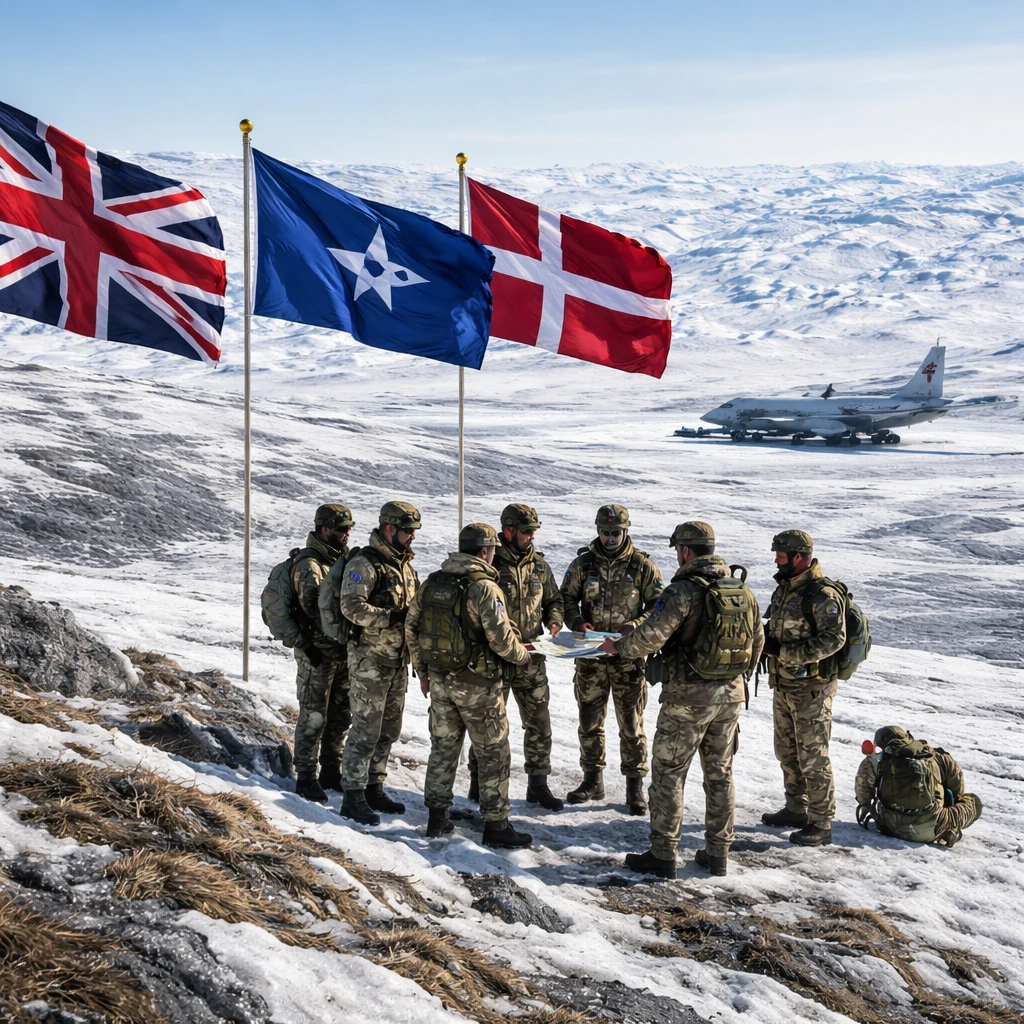

Amid growing strategic concerns over Arctic security, the United Kingdom has initiated discussions with NATO allies on how to bolster defense measures in the region to address threats from Russia and China, according to U.K. Transport Secretary Heidi Alexander. She clarified on Sunday that these talks are routine in nature rather than a direct reaction to recent statements made by U.S. President Donald Trump concerning Greenland.
President Trump has publicly expressed interest in pursuing negotiations to acquire Greenland, which, though geographically vast and sparsely populated with approximately 57,000 residents, functions as a semiautonomous region under the sovereignty of Denmark, a fellow NATO member. Trump’s intention to secure Greenland is purportedly motivated by the desire to prevent Russian or Chinese influence from expanding further into the Arctic. He asserted energetically that securing Greenland would be "easier" than anticipated and conveyed an unwavering determination to obtain the territory in some fashion. Speaking aboard Air Force One en route to Washington, he stated, "One way or the other, we’re going to have Greenland."
Greenland’s strategic significance is underscored by its defense arrangement; Denmark is responsible for its protection, though its military capabilities are limited compared to those of the United States, which operates a military base on the island. Denmark’s Prime Minister has issued warnings that any attempts to seize control over Greenland could undermine NATO’s integrity.
Against this backdrop, President Trump framed his contentious stance as part of his broader advocacy for NATO members to increase defense spending. While affirming his support for NATO, he expressed skepticism about the alliance’s reliability, questioning whether members would respond to U.S. needs if called upon.
Indeed, NATO’s Article 5—which commits members to mutual defense—has historically been invoked only once since its adoption, in response to the terrorist attacks on September 11, 2001. This invocation precipitated NATO’s mission in Afghanistan.
The discourse surrounding Greenland has heightened tensions between the United States and Denmark. Denmark’s ambassador to the U.S., Jesper Møller Sørensen, challenged remarks made by the newly appointed U.S. Greenland envoy, Jeff Landry, who suggested via social media that the U.S. defended Greenland’s sovereignty during World War II when Denmark could not. Sørensen rebutted this narrative, emphasizing Denmark’s steadfast alliance with the U.S., especially following the 2001 attacks, and reaffirmed that decisions regarding Greenland’s future must rest with its inhabitants. He urged continued collaboration to tackle Arctic security challenges as allied partners. Plans for discussions between Danish officials and U.S. Secretary of State Marco Rubio are underway this week.
On the topic of geopolitical competition in the Arctic, Secretary Alexander affirmed that the U.K. aligns with President Trump’s assessment regarding the increasing assertiveness of Russia and China within the Arctic Circle. Highlighting the critical nature of maintaining effective deterrence capabilities against Russian President Vladimir Putin, she noted that while the Arctic has not experienced the severe violence witnessed in Ukraine, the strategic imperative remains significant.
Peter Mandelson, former British ambassador to the United States, remarked that despite provocative statements, he does not anticipate the U.S. utilizing force to claim Greenland. Mandelson cautioned that the international community must acknowledge the necessity of securing the Arctic region against the expanding influence of China and Russia. He predicted that leadership in this endeavor would naturally fall to the United States.
Within the U.K., political leaders are considering concrete responses to these unfolding issues. Ed Davey, head of the Liberal Democrat Party, proposed that Britain could deploy military forces to Greenland in coordination with Denmark under a joint command structure. He criticized President Trump’s rhetoric as divisive and warned that fracturing NATO would ultimately advantage Russian interests.
Uncertainties linger regarding how other NATO members might react should the United States attempt a forcible acquisition of Greenland or how swiftly the alliance would mobilize in defense of Denmark’s territorial claims. These developments pose significant questions for Arctic security dynamics and allied cohesion.
Additional reporting contributions were provided from West Palm Beach, Florida, and Washington.