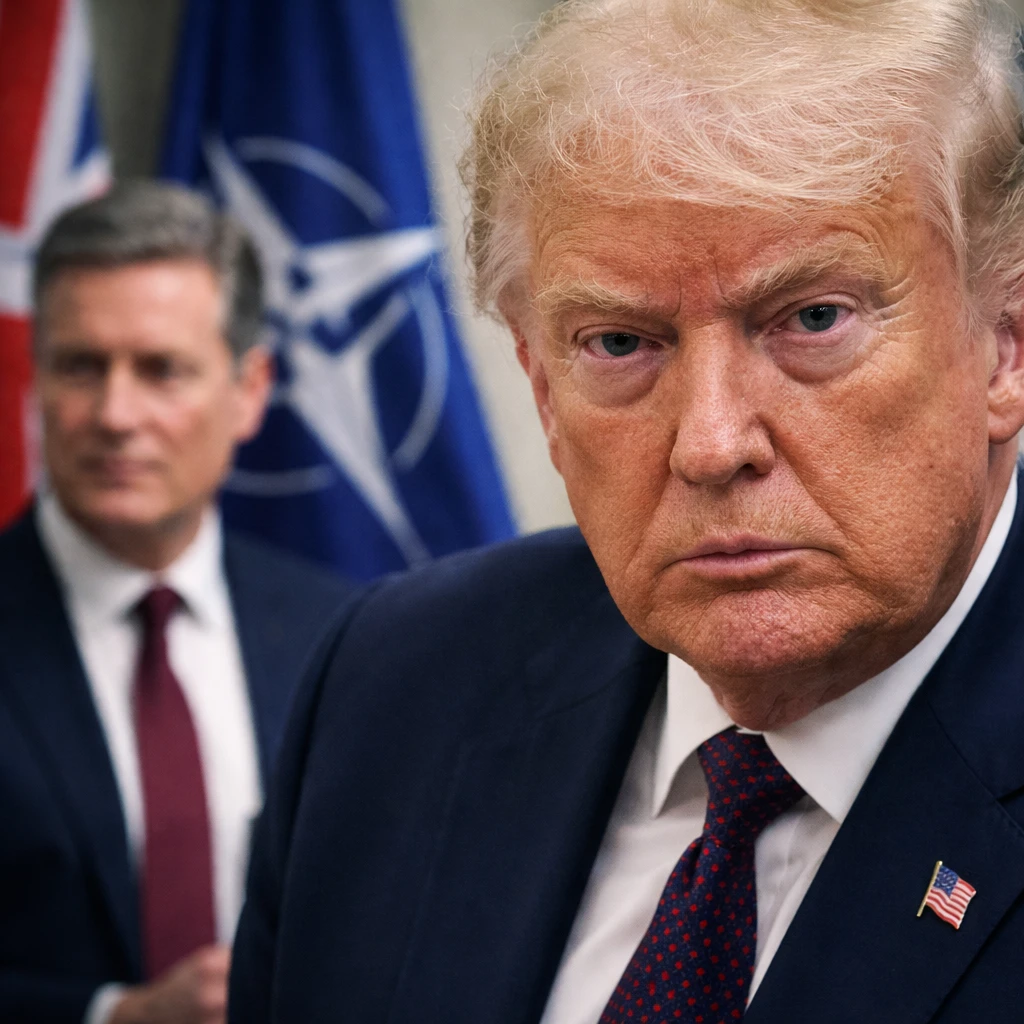
British Prime Minister Keir Starmer has publicly demanded an apology from U.S. President Donald Trump following the latter's remarks minimizing the involvement of non-American NATO troops on the front lines during the Afghanistan war. Starmer described the comments as "insulting" and "appalling," reflecting the deep upset caused across the United Kingdom on Friday regardless of political affiliations.
In an interview conducted in Davos, Switzerland, with Fox Business Network, President Trump questioned the reliability and contributions of NATO allies, stating, "We've never needed them, we have never really asked anything of them." He added, "You know, they'll say they sent some troops to Afghanistan, or this or that, and they did, they stayed a little back, a little off the front lines." These statements directly contradict the historical record of NATO's active role in the Afghanistan conflict.
Following the September 11 attacks in 2001, the United States led a multinational coalition to dismantle al-Qaida, and its Taliban hosts in Afghanistan. This coalition included troops from a range of countries, particularly NATO members. Notably, Article 5 of NATO's treaty—the alliance's mutual-defense obligation—was invoked for the first time after these attacks, underlining the commitment to mutual assistance among member states.
The United Kingdom, as a significant NATO member, suffered considerable losses and made substantial contributions throughout the conflict. Prime Minister Starmer honored the 457 British service members who died and acknowledged those with enduring injuries from the war, stating, "I will never forget their courage, their bravery and the sacrifice they made for their country." He further condemned President Trump's remarks, noting that they have caused pain not only to the families of the fallen and injured but also to the nation as a whole.
Prince Harry, who served two tours in Afghanistan with the British Army and lost comrades during the conflict, also voiced his disapproval indirectly. Without naming the president, he emphasized, "The sacrifices of British soldiers during the war deserve to be spoken about truthfully and with respect." He highlighted the profound and lasting effects on families and communities, recalling that "thousands of lives were changed forever," mentioning specifically the grief borne by parents and children of those lost.
The UK’s engagement in Afghanistan began under then-Prime Minister Tony Blair, who pledged that Britain would "stand shoulder to shoulder" with the United States in the aftermath of the 9/11 attacks. British forces were prominently involved, particularly in Helmand Province, until their withdrawal in 2014. American troops remained until their withdrawal in 2021, ending the long military presence and resulting in the Taliban regaining control.
During the conflict, over 150,000 British personnel served in Afghanistan, making it the largest non-American contingent. Ben Obese-Jecty, a Member of Parliament and former captain in the Royal Yorkshire Regiment who served in Afghanistan, expressed dismay, calling it "sad to see our nation’s sacrifice, and that of our NATO partners, held so cheaply by the president of the United States."
Reaction to the president’s comments was heightened by his own history with military service eligibility. Trump did not serve in the Vietnam War, receiving a deferment for bone spurs, an issue complicated by conflicting accounts of which foot was affected, leading to accusations of draft dodging. Stephen Stewart, author chronicling British troops’ experiences in Afghanistan, described Trump’s remarks as "hugely ironic" given this background.
President Trump's downplaying of NATO contributions has not been an isolated incident. This rhetoric has coincided with his broader confrontational posture toward allies, notably his threats over Greenland and impositions of tariffs on some European countries. Such actions have strained trans-Atlantic relations despite subsequent efforts to negotiate frameworks on Arctic security with NATO Secretary-General Mark Rutte.
Denmark, another NATO member heavily involved in Afghanistan, has also responded to the comments. Former Danish platoon commander Martin Tamm Andersen underscored that Denmark has been a steadfast U.S. ally, suffering the highest per capita military deaths in Afghanistan with 44 soldiers lost, along with eight in Iraq.
The emotional impact of the president’s assertions was underscored by individuals like Diane Dernie, whose son was severely injured in Afghanistan. She characterized the remarks as "the ultimate insult" and urged Prime Minister Starmer to respond firmly and support those who fought under the British flag. Starmer affirmed that, had he made such a statement, he would issue a full apology to those affected.
This controversy arises amid a week marked by significant debate over the president’s policy positions and diplomatic interactions with Europe. The tensions exposed by these remarks about NATO's Afghanistan involvement further complicate the already delicate trans-Atlantic relations.
Anders Kongshaug contributed reporting from Copenhagen, Denmark.