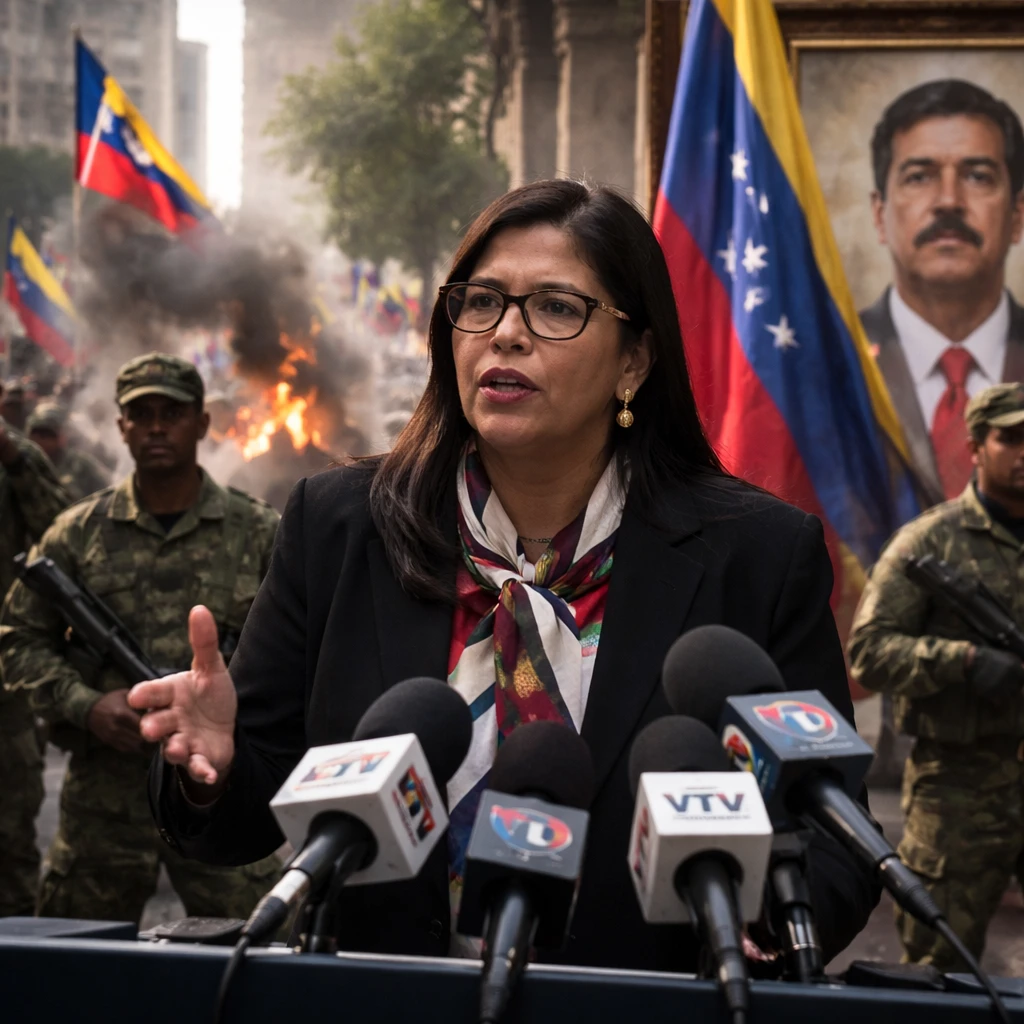
Caracas grapples with uncertainty over its leadership after the unexpected capture of President Nicolás Maduro by U.S. forces. Maduro, who has endured a failed coup attempt, multiple military uprisings, widespread protests, and economic sanctions, was seized from the helm of Venezuela, a nation of close to 29 million people.
Residents like Juan Pablo Petrone in Caracas expressed anxiety about the future, questioning what the immediate moments ahead may hold as the city’s streets quieted, only interrupted by long queues at supermarkets and gas stations.
Donald Trump, the U.S. president at the time, announced a profound shift in Venezuela’s governance. He declared that the United States would assume control of the country, possibly in collaboration with Maduro’s trusted vice president, Delcy Rodríguez. Rodríguez, designated in 2018 and next in Venezuela’s presidential line of succession, oversees significant facets of the country’s oil-dependent economy and controls the feared intelligence services.
According to a recent ruling from Venezuela’s Supreme Court, Rodríguez was instructed to take on the role of interim president.
Trump portrayed Rodríguez as committed to restoring Venezuela’s greatness, remarking that she is prepared to take whatever measures necessary. In doing so, he dismissed opposition leader María Corina Machado, a Nobel Peace Prize laureate, stating she lacks the necessary domestic support to lead.
Trump also disclosed that Rodríguez had a substantial discussion with Secretary of State Marco Rubio, during which she reportedly assured cooperation, saying, “We will do what you need.” Trump characterized the exchange as friendly and emphasized the importance of U.S. influence in preventing leadership unfavorable to Venezuelan people’s welfare.
Despite these assertions, Venezuela’s top officials appear to maintain their positions following the U.S. military operation, with no immediate evidence of U.S. governance control within the country.
Rodríguez sought to project stability and cohesion among the ruling party factions, downplaying suggestions of internal betrayal. Prior to the court order, she demanded the immediate release of Maduro and his wife, Cilia Flores, condemning the U.S. operation as a flagrant violation of the United Nations Charter.
Standing alongside senior civilian and military leaders in state television appearances, Rodríguez affirmed Maduro as the sole president. In parallel, Venezuelan military officials adopted a defiant stance, denouncing Trump and pledging resistance against U.S. pressure.
General Vladimir Padrino López, the Defense Minister, donned combat attire to declare, “We have been attacked, but we will not be broken.” Meanwhile, Interior Minister Diosdado Cabello rallied citizens to defend national sovereignty, condemning the U.S. assault and urging public mobilization.
Some Venezuelans responded with demonstrations supporting the government, including burning U.S. flags in Caracas, though the majority stayed home, paralyzed by fear amid unprecedented events, including explosions near military bases causing property damage and heightening local tension.
While Trump claimed Rodríguez was sworn in as interim president under the constitutional power transfer mechanisms, no publicized ceremony or televised investiture has been confirmed. In televised addresses, Rodríguez has not identified herself as interim president or acknowledged any political transition, instead reiterating opposition to what she termed "barbaric" U.S. aggression.
Venezuela's constitution mandates new elections within a month following a president’s absence, but experts question whether those provisions apply in the context of foreign military intervention and questions about the government’s popular legitimacy.
Delcy Rodríguez, educated in the UK and France and a longtime representative of the revolution initiated by the late Hugo Chávez, shares a socialist political lineage with her brother Jorge Rodríguez, head of the Maduro-controlled National Assembly. Their father, a socialist leader, died in police custody in the 1970s, a pivotal event influencing their political trajectory alongside Maduro's own background.
The Rodríguez siblings have avoided U.S. criminal charges, contrasting with other Maduro allies sought for narcotrafficking and human rights violations. Delcy Rodríguez has cultivated connections with Republican figures in the oil industry and Wall Street, opposing U.S. regime change efforts, engaging with figures such as Erik Prince and Richard Grenell in previous negotiation attempts.
Fluent in English, Rodríguez is sometimes characterized as a moderate when compared to the more radical military elements allied with Chávez's insurgency against Venezuela's former elected government in the 1990s, many of whom remain influential within the armed forces despite facing U.S. charges.
This dynamic presents challenges in consolidating Rodríguez’s authority, though some analysts anticipate the country’s leaders may unify as they have historically, with factions subordinating personal ambitions to shared survival.
David Smilde, a sociologist at Tulane University who researches Venezuelan political dynamics, noted such leaders have historically valued unity and suggested Cabello may again accept a secondary role tied to Maduro’s fate. The military’s strength, particularly after the U.S. bombardment, is a critical variable impacting this balance of power and overall vulnerability.
Prior to Trump’s press briefing, opposition figure María Corina Machado called on diplomat Edmundo González to assert his constitutional mandate and claim leadership based on disputed 2024 elections. Machado vowed to restore order, free political prisoners, and rebuild Venezuela, contending her movement is ready to assume power.
Nonetheless, Trump’s comments appeared to dampen such prospects, stating Machado lacks national support or respect, a stance that surprised Venezuelans anticipating a democratic transition. Machado has yet to respond publicly to Trump's remarks.