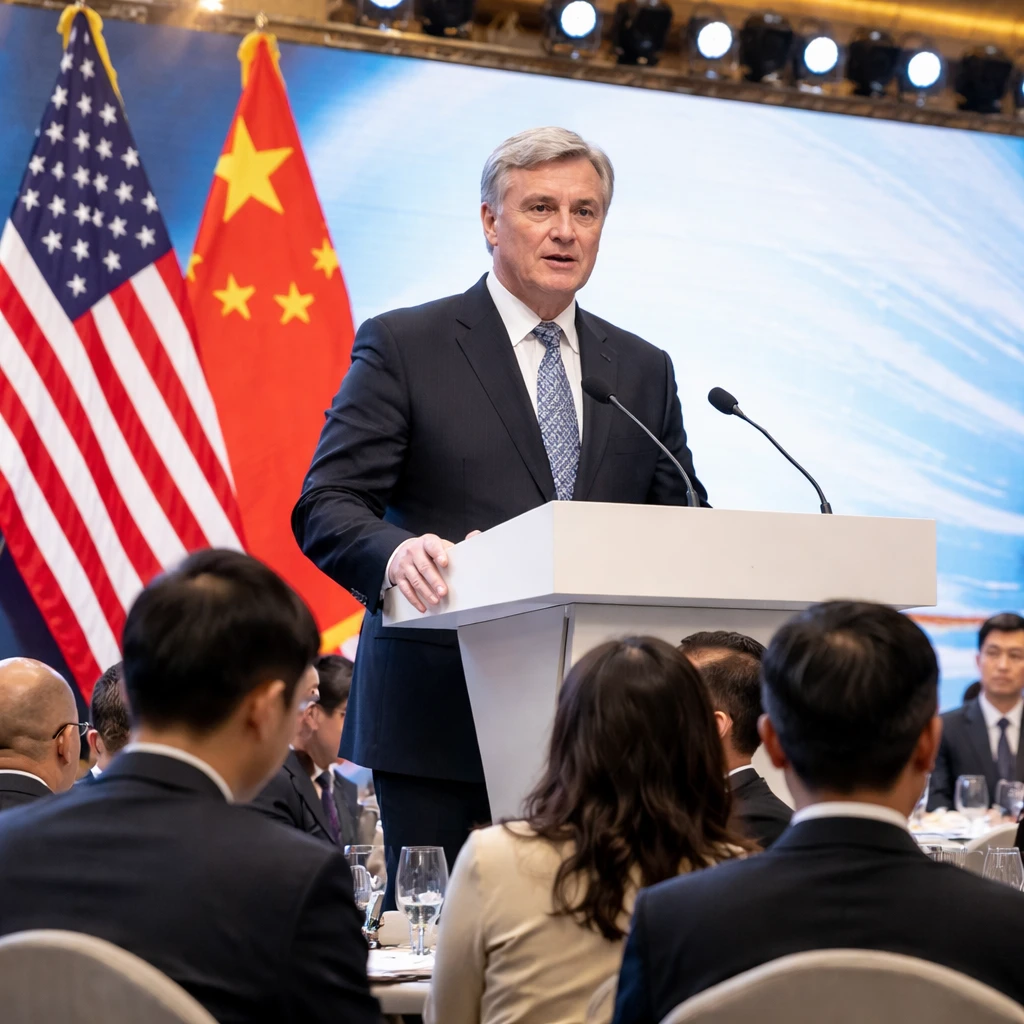

During a formal event in Beijing, the United States Ambassador to China articulated concerns regarding the trajectory of Chinese manufacturing's global dominance and its consequences for international trade balance. The ambassador underscored the value of celebrating China’s ascent as a manufacturing powerhouse, while simultaneously expressing apprehension shared internationally about how China's export strength poses economic challenges to other nations' industrial sectors and workforce stability.
Addressing attendees at the annual U.S.-China Chamber of Commerce dinner, Ambassador David Perdue recognized China’s significant industrial achievements but cautioned against the potential harm this growth inflicts on global economic health. He stressed that the expansion of China’s manufacturing capacity, if unaddressed, could undermine factories and jobs in other countries. "This dynamic is unfavorable for the rest of the world," he remarked, spotlighting the broader economic repercussions.
Ambassador Perdue, appointed by former President Donald Trump, referenced the previous administration's imposition of tariffs on Chinese goods, which was part of a broader strategy to revitalize manufacturing and employment within the United States. The imposition of such tariffs led to retaliatory measures by China, escalating into a cycle of reciprocal tariff increases that reached significant levels before both nations consented to a series of 90-day ceasefires. Notably, in late October, during an Asia-Pacific leaders’ summit in South Korea, the two countries agreed to a one-year pause in tariff escalations following meetings between Trump and Chinese President Xi Jinping.
Perdue characterized this pause as creating an essential window to tackle numerous complex trade-related issues. He emphasized the importance of sustained dialogue and cooperation moving forward.
The ambassador highlighted a perceived asymmetry in trade benefits, pointing out that China has capitalized considerably on free trade globally, whereas American enterprises have contended with persistent entry barriers within China’s market over many years. He affirmed that the United States’ objective is not to engage in a trade war but to foster equitable, open, and mutually advantageous trade relations.
Looking ahead, preparations are underway for a potential visit by President Trump to China in 2026, with Chinese leadership anticipated to reciprocate with a visit to the United States within the current year. Although Trump has suggested an April timeframe for his China visit, neither government has officially confirmed the date.