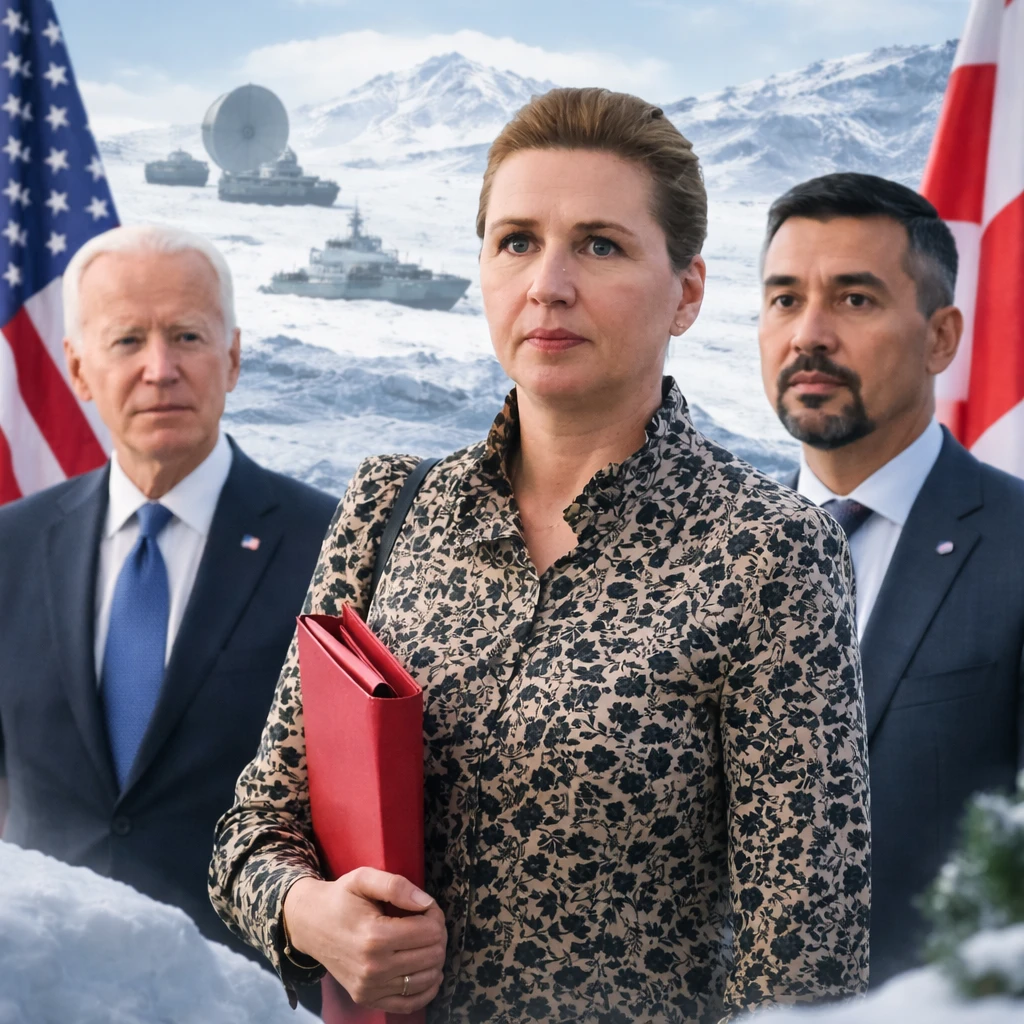

In Copenhagen, Denmark, tensions and diplomatic nuances emerged as US President Donald Trump declared an accord on future Arctic security cooperation that would afford the United States "total access to Greenland," a vast semiautonomous territory under Danish sovereignty. This announcement followed meetings involving NATO's Secretary General Mark Rutte and sparked immediate clarifications and reservations from Danish and Greenlandic officials.
Trump's remarks came in an interview with Fox Business where he articulated hopes for unrestricted US military access to Greenland. He also referenced the possibility of situating a component of his proposed "Golden Dome" missile defense system on the island, indicating a strategic military interest but stopping short of specifying deal details.
This development follows Trump's sudden withdrawal of threatened tariffs on eight European nations, previously issued to exert pressure over Greenland's control. Notably, Trump had earlier expressed ambitions to acquire Greenland outright, including "right, title and ownership," yet concurrently ruled out using force to do so.
Greenlandic Prime Minister Jens-Frederik Nielsen acknowledged the announcement with cautious optimism but emphasized that he had not been privy to specific terms of the purported agreement. When questioned, he said, "I don’t know what there is in the agreement, or the deal about my country."
Denmark's Prime Minister Mette Frederiksen firmly articulated that sovereignty is a non-negotiable principle. In a formal statement, she underscored that Arctic security discourse is appropriate within NATO frameworks and affirmed continual communication with the Dutch Prime Minister Mark Rutte prior to and following his discussions with Trump in Davos. Frederiksen reiterated, "we cannot negotiate on our sovereignty," and expressed Denmark's interest in ongoing constructive dialogue with allies, conditioned on respect for Danish territorial integrity.
Danish officials clarified that NATO lacks explicit authority to negotiate deals on behalf of Denmark or Greenland, underscoring the limited mandate of supranational defense bodies in territorial matters.
The US already maintains a military footprint in Greenland under a 1951 treaty with Denmark allowing establishment of bases upon consent. Denmark has signaled openness to expanded American military installations. NATO spokesperson Allison Hart emphasized that no sovereignty compromises were proposed during Rutte's meeting with Trump, noting that trilateral negotiations aim to forestall Russian and Chinese economic or military inroads in Greenland.
Nielsen revealed that Rutte communicated Greenland's readiness to undertake greater responsibility, including potentially hosting a NATO mission. He remarked, "Until yesterday, we couldn’t rule out anything," characterizing the present tone as respectful and engaging despite previous uncertainties.
The arrangement to form a working group, agreed upon by Danish and Greenlandic foreign ministers alongside US Vice President JD Vance and Secretary of State Marco Rubio prior to the tariff threats, reflects efforts to streamline dialogue, despite earlier conflicting narratives regarding its intent.
Addressing the hypothetical cession of retained sovereign pockets to the US, Nielsen categorically stated sovereignty remains a "red line," though openness to negotiating improved partnerships persists.
Public sentiment in Copenhagen reflects skepticism toward the evolving US stance. Citizens like Louise Pedersen questioned Trump's consistency and expressed apprehension concerning Greenland's fate, emphasizing the necessity for Greenlanders to determine their own future. Similarly, Poul Bjoern Strand voiced distrust regarding Trump's declarations.
Meanwhile, German Chancellor Friedrich Merz, representing European NATO members previously subject to US tariff threats related to Greenland, stressed collective responsibility in securing the Arctic. Speaking at the World Economic Forum in Davos, he reaffirmed the shared trans-Atlantic interest in defending Denmark, Greenland, and northern territories from Russian threats, upholding sovereignty and territorial integrity as foundational principles. Merz supported ongoing US-Denmark-Greenland dialogue aiming for enhanced cooperation and welcomed Trump's recent conciliatory remarks as a positive development.
Separately, Frederiksen embarked on a visit to the United Kingdom to confer with British Prime Minister Keir Starmer, who highlighted the commencement of efforts to strengthen Arctic security and attributed Trump’s tariff withdrawal to pragmatic considerations.
The unfolding dynamics illustrate a complex geopolitical negotiations environment whereby US military ambitions in the Arctic are tempered by steadfast Nordic insistence on sovereignty and territorial respect. While avenues for cooperation advance, ambiguity and wariness persist regarding the precise terms and implications of US access to Greenland.